

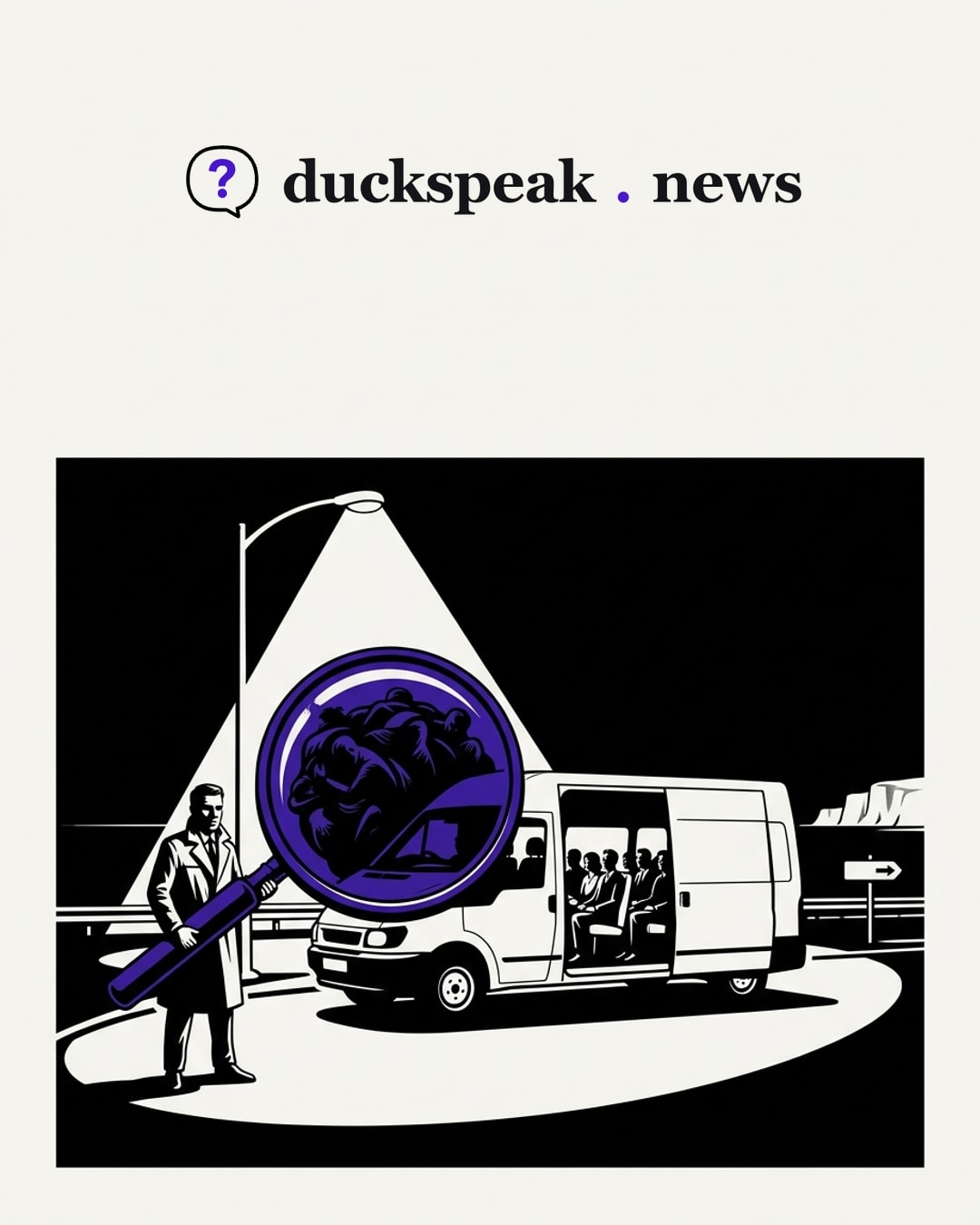
What both articles actually report
Both outlets attribute the same core facts to Troyes prosecutor Isabelle Verissimo. A 47-year-old man was found dead at around 5am on Friday 2 October [1] at the Champ-l’Épée rest area on the A26 near Troyes, with what GB News renders as a “gunshot wound to the head” [2] and France Info as “une blessure par arme à feu au niveau de la tête” (a gunshot wound to the head), “sur le siège passager” (on the passenger seat) [1]. GB News’s own body text agrees on the seating: “in the passenger seat” [2]. In the van, police found what GB News quotes as “around 10 foreign nationals who were irregularly on French territory” [2]; France Info gives the French original, “une dizaine de personnes de nationalité étrangère en situation irrégulière sur le territoire français” (about ten people of foreign nationality in an irregular situation on French territory) [1]. A person “susceptible d’avoir été présente sur le lieu des faits” (likely to have been present at the scene) [1], rendered by GB News as “believed to have been present at the crime scene” [2], was arrested and placed in custody. Shots were fired as the van pulled into a parking space; several people fled; the case went to the Reims research section [1][2].
Note what is missing from both pieces: the prosecutor’s full statement. We know her words only as each outlet chose to quote them, and every divergence below is measurable against those fragments.
The words that exist only in the headline
GB News’s headline reads: “Man, 47, found ‘shot in the head’ in British van packed with 10 illegal migrants by side of French motorway” [2]. Measured against the article’s own attributed material, its load-bearing words are additions.
“Illegal migrants.” The prosecutor’s phrase, quoted by GB News itself, is “foreign nationals who were irregularly on French territory” [2]. Hers is administrative language: an irregularity in a person’s papers. GB News’s relocates the irregularity into the person. The same article later quotes the case being opened for “murder, attempted murder, unauthorised possession of a weapon” and “aiding the irregular entry, the movement and the residence of a foreigner in France as part of an organised group, and human trafficking as part of an organised group” [2]. Nobody has been charged with anything; the one person arrested is described, in the prosecutor’s words, only as likely to have been present at the scene [1][2]. No source describes the ten passengers as suspects. The headline convicts them of existing. (GB News does upgrade the arrested person to “a suspect” [2], a word sitting outside its quotation marks; the prosecutor’s phrase, preserved intact by France Info [1], claims only presence.)
“Packed.” The word appears nowhere in the attributed material. “Une dizaine” (about ten) [1] hardens into “10” [2], and “packed” supplies the crowding, the squalor, the cargo hold. A fact has been converted into a mood.
“In the back of.” The headline, the lede and the photo caption all place the body “in the back of a British van” [2]. The attributed paragraph says “in the passenger seat” [2], and France Info agrees [1]. GB News’s dramatized version is contradicted by GB News’s own body text. The caption then hedges twice in a single line: “reports claim (file photo)” [2]. The outlet attributes its own reporting to “reports” and illustrates the scene with a stock image. The scene is manufactured; the disclaimer sits in the small print. Even the geography is adjusted: the record places the discovery at a rest area [1][2], not “by side of” a motorway.
Three labels for the same ten people
Within one GB News article the passengers are “illegal migrants” (headline, lede, caption), “undocumented migrants” (second paragraph), and “foreign nationals who were irregularly on French territory” (the only quoted version) [2]. The label is unstable in exact proportion to its checkability: when the words must be attributable they revert to the prosecutor’s; when they must sell, they escalate. That instability is the tell.
France Info’s drift is smaller but real. Its headline says the vehicle was “transportant des étrangers en situation irrégulière” (transporting foreigners in an irregular situation) [1], where its own body says the people were discovered “dans la fourgonnette” (in the van) [1]. The verb turns passengers into freight before any charge has established a smuggling function. And both outlets headline the passengers’ status; in both, the killing of a 47-year-old man is the setting, not the story.
The Britain scaffolding
The two outlets weight one fact very differently: the van’s registration. France Info never mentions it [1]. GB News puts “British van” in the headline and quotes the prosecutor on “a British commercial vehicle registered in England” [2]. Around that fact it builds a UK frame: the scene lies “200 miles from the Channel” [2]; the A26 is “a 220-mile stretch of tarmac from Troyes to Calais”, “often referred to as the ‘Motorway of the English’”; “People often use the route to get to the English Channel to travel to the UK” [2]. All of it geographically true; none of it about a man being shot. It converts a homicide at a rest stop into a waypoint on the route to Britain, then closes the loop with a non-event dressed as a scoop: “GB News understands the Foreign Office have not been contacted regarding the case” [2]. An absence, sourced to the outlet’s own understanding, whose only visible function is to keep the story pointed at London.
Meanwhile the standfirst quietly states: “The nationality of the dead man has not been confirmed” [2]. The hedge and the headline’s assertion coexist, “British van” above, unknown nationality below. It is speculative to call the arrangement deliberate; it is observable that the small text disclaims what the big text implies.
The charge the headline refuses to read
The sharpest contradiction is internal to GB News. The article quotes the prosecutor opening a case that includes “human trafficking as part of an organised group” [2]. If that charge proceeds, the ten people in the van are not “illegal migrants”; in the prosecutor’s own vocabulary they are probable victims of an organised crime. GB News prints that possibility in paragraph form and erases it in the headline. The label does not merely lack precision; it forecloses the victim reading before any trial. France Info, which never mentions the charges at all [1], never confronts the contradiction; its silence is a different problem.
The mechanism
Orwell first. This is Newspeak compression with the polarity reversed. The prosecutor’s phrase is long because it is precise: which status, whose territory, what irregularity. “Illegal migrant” is short because it has already decided: the person is the crime. The adjective migrates from acts (the charges list acts: murder, weapons, aiding entry) to beings. And note the punctuation: everything checkable arrives in quotation marks; everything invented sits outside them. The quoted words are the prosecutor’s; the unquoted ones are the outlet’s. That is the grammar of manufactured framing: attribution for the sober, ownership of the lurid. It is also duckspeak in Orwell’s exact sense, a phrase quacked without thought, whose function is to signal belonging rather than to describe.
Huxley second. The packaging is the product. A stock photo captioned as the scene [2]; a scare-quoted head shot in the headline; the page’s surrounding furniture promoting “WATCH: France to ‘make parents pay’ for damages in riots” [2] (sidebar material, weighted lightly here, but the reader arrives primed to read France as disorder). The story is engineered for the UK anxiety market: death, Channel, migrants, in that order. What is consumed is not a homicide investigation but a border feeling.
What a reader would need instead
- The prosecutor’s full statement from the parquet de Troyes, and the Reims research section’s investigation, as the institutions of record [1][2]. Both articles are built from the prosecutor’s words and quote them only in fragments; neither links the source.
- The distinction between an administrative status (irregular presence, which is not by itself a charge anyone here faces) and criminal acts (murder, weapons possession, aiding entry, trafficking), none yet attributed to a named person.
- That the ten people in the van are, on the available record, likely witnesses to a homicide rather than suspects in one, and, if the trafficking charge proceeds, its probable victims; their disappearance into the label “illegal migrants” is the coverage’s central omission.
- That no nationality has been confirmed for anyone, dead or arrested [1][2].
- That “packed”, “back of” and “illegal migrants” are GB News’s words, not the record’s; and that “transportant” is France Info’s verb, not the prosecutor’s.