

Three outlets, one press release
On Monday the judiciary’s press office confirmed that Andrew Mountbatten-Windsor has filed for judicial review to “quash search warrants issued by a judge at the Central Criminal Court on 18 February 2026,” with a High Court hearing set for Thursday [3]. France 24 carries the same statement in French, nearly clause for clause: a request to “annuler des mandats de perquisition délivrés par un juge de la cour criminelle centrale le 18 février 2026” (quash search warrants issued by a Central Criminal Court judge on 18 February 2026) [1]. The Daily Telegraph broke the story; France 24 and CBS both note the Telegraph report and an AFP confirmation [1][3]. NPR’s version adds the High Court filing and Thursday hearing from the same judicial spokesperson [2]. Three bylines on three continents, and the skeleton of each is one announcement. That is not a scandal; it is how wire copy works. The question is what each outlet builds on the skeleton, and what none of them do.
What the filing is for
CBS states the stakes in a single sentence: “If the review were to throw out the warrants, it would potentially deprive prosecutors handling the case of any evidence discovered during the searches of the former prince’s homes” [3]. That is the point of the exercise. As CBS itself notes, this is a bid to strip the case of its search evidence; if the warrants fall, whatever police found at Sandringham and Royal Lodge plausibly falls with them.
NPR never says this. Its account runs from filing to hearing to four centuries of history without telling the reader what a win for Mountbatten-Windsor would do [2]. France 24 likewise reports the recours as a contest over legality, full stop [1]. Two of the three outlets never tell the reader what the filing is for. The most consequential fact in the story appears once, in the third, as a conditional clause.
The euphemism ladder
What police suspect is specific: that while holding the office of UK trade envoy from 2001 to 2011, he transmitted confidential economic documents to Jeffrey Epstein [1], including, per files released by the US government, a November 2010 email in which he “appeared to share” reports on his visits to Asian countries [3]. CBS notes in passing that two years before that email, Epstein had been convicted in the United States of procuring a child for prostitution [3].
Now watch the language the outlets choose. The suspected act is called “misconduct in public office” [2][3], rendered by France 24 as “manquement dans l’exercice d’une fonction publique” [1], a phrase with the moral temperature of a parking fine. The documents become “sensitive information” [2]. CBS stacks two hedges into one clause: emails in which Andrew “appeared to share potentially confidential information” [3]. Appeared. Potentially. The bureaucratic name for the offense becomes the press’s name for it, untranslated, so the reader must do the work of realizing that “misconduct in public office” here means allegedly feeding state material to a convicted trafficker while representing the state.
The same softening applies to the accusers. France 24 notes in one clause that police said in May they were also examining an accusation of sexual assault against him, and that Virginia Giuffre accused him of assaults when she was 17, before her suicide in April 2025 [1]. CBS gives Giuffre’s posthumous memoir claims and the 2022 civil settlement [3]. NPR names no accuser and no sexual allegation at all; its readers learn only of “allegations related to his links to the late sex offender” [2]. A public-radio reader is told less about the substance of the case than a French or American commercial-television reader.
The tautology as candor
NPR frames the monarchy’s response as a breakthrough in royal communication. Charles, it reports, “departed from the ‘never complain, never explain’ approach of his late mother” and “took the unusual step of issuing a statement”: “Let me state clearly: the law must take its course” [2]. The statement contains no information; it could be attached to any legal process in the history of any state. It commits the speaker to nothing, predicts nothing, excludes nothing. Yet NPR treats the utterance as an event, and the event as transparency. In Orwell’s terms this is orthodoxy functioning as news: a sentence of zero content is reported as a departure, because the family’s previous norm was silence.
NPR also supplies the frame in which the whole affair is legible: the Epstein relationship “has been a source of embarrassment to the royal family for more than a decade,” and the king “moved to insulate the monarchy from the fallout” [2]. The injured party in misconduct in public office is the public, whose confidential information was allegedly handed to a convicted sex offender. In this coverage the harm lands on the family’s reputation. The state office that carried the secrets, and whatever process kept this man in it for a decade, is offstage; the institution appears only as a household managing its image.
The crowd as audience
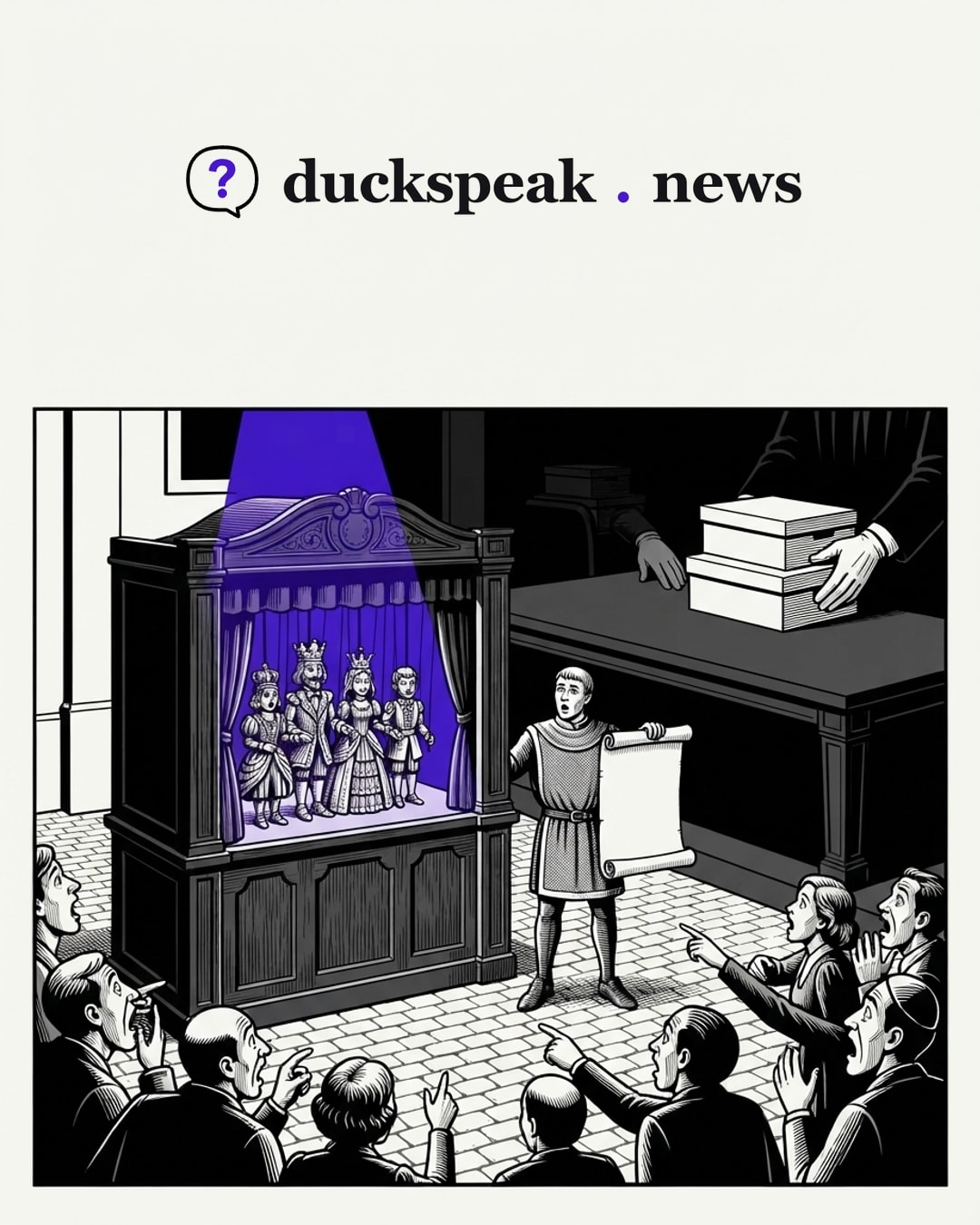
France 24’s own related-coverage links frame the affair as entertainment: “l’épilogue d’un long et sordide feuilleton?” (the epilogue of a long and sordid soap opera?) and Britons greeting the arrest “avec joie” (with joy) [1]. CBS contributes the spectacle details: the arrest came “on his 66th birthday,” and it is called, without attribution, “his shock arrest” [3]. The Telegraph’s comparison, relayed by CBS, is that this is the first royal challenge to the lawfulness of criminal proceedings since the trial of Charles I in 1649 [3]; NPR matches it with “the first time in nearly four centuries that a senior British royal was placed under arrest, underscoring how deference to the monarchy has eroded” [2]. Both uses treat 1649 as trivia. Neither pauses on what the comparison contains: a royal defendant contesting the authority of the process itself.
This is the Huxley half of the mechanism. The public enters the story only as an audience, cheering or shocked, watching a feuilleton; the one party with standing, the public in “public office,” is never addressed. Even the government’s contemplated response is rendered in the softest available verb: it has “mulled” a law to remove him from the line of succession [3].
One detail is worth noting: CBS reports the High Court hearing will be “private” [3]. Whether that is routine for judicial review is something none of the outlets says; a hearing on whether police lawfully searched a royal residence, held out of public view, deserves at least a sentence explaining why.
What a reader would need instead
- The stakes stated in every story, not one: that quashing the warrants would potentially strip the case of the search evidence [3].
- What the warrants authorized police to seek, and what, if anything, was seized. None of the three reports says.
- The allegation in plain language: that a serving state trade envoy allegedly passed confidential government material to a man already convicted of procuring a child for prostitution [1][3].
- The status of the sexual assault accusation police confirmed examining in May [1], which NPR’s reader never hears of at all.
- The provenance of everything: the roughly three million Epstein files the US government released in January [3], the “millions of pages” NPR gestures at [2], which are the origin of the warrants, the arrest, and the memoir claims. That is the record a reader could consult; the outlets point at it and move on.
- The scale of the UK response, which only CBS reports: at least nine police forces examining claims from the released files [3].
- An answer to the question none of them asks: how the alleged conduct went unexamined for a decade inside a state office, and who is accountable for that.