

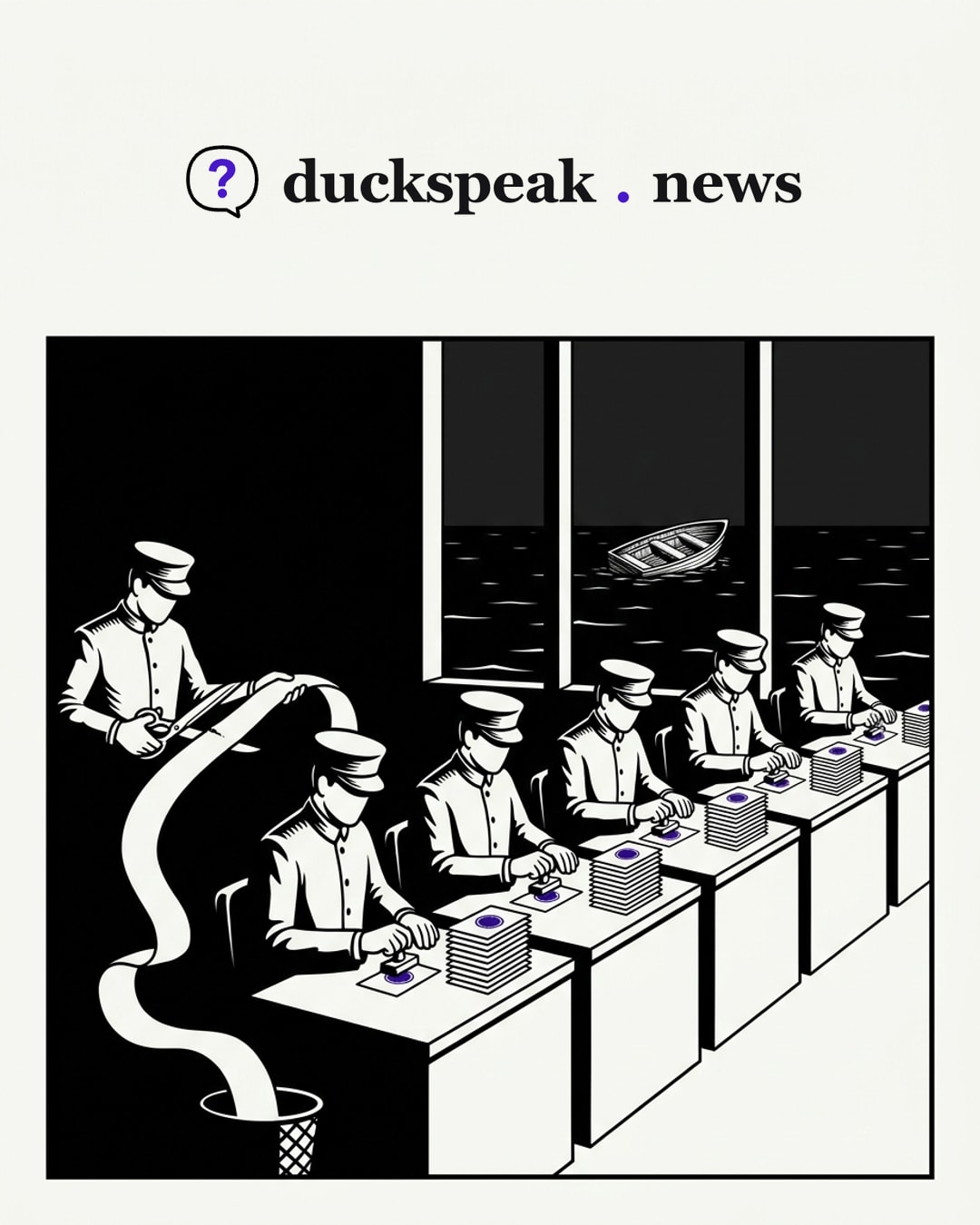
On Sunday 11 October, six outlets in two countries reported the same shipwreck: a boat from Djibouti to Yemen capsized a few dozen metres off the coast near Obock [2]; at least 139 people drowned, 84 are missing, and around 80 survived, all of them Ethiopian nationals [2][3][4][5][6]. Read the six in sequence: the facts vary at the edges; the explanation does not vary at all. It arrives pre-installed, in the same words, every time.
The clause that travelled
Every outlet quotes Alexandre Coissac, the IOM’s mission chief in Djibouti, calling the wreck “a stark reminder of the dangers faced by migrants along this migration corridor as they seek economic opportunities” [1][5]. France Info and France 24 carry the French rendering, the hope of better “opportunités économiques” [2][3]; RFI has them hoping to find “opportunités” in the Gulf [4]; the BBC splits the difference with “safety and work” [6]. The clause is attributed, so nothing is concealed, but attribution is not examination. Six newsrooms received it, and not one put a question mark after it. Orwell had a word for speech that is orthodox, fluent, and emitted without thought: duckspeak. The clause quacked identically in six newsrooms.
It also does real work. “Economic opportunities” files the dead under aspiration rather than flight, and it settles a question the coverage never openly asks: were these people fleeing something or choosing something? If they were fleeing war, the vocabulary changes (refugee, asylum, non-refoulement), and so do states’ obligations. “Migrant” in every headline plus “economic opportunities” in every explanation pre-decides the category. That is Newspeak’s method: not lying about the facts, but choosing the noun that decides what the facts mean.
The coverage contains its own counter-evidence, unexamined. France Info, alone, reports the passengers were mostly Ethiopians “fuyant la reprise des combats dans leur pays depuis un mois” (fleeing the resumption of fighting in their country over the past month) [2]. War at home, in one outlet’s copy, five outlets away from everyone else’s job-seekers; France Info runs both explanations without noticing they argue. Even the IOM’s fuller list, per France 24, includes “l’insécurité” (insecurity) alongside poverty and climate change [3]; that is the part that falls out in transmission. I cannot adjudicate from this material whether these passengers were refugees; neither could the outlets, and they did not try. They took the shortest clause in the press release and made it the epitaph.
The half of the quote that got cut
The Mirror alone prints the rest of the statement: “No one gets into a boat like that unless they believe there is no other safe way. We cannot keep treating these deaths as normal. Safe and legal pathways save lives. I am asking governments and donors to act before the next boat goes down.” [5]
The BBC’s quotation ends at “remain without news of their relatives” [6]; GB News stops at the same sentence [1]; France 24 carries the reminder sentence but not the demand [3]; RFI compresses the whole statement into “une perte humaine dévastatrice” (a devastating human loss) [4]. The pattern, in the versions collected here, is precise. The sentences that mourn appear everywhere; the sentences with addressees in them (governments, donors, a policy) appear once, mid-article, under a toll-count headline.
This is the coverage’s quiet editorial act. Grief addressed to no one is safe; it requires nothing. A demand names parties, and parties can be asked questions. Five of six outlets kept what cost nothing and cut what cost something, then recited the numbers that prove his point: more than 900 dead or missing on this route in 2025 [1][3][5][6], nine killed and 45 missing as recently as March [1][6], 94 deaths in the first quarter of 2026 alone [4]. That recitation, offered as neutral background, is the normalization Coissac said must not continue, performed inside the articles quoting his grief.
Movements
GB News and the BBC both report that the IOM’s Displacement Tracking Matrix logged “more than 20,000 ‘movements’ from Ethiopia to Djibouti” [1][6], and both put “movements” in scare quotes: two newsrooms flinched at the same word and printed it anyway. “Movements” is the matrix’s term. The people have become entries in a dataset, and the quotation marks mark the journalists’ own unease, unexamined. Nobody explains what a “movement” is.
The counting is correspondingly loose. GB News and France 24 put the boat at 350 people [1][3]; Coissac told AFP 305 [2][5][6]. A 45-person gap in the disaster’s denominator, and not one of the six pieces flags it. GB News alone still carried the first toll of 109 under a headline claiming “Hundreds of migrants dead,” in copy whose breakdown (52 men, 14 women, 15 children) sums to 81, not 109 [1]; France 24’s version of the same breakdown says 42 women, which sums correctly [3]. When people are “movements,” the numbers become ambient too.
Safe navigation, safe migration
GB News ends by pivoting from the dead to the strait: the Houthis’ presence “could jeopardise safe navigation” through Bab el-Mandeb, and the Yemeni government says it has “secured” the Strait [1]. The same corridor, in the same article, has just killed 139 people trying to cross it; “safe navigation” turns out to be a term for shipping. The dead Ethiopians become the opening paragraph of a story about shipping lanes.
The African Union’s response, carried only by France 24, answers in the same managerial dialect: “lutter contre le trafic de migrants” (fight migrant trafficking), “s’attaquer aux causes profondes de la migration irrégulière” (address the root causes of irregular migration), “promouvoir une migration sûre, ordonnée et régulière” (promote safe, orderly and regular migration) [3]. Order is the horizon. France 24’s sidebar even markets a video on the route to “l’eldorado” saoudien (the Saudi Eldorado) [3]: the dead as gold-seekers. RFI names the pull, “en particulier en Arabie Saoudite” (in particular Saudi Arabia) [4], and there every outlet stops. What awaits Ethiopians who do reach the Gulf, what the “opportunities” consist of, why people expelled from Yemen re-board boats toward it (about 150 of those aboard had already been pushed back from Yemen and tried the crossing again [2]): none of the six asks. The pull side of the route is a single word, and it is never opened.
The feed
Huxley’s mechanism is not suppression; it is placement. France Info’s report sits in a sidebar between “Andouille de Guémené : ce savoir-faire menacé par les normes européennes” (Andouille de Guémené: this savoir-faire threatened by European norms) and “Pourquoi les astronautes sont-ils constipés dans l’espace ?” (Why are astronauts constipated in space?) [2], tiles away from a live execution and the northern lights. GB News opens with “You are about to be charged £0.00*” and closes with “Join the fight for free speech and fearless journalism” [1]; the Mirror appends a plea to become a “Preferred Source” on Google News [5]. Nothing is hidden; everything is flattened. The adjective “devastating” attaches to the loss of life [1][5][6], to the civil war [1][6], to the human loss [4], worn smooth by reuse. That is the soma function: grief as one more consumable tile, complete in itself, addressed to no one, requiring nothing.
What a reader would need instead
Both explanations, reconciled or in open conflict: France Info’s war-flight reporting [2] set against the “economic opportunities” clause [1][3][4][5], with the status question actually asked rather than settled by vocabulary.
The whole statement, not the safe half: the Mirror’s lines [5], and the IOM’s call for funding for search, rescue and safe routes [3], belong in any piece that quotes the grief.
The caveat on the numbers: RFI alone notes that the IOM considers its own figures “largement sous-estimés” (largely underestimated) [4]; the 900 recited elsewhere is a floor, not a count.
The institutions to read directly: the IOM’s Missing Migrants Project, named once, by the Mirror [5], and the Displacement Tracking Matrix [1][6]. The agency that produces the data also produced the frame; the explanatory clause is the agency’s, not the newsroom’s.
The destination: what “opportunities” in Saudi Arabia [4] actually are, what became of the 150 already expelled from Yemen [2], and who profits from the crossing. None of the six pieces goes there. The story stops at the shoreline, which is exactly where the press release stopped.