

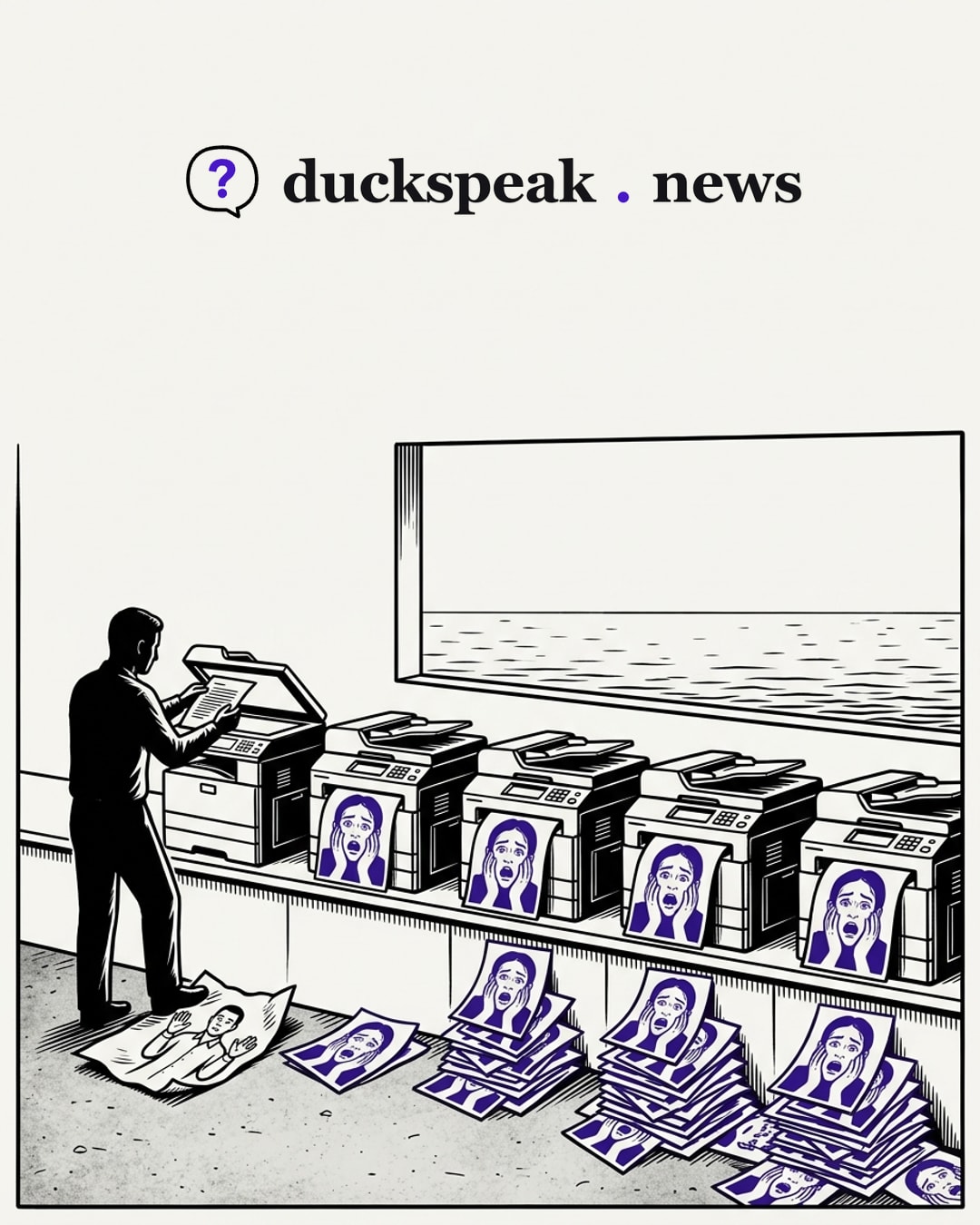
On 9 October 2026 a magnitude 7.7 earthquake struck off Panama’s southern coast near Pitaloza Arriba; tsunami warnings went out for most of the eastern Pacific and were lifted the same evening [5][6]. Six outlets covered it. Underneath the six bylines there are, generously, two shared texts (one French, one English) plus one aggregation, and the interesting part is what the sharing did: it selected fear, duplicated it, and dropped the one sentence of official speech that argued against alarm.
Two texts, six bylines
NBC and CBS run a sentence that is not similar but identical: “Visibly shaken residents gathered outside as they waited for news of the quake’s impact” [3][6]. Both carry the same AP-sourced resident quote, the same cathedral-and-facade paragraph, and the same closing Ring of Fire paragraph [3][6]. The French trio of France 24, franceinfo and Ouest-France share the evacuation sentence (“Des centaines de personnes ont évacué les immeubles,” attributed to AFP in all three), the same aftershock sentence, and, at two of the three, the same Chiriquí boilerplate [1][4][5]. franceinfo goes further and pastes a paragraph onto itself: “Selon les rapports préliminaires, le tremblement de terre a été ressenti dans tout le Panama. Les autorités ont appelé la population au calme” (according to preliminary reports, the earthquake was felt throughout Panama; the authorities called on the population to stay calm) appears twice in one short article [4]. That is Orwell’s duckspeak made visible: words issued from the larynx without engaging the higher brain centers, in this case issued twice because nobody at the desk read what was published. The bylines (Brittany Miller at Fox, “a Fox News Digital breaking news writer” [2]; Michelle Garcia at NBC, “a senior editor for NBC News Digital” [3]) present ingestion as authorship. The duplication is not total; CBS alone adds the regional tally, noting this is at least the fourth Latin American quake above 7.0 this year [6]. That is what one desk actually reading one wire copy looks like, and it appears once.
The panic that outran the damage
The French headline frame is unanimous: France 24 gives us “provoque la panique dans la capitale” (causes panic in the capital) [1], franceinfo “La secousse a provoqué la panique dans la ville de Panama” (the tremor caused panic in Panama City) [4], Ouest-France “provoquant la panique dans la capitale” (causing panic in the capital) [5]. What the same copy records is hundreds of people evacuating buildings while a tsunami alert was live [1][4][5]. Evacuation is a protocol; “panic” is a story. The word converts compliance with a safety procedure into an emotional spectacle, and nothing in the copy demonstrates the emotion beyond the procedure itself.
The frame also points at the wrong geography. Omar Smith of Panama’s National Civil Protection Service placed the damage in Veraguas, Herrera and Los Santos, with “no reports of damage in the capital” [6]. The damage record in this coverage is provincial: a Catholic cathedral collapsing and a hotel facade falling onto a car in Penonomé [3][6], “significant structural damage” to the governor’s palace in Coclé [3], damage in Chitré and along the Los Santos coast [1]. Yet both US pieces pause to note that Panama City “is known for its tall skyscrapers” [3] or its “hundreds of skyscrapers” [6]. The sentence does no informational work about a quake whose damage was elsewhere; it pre-loads the image of a skyline collapse. That is Huxley’s mechanism, supplying the picture before the event justifies it and inviting the reader to watch a collapse that did not happen.
The quote that didn’t travel
The most-reproduced human speech in the coverage is Rosendo Domínguez, 60, of Herrera: “We felt it very strongly. It knocked things over in the kitchen, but we’re OK, though we’re very scared” and “Everyone is outside, scared” [3][6]. Good quoting, and also the fear product. The least-reproduced speech is the head of state’s. CBS alone carries President José Raúl Mulino’s call for calm: “What happened should not be used to cause alarm or disorder” [6]. Five of six outlets omitted the one sentence of official speech about how the event should be talked about. The wire selected the frightened resident for distribution and left the president’s plea against alarm behind, and every downstream outlet inherited the selection. Framing by omission, and measurable: one quote in two outlets, the other in one.
The number that wouldn’t die
USGS first said 8.0, then 7.6, then 7.7 [5]. The outlets froze at different moments and now disagree in their headlines: France 24 stopped at 7,6 [1], Fox’s copy records only the jump from 8.0 to 7.7 [2], franceinfo says 7,7 [4], and Ouest-France manages both numbers in a single article, 7,7 in the headline and 7,6 in the first sentence [5]. Fox’s body reports its revision correctly [2] while its photo caption, run twice, still describes “a severe magnitude 8 earthquake” [2]; the caption also misspells “that” as “thet,” a small clue that nobody read it. The correction traveled the body text; the error kept the caption. The first number went in front and the revision never displaced it, which is the memory hole in miniature. The two wire families even disagree on the aftershocks: the French copy reports replicas “de magnitude 6” [1][4][5] while the US copy tops out at 5.8 [3]. No outlet reconciled the two, and the French ledes assert “aucun dégât” even as France 24’s own body reports damage in Chitré and along the Los Santos coast [1][4].
Threat up top, all-clear below
Fox’s headline promises an investigation into a “potential tsunami threat” [2]; four paragraphs down, “officials said a Pacific-wide tsunami was not expected” [2]. Ouest-France is the only outlet whose headline contains the resolution, “l’alerte au tsunami émise à l’est du Pacifique levée” (the tsunami alert issued for the eastern Pacific lifted), “peu après 22 h heure française” (shortly after 10 p.m. French time) [5]; CBS tucks the same fact into its second paragraph [6]. The threat is headline-grade; the all-clear is body-text-grade. Fear moves up the page, reassurance moves down, and the reader who only meets the headline meets only the threat.
Fox also runs “Information about possible damage or casualties from Friday’s earthquake was not immediately available” [2] on a page whose own embedded links shout “COLOMBIA BUILDING COLLAPSES ON CAMERA AS EARTHQUAKE BRINGS DEATH, DESTRUCTION” [2]. Whether Fox’s damage-blindness was timing or editing cannot be determined from these articles. The same flag applies to a smaller discrepancy: Fox dates the quake to 1:56 p.m. ET [2] while CBS says “Friday morning” [6]; one is wrong or they measure different things, and neither desk appears to have checked. Meanwhile franceinfo’s article sits inside a page of newsletter consent language and Spanish flood headlines [4], the quake text serving as filler around the packaging, which is the Huxleyan arrangement stated plainly.
What a reader would need instead
- Alert status with timestamps: the U.S. Pacific Tsunami Warning Center issued and lifted the warning, and Ouest-France alone timed the lift [5][6]. The stand-down belongs where the alert was.
- The provincial damage record already present in the copy: Smith’s assessment [1][3][6], the Penonomé cathedral and hotel facade [3][6], the Coclé governor’s palace [3], Chitré and the Los Santos coast [1].
- The distinction between evacuation and panic, and the president’s actual words on alarm [6].
- One line of magnitude with its revision history (8.0, then 7.6, then 7.7 [1][2][5]) instead of a single frozen figure.
- The institutions that already track all of it: USGS for magnitude, depth and epicenter; the Pacific Tsunami Warning Center for alert status; Panama’s National Civil Protection Service for damage. All three are cited in the copy. The framing simply preferred the panic.
The quake was real; the panic was a distribution decision.