

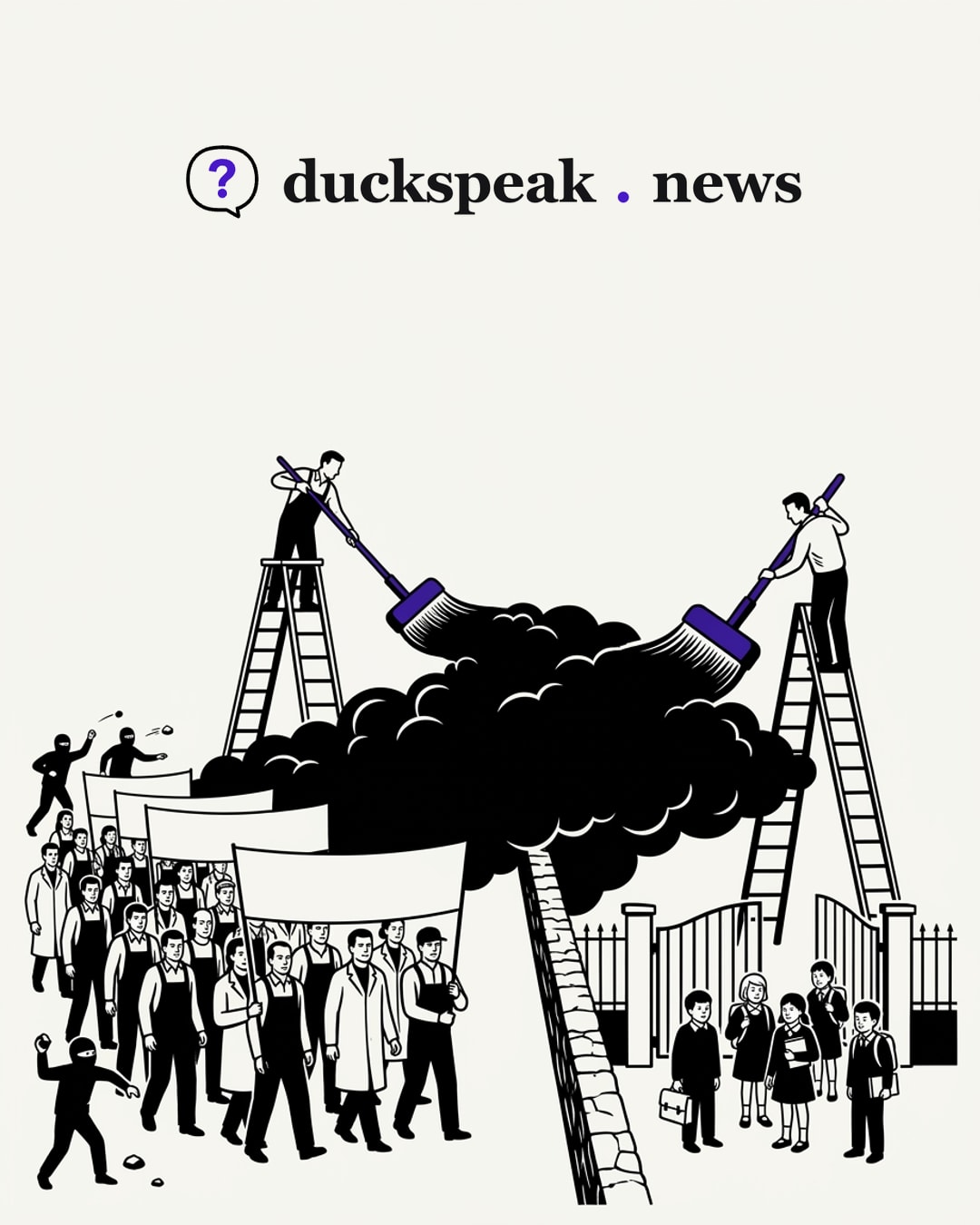
On Friday, tens of thousands of people marched through Brussels against budget austerity. If you read GB News, you learned that “roughly 30,000 masked youths descended on the Belgian capital” [1]. Same day, same city, same march; two different stories.
One headline, two countries, no students
The headline reads “Student riots spread across EU as hundreds clash with Belgian police in Brussels” [1], and the video caption doubles down: “Brussels students clash with police as riots spread across Europe” [1]. The article’s very first sentence calls them “student demonstrators” [1]. But the same report states that “The national strike was organised by Belgium’s two biggest trade unions” in opposition to Prime Minister Bart De Wever’s hunt for €10 billion in savings [1]. The students are in France, protesting “a lack of educational resources and staff” [1]. Neither report describes the Brussels marchers as students; France Info calls the projectile-throwers “jeunes souvent vêtus de noir et masqués” (youths often dressed in black and masked) [2]. Two events, two countries, two grievances, welded into one contagion. The verb “spread” does the welding: protest as disease, crossing borders, heading your way.
The mask migrates
Here is GB News’s key sentence: “Violent confrontations erupted as roughly 30,000 masked youths descended on the Belgian capital as part of a major anti-austerity demonstration” [1]. Parse it. The headcount belongs to the union march; France Info reports “plusieurs dizaines de milliers de personnes” (several tens of thousands of people), demonstrating against austerity [2]. The masks belong to a subset, the “jeunes souvent vêtus de noir et masqués” (youths often dressed in black and masked) who threw projectiles [2]. GB News’s grammar fuses them: all thirty thousand are masked, all are youths, and the violence erupts “as” they descend. Later the marchers become “gangs of youths” [1], and the invasion verb “descended” finishes the picture: not citizens with demands but a horde arriving.
Then the load-bearing omission. France Info relays the Belgian police’s own statement that the trouble had “aucun lien avec les revendications ni avec le déroulement” (no link with the demands or the course) of the union-called demonstration [2]. GB News carries no such sentence. That single line is the fact that separates a march from a riot, and it is the one fact a riot frame cannot survive.
The numbers that don’t fit
The standfirst announces “More than 100 people have been arrested following the protests” [1]. Later in the same article: “Police confirmed that 21 individuals were detained or arrested in connection with the violence, 13 of whom were minors” [1]. France Info, relaying the police’s first tally, gives “une vingtaine de suspects” (about twenty suspects), a majority minors [2]. Nothing in either report supports “more than 100.” Why the discrepancy? I cannot tell you. It may be stale copy from an earlier version of the piece, or a smear of the French arrest figure (more than 6,000 there [1]) onto Brussels; that is speculation and I flag it as such. What is not speculation is the placement: the bigger, vaguer number sits at the top of the page, the precise, smaller, mostly-minor number sits where few readers arrive, and the headline’s “hundreds clashed” rests on no figure in either report.
There is a smaller tell, too. The body says the groups “appeared to pelt police with rocks” [1]. Appeared to. The reporter was not sure; the headline already was. In this genre, hedging is for the body and certainty is for the top of the page.
What the smoke covers
The Orwellian mechanism here is vocabulary shrinkage. “National strike,” “day of action,” “demands,” “coalition negotiations” are longer words than “riot,” “gangs,” “masked youths,” and the shorter words win the headline. A strike has demands. A riot has no demands; that is the point of the word. The union position does surface in the GB News piece, in one sentence: unions “called instead for higher taxes on top earners rather than cuts to health spending and VAT rises” [1]. It is wedged between water cannons and a circling helicopter. The stakes, a deficit “dépassant les 5 % du PIB” (exceeding 5% of GDP) [2] and a hard budget deadline of October 13 [1], are garnish.
The Huxleyan mechanism is the spectacle loop the piece is built as: blazes, tear gas, and “a helicopter circled above as motorists trapped in the chaos either ducked in their vehicles or filmed the unfolding disorder” [1]. The reader is seated in the trapped car, watching. The fiscal detail arrives after the fire, if the reader arrives at all.
France Info, a public broadcaster, ran the same event as a short international brief: the march, the deficit, and the police quote separating the march from the violence [2]. Calm coverage was not just possible; it was shorter than the riot version and contained more politics.
What a reader would need instead
- The police’s own distinction, as relayed by France Info: the violence had “aucun lien avec les revendications ni avec le déroulement” (no link with the demands or the course) of the union demonstration [2]. One sentence, omitted by GB News.
- Who actually marched: Belgium’s two biggest trade unions, on a national day of action against €10 billion in savings, against a deficit above 5% of GDP, under a budget deadline of October 13 [1][2].
- What they propose instead: taxing top earners rather than cutting health spending or raising VAT [1].
- The French school protests as their own story, with their own numbers: 86,000 protesters across more than 30 towns, more than 6,000 arrests, 891 schools fully or partially suspended, 3,000 replacement teachers promised [1]. A different grievance in a different country, not a chapter of one spreading riot.
- An arrest count that matches the police tally: about twenty, a majority of them minors [1][2].
- And from any outlet that wants to own this story: an explanation of why its standfirst says more than 100 arrests while its own body says 21 [1].