

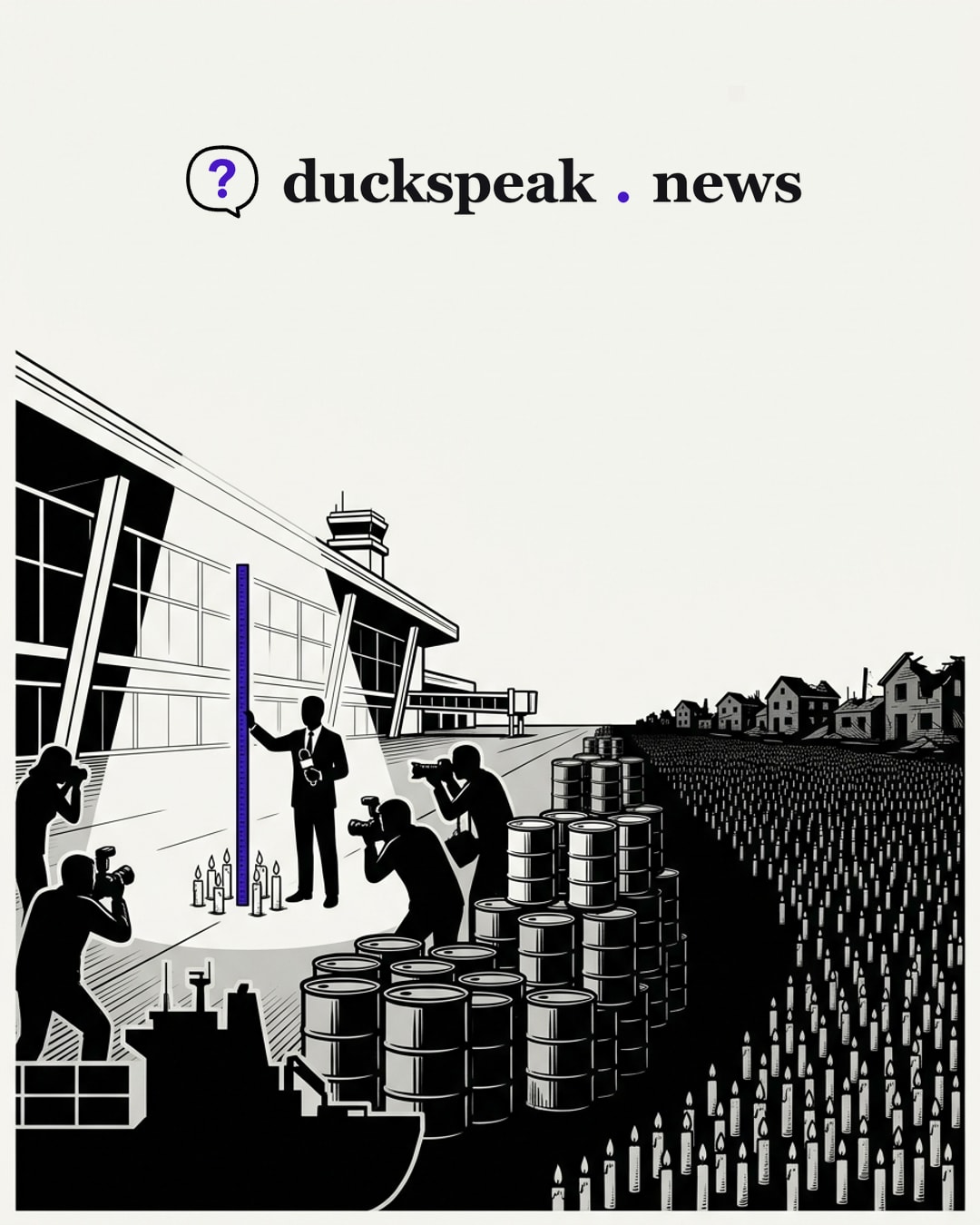
Seven of the eight articles gathered here open the Riyadh airport death toll with a superlative. NBC calls it “the deadliest to hit the kingdom in a decade” [3]; NPR and PBS, running the same Associated Press copy, call it “the deadliest in a Gulf Arab nation since the Iran war began” [2][7]; Ouest-France has “l’attaque la plus meurtrière en Arabie saoudite depuis dix ans” (the deadliest attack in Saudi Arabia in ten years) [4]; RFI and France Info both run “la plus meurtrière en dix ans dans le royaume” (the deadliest in ten years in the kingdom) [5][6]; NBC’s follow-up stretches it to “the deadliest by the Houthis on Saudi Arabia in more than a decade” [8]. The phrase is accurate. The framing work is in what it measures: a decade in which, by the same articles’ account, the Saudi-led coalition has been bombing Yemen, and the yardstick the press installs for that war’s seriousness is the number of dead inside the kingdom. (Two of those seven are literally the same AP text under two mastheads [2][7]; part of a phrase’s spread is syndication, not seven separate judgments.)
The same wire copy records that “the Houthi-run health ministry said… 91 Yemenis have been killed by the Saudi-led coalition in five weeks, 60% of them women and children” [2][7]. No superlative attaches to that figure. No headline in the set carries it.
Whose dead are facts
NPR and PBS state the Saudi toll in the newsroom’s own voice: “Saturday’s missile attack was the deadliest in a Gulf Arab nation since the Iran war began, with another 300 people wounded, some critically” [2][7]. No attribution; the sentence simply knows. Three paragraphs later the Yemeni toll arrives triple-wrapped: the source is a ministry rendered as “Houthi-run” (a construction never applied to “Saudi authorities”), the strike on a house in Sanaa is “suspected,” and the figure sits inside “said,” sealed with “There was no immediate comment from Saudi authorities on the claims” [2][7]. A claim, by definition, awaits a fact; the Saudi figures have already been promoted to one. NBC does better, hanging its toll on “Saudi civil aviation authorities” [3], but the ecosystem’s default is set by the wire.
The asymmetry extends to names. Within a day the Riyadh dead include an Egyptian flight attendant, Azza Ramzy, and “a widowed mother of four who had been living in Saudi Arabia for five years” [2]. The 91 Yemenis are a percentage. Not one Yemeni victim in any of the eight articles has a name, though the wire copy proves naming was possible; it just ran one way. The same articles also assert, in their own voice, that the Houthis “have targeted the Riyadh airport, which has no military facilities, every day since Wednesday” [2][7]. One side’s civilian status is asserted; the other’s is hedged.
The stakes, in order
The AP sentence, carried under both the NPR and PBS mastheads: “At stake, again, in this escalation are global supplies and prices of oil as well as commercial shipping through a crucial alternative waterway to the Iran-threatened Strait of Hormuz — along with civilians and aviation throughout the region” [2][7]. Oil, then shipping, then civilians, appended after a dash. The ordering is the analysis. NBC’s variant: a campaign “which has already rattled the global economy” [3]. BBC’s related-coverage pitch: “How escalating Saudi oil crisis could drive up prices everywhere” [1].
This is the Huxley half of the coverage: war as brand management. NBC’s Monday follow-up spends its middle paragraphs on the WPC Energy Congress, where “the chief executives of Exxon Mobil, TotalEnergies, Shell, Chevron and BP” quietly dropped off the agenda, and on the Saudi energy minister telling investors “You know this country is safe” [8]. NPR, PBS and NBC all carry his phoenix line verbatim: “There is no way that somebody will break our back. We are like a phoenix, we come out of the ashes all the time” [2][7][8]. A prince’s investor-facing copy, quoted across three outlets, labeled nowhere as branding. BBC writes the brand into its own prose: “the country’s reputation as a safe haven of stability is taking a battering” [1]. Two paragraphs earlier, the same article recalls that the kingdom “shrugged off” an Iranian ballistic missile attack on Riyadh in March [1]. A safe haven that shrugs off missile strikes on its capital is a slogan, not a description.
Words that arrive pre-owned
The coalition’s vocabulary travels intact: its “unknown projectile” [1] becomes NBC’s “unidentified projectile” [3] and Ouest-France’s « projectile non identifié » (unidentified projectile) [4]. Its legal vocabulary travels too: NBC quotes the coalition calling the attack “a fully-fledged war crime” and UN Secretary-General Guterres calling it “a violation of international law” [3]. Both attributions are correct journalism. What is missing is that vocabulary anywhere else in the set: no article applies a legal term to the strike on the Sanaa house reported in its own paragraphs [2][7], or to the five weeks of airstrikes behind the 91. In this coverage “war crime” is a weapon one belligerent fires and the press relays.
The cast list is completed by a fixed formula, “internationally recognized government,” appearing in five of the eight articles [1][2][3][7][8]. The descriptor is true and does no work on its own; its power is the repetition. It pairs with “rebels” [2][3][7] and, in the coalition statement France Info quotes, « la milice terroriste houthie » (the Houthi terrorist militia) [6], to sort the actors into government, rebels, terrorists. Recognition is a fact about diplomacy; repeated unexamined, it reads as a fact about legitimacy. That is the Orwell mechanism: a phrase that settles a question so the sentence never has to.
The analysis with nobody in it
BBC’s piece is the only major one here with no independent voice; the sole quoted human being is Trump (“We just found out about the recent attack… We move very quickly” [1], a quote NBC also runs [3][8]). Its analysis subsumes the Houthis into Tehran’s hand: “As part of the ‘axis of resistance’, the Houthis are a vital strategic partner for Iran,” their attacks “a key bargaining chip for Tehran” [1]. The AP wire’s own history section complicates that: the Houthis “had been largely on the sidelines of the Iran war,” resumed attacks after “the Saudis fired on the Sanaa airport as a plane from Iran was trying to land,” and act amid anger at “the Saudi-led blockade that has largely isolated Houthi-run areas” [2][7]. The blockade appears nowhere in BBC’s account of a war the same article says has gone on for more than a decade [1]. And where the Yemeni toll is concerned, BBC’s verb deletes the agent: the war “has left many thousands of people dead” [1]. Left them dead; no one did it. The Houthis, by contrast, “know exactly where to hit back” [1]. Agents on one side, weather on the other.
Small tells, honestly flagged
The count drifts: twelve dead [1][2][3], then thirteen after an Indian victim died of his wounds [4][8]; RFI’s liveblog opens with “14 morts” (14 dead) and settles at thirteen [5]; France Info’s own page says “douze morts” (twelve dead) in its lede and “treize morts” (thirteen dead) in a bullet beneath it [6]. Liveblog artifacts, most likely, but no correction note marks them, and a reader reconciling the dead is doing unpaid sub-editing. France Info’s headline makes the day’s story China’s “condamnation” (condemnation) [6], one reactions roundup among several [3], while the 91 go unfollowed. Credit where due: Ouest-France notes that “les autorités saoudiennes… ont pour habitude de peu communiquer sur ces attaques” (the Saudi authorities… habitually say little about these attacks) [4], and RFI’s correspondent reports that “tout a été fait pour gommer l’intensification du conflit” (everything was done to gloss over the escalation of the conflict), until the wounded reached the hospitals [5] (the paragraph reads as the kingdom, though its placement leaves room for doubt). The French copy at least admits the information environment is managed; the Anglophone wire adopts the managed source’s phrasing instead.
What a reader would need instead
- Both tolls held to one attribution standard, or replaced with independent casualty monitoring; none of the eight articles cites any, and the UN’s Yemen casualty reporting and databases such as ACLED exist for precisely this function. Their absence from every paragraph of death-count copy is itself a finding.
- The blockade and the collapse of the 2022 ceasefire in every story, not only in the wire’s history section [2][7] and NBC’s [8]; BBC’s omission of the blockade is the difference between a war with grievances and a war with weather.
- Legal vocabulary applied symmetrically, or an explicit note that “war crime” here is sourced exclusively from one belligerent [3].
- Government branding labeled as branding: the phoenix line is a prince selling stability to investors [8]; “safe haven of stability” is a slogan [1].
- The escalation vector that matters: Saudi Arabia “is running low on missile interceptors and has asked France, Britain, Pakistan and Egypt to deploy air defense support” [2][7], a fact carried only in the wire, versus the midterm timing BBC and NBC foreground [1][3].
The coverage is not dishonest; it is symmetrical in the wrong place and asymmetrical in the wrong one. It attributes scrupulously to the ministry it has already labeled illegitimate, and quotes without label the prince whose product is stability.