

The charge versus the story
The legal facts in this case are narrow. Abdulrahman Alfozan, 35, is charged with using or attempting to use a device “to intercept oral communications” [1]. The maximum penalty is five years and a $250,000 fine [1]. France 24 notes that he is prosecuted for interception of communications “and not for espionage” and that the ministry does not, at this stage, accuse him of economic espionage or theft of trade secrets [5]. BBC’s explainer concedes: “As yet, it is not clear what he was planning to do with the recordings” [1].
Yet the headlines lead with a different set of words. BBC’s breaking story: “Saudi national charged with secretly planting recording device in OpenAI office” [2]. France Info: “un ingénieur saoudien arrêté et inculpé” (a Saudi engineer arrested and charged) [3]. CBS also fronts nationality in the opening lines [4]. The nationality is not false, and it is in the charging record. But a charge with no stated motive, no alleged foreign sponsor, and no espionage count is delivered to the reader with a nationality attached. That is a framing choice, and the reader is left to do the arithmetic.
Who supplied the frame
The national-security frame did not come from the complaint as the press describes it. It came from officials. France Info and France 24 both quote Jay Clayton: “Cette affaire grave montre pourquoi remporter la course mondiale à la super-intelligence est un impératif de sécurité nationale” (this serious case shows why winning the global race to superintelligence is a national security imperative) [3][5]. He spoke of protecting intellectual property “contre les menaces étrangères” (against foreign threats) while, as France Info itself notes, naming no sponsor in this case [3]. Federal prosecutor Craig Missakian added: “Pour nous, c’est une question de sécurité nationale” (for us, this is a matter of national security) [5]. France 24 describes Washington as having presented the arrest as a national-security matter, and calls the arrest “fait rarissime” (a very rare occurrence) [5].
OpenAI joined in, calling the matter one of “national importance” and the case “an example of how AI can help address these sophisticated security threats” [4]. That last line is a product pitch sitting inside a victim statement. CBS reproduces it without comment [4]. BBC repeats that OpenAI used its own models to trace the device [1][2], which is a company’s self-account, not independently established in these texts.
Newspeak at work
France 24 supplies the most Orwellian detail, and does so almost in passing: Clayton heads a White House task force called the “Super Intelligence Force,” which “tente d’imposer de rebaptiser cette technologie ‘super intelligence’” (is trying to impose renaming this technology “super intelligence”) [5]. This is renaming as policy. If a technology is relabeled with a word that implies inevitability and a race, then a bugging charge becomes a skirmish in that race. Only France 24 flags the relabeling; the BBC and CBS pieces do not mention it [1][2][4]. France Info reports the quote and the task force’s name but does not explain the rebranding [3].
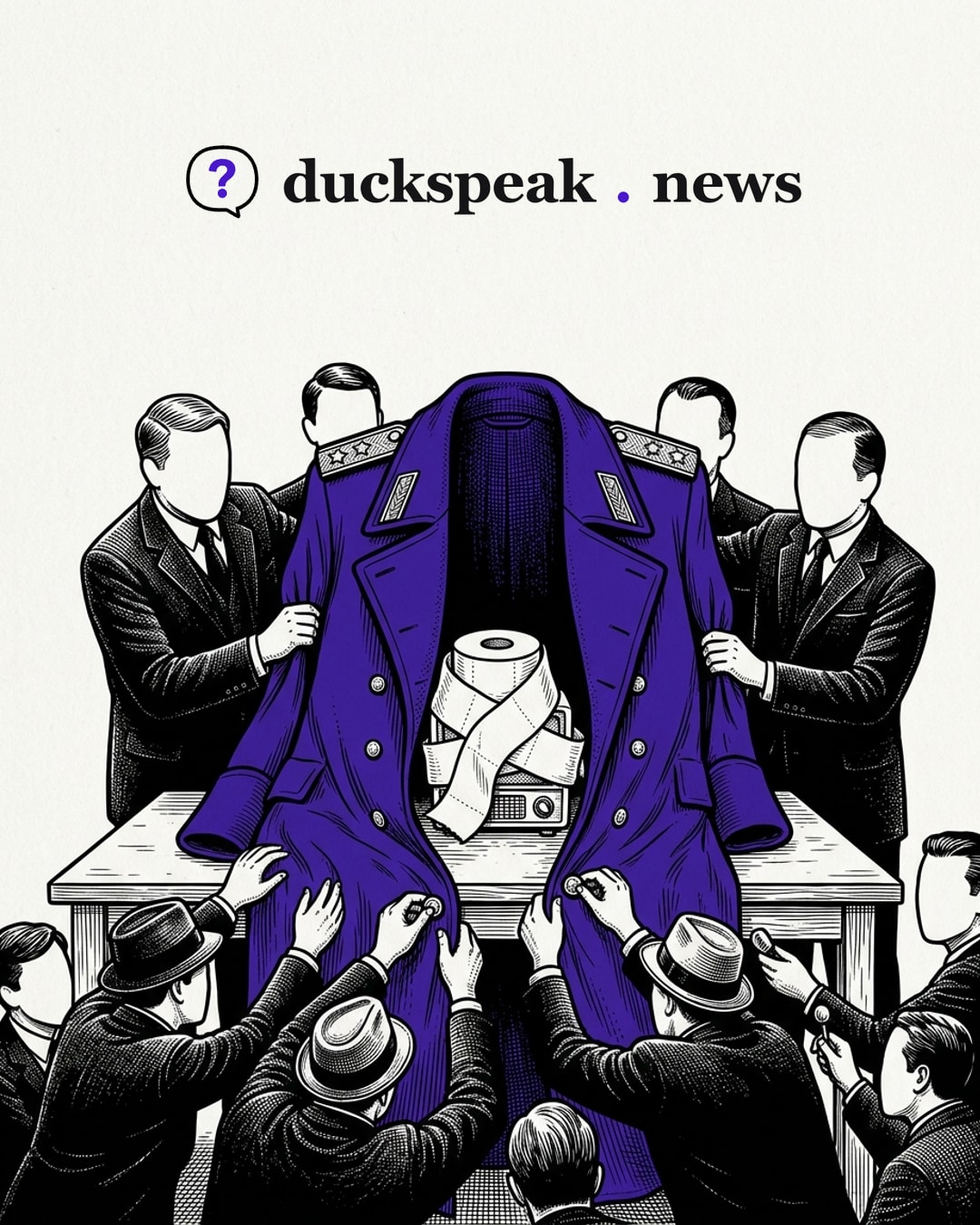
The language of the official quote also does quiet work. “Imperative” and “race” make the conclusion (that this matters nationally) precede the evidence (what was recorded, and for whom). The word “sophisticated” appears in OpenAI’s account of the device [2][3]; the same device, per BBC and others, was wrapped in toilet paper [1][2][3][4][5]. Both descriptions may be accurate, but only one of them appears in the headline of a major explainer [1], and it is the comic one.
The Huxley problem: vivid detail as sedative
The toilet paper detail is repeated in every source [1][2][3][4][5]. It is memorable, and it is in the complaint. But repetition of a vivid, slightly absurd image absorbs attention that could go to the questions the sources leave open: what the device actually recorded, whether anything was recorded at all, and who, if anyone, directed him. France 24 says the device “contenait des enregistrements chiffrés” [5]; BBC says only that the device was encrypted [2]; OpenAI says it has no indication of access to model weights, source code or customer data [1][2][4]. None of the sources says what, if anything, was captured. This piece cannot say either, and that is the point.
Allegation, presented as narrative
Much of the chronology comes from a single document, the complaint, and is filtered through prosecutors and the victim company. BBC does mostly signal this (“allegedly,” “prosecutors say”) [1][2]. Its explainer also includes the defense: lawyer William Pernik asks the public to withhold judgment, noting this is “an accusation, not a finding of guilt” [1]. CBS says it asked the lawyer for comment [4]; BBC’s breaking piece says it is unclear whether he has representation [2], which the explainer later answers [1]. That is the system working, though it is the least-quoted element.
A smaller flag: the chatbot queries came, per the complaint as reported, from an account “associated with” his spouse [1][4][5]. That is an inference about authorship. Several outlets then describe the prompts as his research [2], collapsing the distinction. Whether this is sloppy summary or a fair reading of the complaint, we cannot tell from the coverage.
One more note of caution on our own side: France 24 reports that the profile shows an MIT graduate who worked five years at Meta, and that a September video presented him as OpenAI’s only Saudi employee [5]. This is background, not evidence, and its inclusion invites the reader to treat identity as relevant. Whether that is the intent is speculative.
What a reader would need instead
- The complaint itself, so that quotes such as “highly confidential” meeting content can be read in context rather than through the outlets’ summaries. Federal court filings are public records.
- A clear separation between what the charging document alleges and what officials and the company have said around it. Clayton’s and Missakian’s statements are policy positions, not findings.
- Plain statements of what is unknown: motive, any third party, and what was recorded.
- Scrutiny of the “Super Intelligence Force” label, and the June presidential memorandum that France 24 says the Justice Department cites in support of the prosecution [5], rather than treating them as neutral background.
- Context on comparable cases. France 24 mentions a former Google engineer convicted in January of stealing AI secrets while working for two Chinese companies [5]; that was a trade-secret theft charge, which this one is not. Independent trackers of such prosecutions, and the court docket, would let readers judge whether this case is truly unusual.
The facts may yet turn out to be serious. But on the present record, a modest wiretap charge arrived wearing a much larger coat, and most of the coverage helped button it.