

One word, two realities
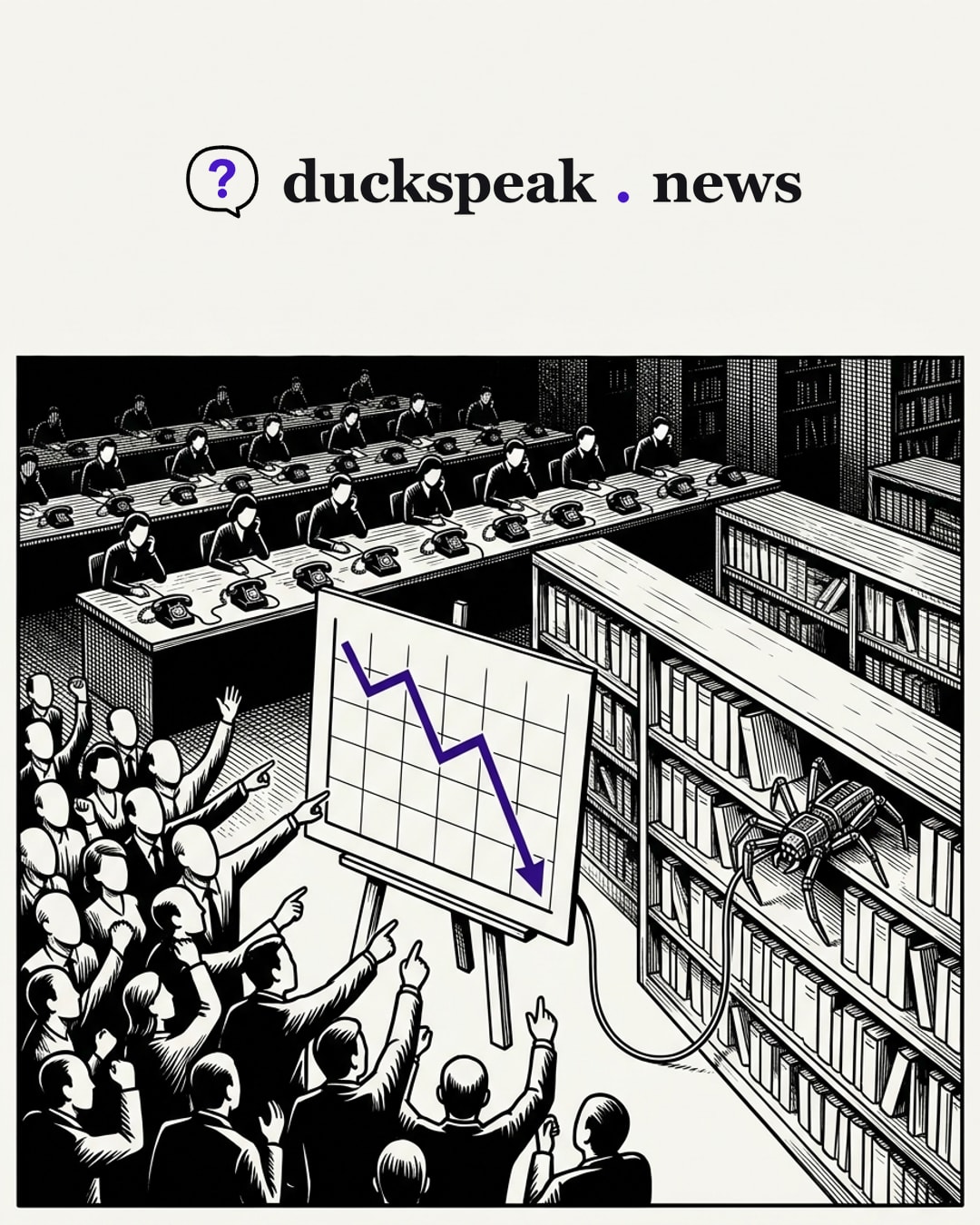
In newspeak, a word that covers two opposite things does the propagandist’s work for him. The word “bot” is a textbook case. In the affair of Ukrainian strikes on Yandex’s data centres, it sometimes designates a fake account that amplifies a lie, and sometimes a crawler that roams the web to feed a search engine. A Cloudflare chart measured the second, and thousands of internet users read the first into it.
The sources gathered here are fairly rigorous on this point, which makes the exercise more interesting: the criticism bears less on an error by the press than on how the original narrative was validated, relayed, then corrected, to very unequal degrees.
What the figures said, and what they did not say
The BBC reports that viral posts claimed a significant drop in influence operations, with President Zelensky mentioning “less hate, less division and fewer provocations” thanks to “fewer bots” [1]. France 24 (Les Observateurs) details a Cloudflare Radar chart that supposedly showed a 49% drop, and another, relayed by MEP Tomáš Zdechovský, citing 56% for activity linked to the AfD [4]. But Cloudflare itself specifies that its « trafic de bots » (bot traffic) refers to automated requests and « ne fait pas nécessairement référence au comportement des bots sur les plateformes de réseaux sociaux » (does not necessarily refer to bot behaviour on social media platforms) [4]. The BBC reports the same caveat [1].
The MEP’s chart cites no source and, according to a researcher quoted by France 24, shows data running up to 15 October 2026, although it had been circulating since the 11th [4]. The BBC notes that Mr Zdechovský later said he “did not present it as a clear fact”, but the post remains pinned to the top of his profile [1]. Here is a retraction that retracts nothing: the conditional formula “If confirmed, this is telling” keeps the insinuation circulating while preserving the alibi.
The expert consensus, except for one narrative
The Guardian quotes Amil Khan (Valent): “no discernible change” in posting patterns, and “Yandex datacentres have no practical connection to social media bot farms” [5]. Researchers at dTeam tell the BBC they observed no “traffic change” among known accounts and clusters [1]. Ned Mendez (Alliance4Europe) notes that serious networks operate through residential connections and phone farms that the strikes cannot reach: “We can’t simply bomb the bots out of existence” [5].
The franceinfo case is more ambiguous. The article claims the attacks have « donné un bon coup de frein à l’intelligence artificielle du Google russe » (dealt a good blow to the artificial intelligence of Russia’s Google), citing Cloudflare Radar data on AI-assisted Yandex searches [2]. It then draws on historian David Colon to compare the view counts of two false stories targeting French political figures, before conceding that « cela ne veut pas dire que tous les trolls russes sont hors service » (this does not mean all Russian trolls are out of service) [2]. The headline asks whether a « sérieux coup » (serious blow) has been dealt to disinformation, while comparing two isolated posts is a thin basis for suggesting any effect. The reasoning is anecdotal, and the article itself notes that other experts are « plus prudents » (more cautious) [2]. I call it fragile, not false.
The leader’s framing: irony as evidence
France 24 reports that Zelensky « ironisé » (joked) that it had become « un peu plus facile de respirer » (a little easier to breathe) on social networks, and that the outlet judges that, « en réalité » (in reality), the impact is limited because of a decentralised architecture [3]. The Guardian describes a “commendable hope” whose scale may have been overstated [5]. The president’s office told the BBC he was “talking about the atmosphere on social media” and not to a drop in bot activity [1]. This after-the-fact rewording is a classic move: a subjective impression, stated with a head of state’s authority, takes on the appearance of a technical finding, then retreats to the register of impression when checked.
What war does to vocabulary
Two sources show another, more subtle shift. France 24 describes « centres de données » (data centres) that have become « cibles » (targets), and quotes Fabrice Epelboin saying that « taper des infrastructures civiles ne semble plus du tout un problème » (hitting civilian infrastructure no longer seems to be a problem at all), while noting that the Geneva Convention does not « couvre pas les infrastructures numériques » (cover digital infrastructure) [3]. Fox News, in an opinion piece by Robert Maginnis, presents the strikes as a demonstration (“Ukraine proved the point”) and a “warning shot” for Washington [6]. This is opinion, and the author labels it as such, but the reader finds a framing that serves an argument about American defence, not an assessment of the actual damage: Yandex itself says it does not yet know whether the Sasovo equipment can be restored [6]. Olivier Kempf, by contrast, judges the disruptions « relativement temporaires » (relatively temporary) and points to « résilience russe » (Russian resilience) [3]. The same event thus serves as proof of fragility or of resilience depending on the author. I note that a deeper reading of this divergence remains speculative without an independent tally.
What the reader should take away
There is a real effect: the Guardian relays Meduza on banks, retailers and apps affected in Russia [5], and Netblocks describes a “significant infrastructure-level incident” whose disruptions “affect all users” [1]. The confusion over bots has erased this more solid fact in favour of an appealing but unproven one. It is also worth noting that franceinfo reports an attack on a Sberbank data centre, which the bank says had no consequences for its services [7]: a company statement, not independently verified in the text.
What a reader would need instead
- A systematic definition, from the first paragraph, of what Cloudflare Radar measures (automated requests to websites) and what it does not measure (fake social media accounts).
- A pointer to the bodies that actually track these networks: the BBC cites dTeam and mentions Storm-1516 and Matryoshka [1]; France 24 cites Viginum on Doppelgänger and Portal Kombat [4]; the Guardian cites Valent and Alliance4Europe [5].
- A clear distinction between the demonstrated effect (service outages) and the assumed effect (disinformation), and a headline that does not let readers believe the latter.
- A reminder that corrected viral posts keep their audience: the MEP’s pinned message was seen more than four million times according to the BBC [1], far more than any correction.
Huxley would have recognised the mechanism: nobody needs to ban the truth when a neat chart travels faster than its correction.