

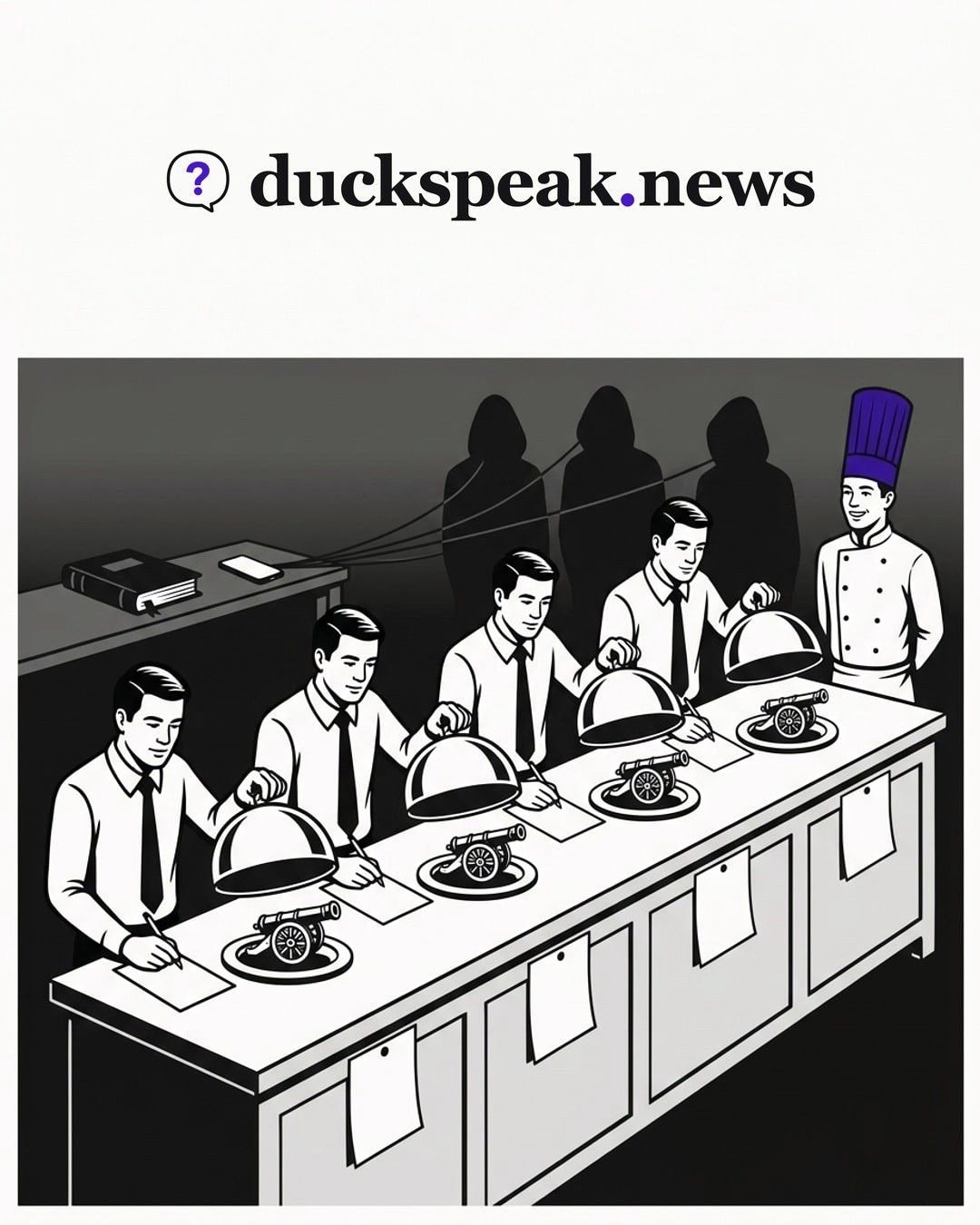
Four headlines, one script
A serving soldier was jailed for 46 months after making explosives and a weapon while promoting extreme right-wing views. The Mirror, the BBC, The Independent and The Telegraph all covered it. Reading them side by side, the striking thing is not disagreement but sameness. Each leads with the same two phrases: a “homemade cannon”ChurnalismChurnalism is a press release, wire feed, or one outlet's unsourced reporting republished under several bylines and read by the public as independent confirmation. and an “Army chef” [1][2][3][5]. (A second Independent item sits behind a login wall [4], so we cannot say what it contains.)
The critique is partly speculative. The likeliest explanation for the sameness is shared source material: the court hearing and a police and CPS press release. We cannot prove that from the articles alone. What we can show is on the page.
Newspeak by diminutive
“Cannon” is a word from pirate films and castle walls. The outlets lean on an expert’s description of the device as “crude” and “similar to a 14th century gun” [1], a detail every outlet repeats [2][3][5]. It is a vivid, almost comic image, and it is accurate as reported. But it sits in the headline slot, while the judicial finding sits lower down. The Telegraph’s headline says he made a cannon and explosives “to impress fellow extremists” [5], which frames the motive as social vanity. That is close to what the judge found: that he made the weapon so he “would be taken seriously” by other members of the groups [3]. Yet the same record shows the prosecution saying he wanted to be “in history books and criminal records”Buried ledeA buried lede is the fact that should have organized the whole story, relegated instead to the final sentence or hidden inside someone else's quote. for terrorism and killing police officers [3]. That line is the darkest in the case, and BBC, Mirror and Telegraph bury it mid-article [1][3][5].
“Chef” does similar work. It is true; he was an Army chef. But the occupational label, repeated in the BBC and Telegraph headlines [3][5], domesticates the story. The defence’s reference describing him as “excellent at mentoring junior members of the catering team” [3] is reproduced by all four full articles [1][2][3][5]. It is a legitimate detail of mitigation. Reproduced identically without comment, it also works as a Huxleyan sedative: the reader is offered a nice-guy counterweight with no weighing of it.
The finding that gets passed along without scrutiny
The most important fact is a dispute. Broadhurst “did not accept that his intent had a terrorist motivation” [3], and the judge found otherwise. The outlets report this accurately, mainly by quoting Det Ch Supt James Dunkerley [1][2][3][5]. Good. But none of these articles explains what a “terrorist connection” means in sentencing, or what difference it made to the 46 months. A reader is told the label applies and not what it does. The Independent’s headline, “terror-linked offences” [2], and the BBC’s identical phrase [3] invite the vague reading that “linked” is a lesser category. That is our interpretation; the articles do not define it.
Who is quoted, and who is not
Voices are almost entirely institutional: prosecutor, defence counsel, police, CPS. Frank Ferguson’s statement that the prosecution could use evidence from his own devices, “which meant he had little choice but to admit his guilt” [1], appears in the Mirror, but not in the BBC, Telegraph or the Independent. The Mirror also carries Ferguson’s remark that the CPS will work with police so “terrorist activity is disrupted at an early stage” [1], a self-congratulatory line left unchallenged.
One real omission matters. Prosecutor Matthew Donkin said most of the offending happened before Broadhurst joined the Army [1][2][3][5]. All outlets include it. None of them asks the obvious institutional question: what vetting or monitoring applied at recruitment, and what happened between his arrest and now? We do not know the answer, and the articles do not say. It may be unremarkable. It is still the question the framing steers away from.
The Mirror’s headline puts “Racist”Scare quotesScare quotes are quotation marks placed around a word an outlet won't stand behind, so it can print the word anyway. in quotation marks [1], a hedge that sits oddly beside the judge’s finding of a “violent, racist and anti-authority ideology” [3]. The scare quotes suggest doubt that the court did not express.
What a reader would need instead
5 checks to run on the next story like this one.
-
A plain account of what a terrorist connection finding means legally and for the sentence; Counter Terrorism Policing and the CPS, both quoted here, are the bodies that could explain it.
Gap in the coverage
-
Headlines that lead with the court’s finding rather than the quaint object.
-
Scrutiny of the Army’s recruitment and monitoring, even if the answer is reassuring.
Gap in the coverage
-
Notice that Broadhurst’s contact with “three now-convicted terrorists” over nearly two years on Facebook and Telegram [1] is a pattern of networks, not a lone eccentric with a cannon.
Gap in the coverage
-
Editors who treat a shared press script as a starting point, not the story.