

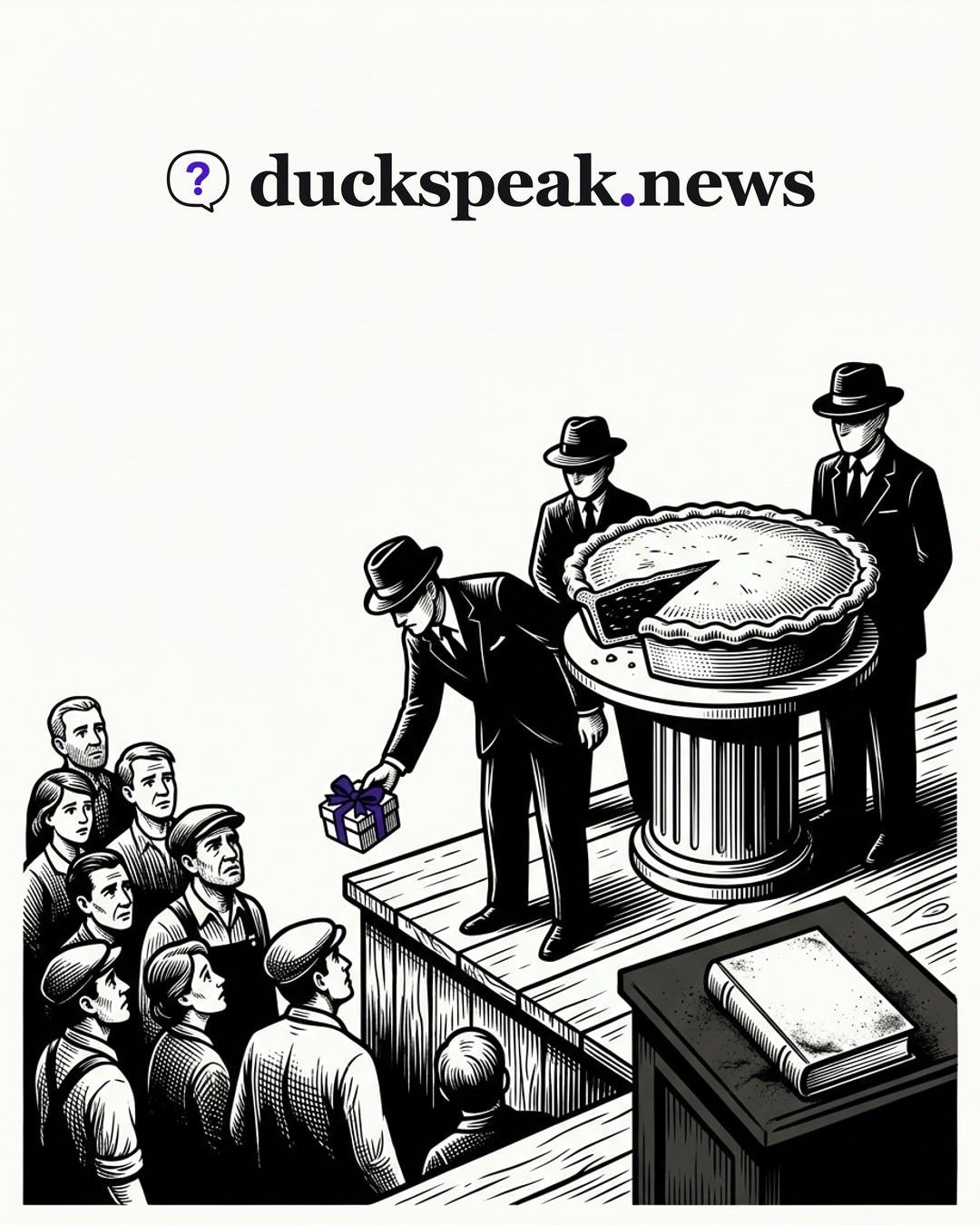
The headline verb is “give”
Five outlets covered the same two announcements, and the verbs largely match. The Independent says Musk and Anthropic “will give away billions of dollars in shares to try and ease panic about artificial intelligence” [1]. The BBC calls them “big financial giveaways” [2]. NBC titles its piece with “a piece of the AI pie” [5]. The LA Times says the two are “ready to share some of the wealth” [3].
Compare that with what the same articles actually describe. Musk has posted a pledge for “next year,” and the BBC notes that “Details over how each American child would be handed a share in SpaceX have not been disclosed” [2]. Anthropic’s fund has not said what the money will do. The Independent reports it “did not say what that money would be used for” and “suggested that it was yet to decide” [1]. The LA Times adds that the company “has not yet laid out how the fund will be governed” [3]. A pledge with no mechanism, no date and no governance is being reported in the grammar of a completed act. That is a Newspeak move in miniature: the vocabulary of action does the work that the facts have not yet done.
“Public benefit” as a brand
Anthropic’s own phrases travel nearly untouched: “public benefit fundEuphemism launderingEuphemism laundering is official or institutional vocabulary repeated across coverage until it stops sounding like a chosen frame and starts sounding like plain description.” [1], “the public good” [2], “directing that equity to the public benefit” [3]. Quoting a company’s self-description is legitimate. The problem is how rarely it is tested.
The Independent supplies the sharpest corrective, and buries it near the end: Anthropic is already a public benefit corporation, a structure that “does not come with any particular requirements about the work it doesBuried ledeA buried lede is the fact that should have organized the whole story, relegated instead to the final sentence or hidden inside someone else's quote.” [1]. The LA Times notes the fund is “a company-owned limited liability corporation” rather than “a conventional nonprofit” [3]. It also reports the Chan Zuckerberg Initiative used the same LLC structure [3]. A reader who skims the headlines would not learn that “public benefit” here describes a legal form, not an obligation.
Note also the company’s framing of its own incentive: “It is common practice for tech companies to offer escalating compensation awards to their executives. We are instead directing that equity to the public benefit” [1]. The Independent reports that the fund grows by 2% “for every 50 per cent increase in the company’s value” [1]. In the company’s words, “the more Anthropic grows, the larger the share of the company that can be dedicated expressly to the public good” [1]. That sentence presents growth and virtue as the same line on a chart. Whether or not that is sincere, it is a framing worth naming, and none of the outlets interrogates it.
Who is being soothed, and why now
The motive is stated plainly in the coverage, and then treated as background. The Independent says the move is “to try and ease panic” [1]. The BBC places it “as Big Tech firms come under pressure over the potential impact of AI on humanity” [2]. PBS cites an AP-NORC poll in which 64% say AI is developing “too fast” [4]. NBC cites a poll finding 70% “more worried than excited” [5].
Huxley’s lens fits here. The remedy offered for anxiety about a technology is a stake in the technology: a share, a pie, a fund. The question of whether the public wants to be a shareholder in the thing it fears, rather than have a say over it, is not asked. The BBC notes that Trump “has repeatedly rejected the idea of laws to control development” and that a “morally binding” document makes firms “responsible for ensuring the safety of their own technology” [2]. Voluntary generosity then fills the space where rules might have been. Both pledges also arrive ahead of public listings: the BBC calls Anthropic’s move “laying the ground for a potential blockbuster stock market listing” [2]. Coverage mentions the IPO in every piece but rarely connects it to the timing of the generosity. We can only call that connection suggestive; none of the outlets claims it, and we do not either.
The omissions that matter
- Musk’s record. Only NBC says “Musk has made numerous bold statements in his career only to subsequently not follow through on them,” citing the 2018 “secured” Tesla funding claim [5]. The BBC, LA Times and PBS relay the pledge without that context. The Independent notes Musk “did not explicitly say that it was intended to change people’s view of AI” [1], a useful caution, but a brief one.
- Political money. PBS alone reports that Musk “has quietly become the biggest known donor in this year’s midterm elections, doling out more than $276 million since July” [4]. Next to a pledge that skips lobbying and political donations, Anthropic’s exclusion of them [2][3] reads differently, yet no outlet puts the two facts together.
- The numbers do not agree. Child counts are 72 million [1][5] or 73 million [3][4]. Value estimates are “over $10 billion” [1], “about $10.66 billion” [4], “about $10.8 billion” [5] and “close to $11 billion” [3]. Anthropic’s potential valuation is “up to $1 trillion” [1], “more than $1tn” [2], “more than $1 trillion” [5] and “up to $2 trillion” [3], the last flagged as uncertain. Another detail jars: PBS says SpaceX shares are “down 35.3% since peaking” [4], which makes the headline sums softer than they look. Nobody reconciles these differences.
- Scale. NBC puts the SpaceX pledge at “less than 2% of his current net worth” [5], and the Independent calls it “only a small portion” of his shares [1]. That is context for judging a “giveaway,” and it is absent from the headlines. A single share per child is also a very small stake, which the coverage mostly leaves implied.
Unexamined repetition
The stock phrase “every kid in America” is quoted verbatim in four of the five pieces and in two headlines [1][4]. It is a good slogan: warm, simple, and impossible to check. Who counts, how a minor holds a share, and what taxes or custodians apply are not addressed. The LA Times and NBC link the idea to existing “Trump Accounts” [3][5], which at least points to an existing mechanism, though neither asks whether Musk’s pledge would use it.
What a reader would need instead
6 checks to run on the next story like this one.
-
A plain distinction between a pledge and a transfer, in headlines as well as the body.
Gap in the coverage
-
The legal fact that a public benefit corporation has no binding duty on what it does [1], and that the fund is an LLC the company owns [3].
-
Musk’s follow-through record and political spending placed next to the pledge, not in separate articles [4][5].
Gap in the coverage
-
Consistent figures, with the source of each number given.
Gap in the coverage
-
Independent trackers: the SEC filing process for the IPO, and the “public benefit report” Anthropic promises [1], should be treated as the real tests. Readers should watch whether the promised “coming months” detail [1] ever arrives.
Gap in the coverage
-
A direct question: if the public is worried enough to need reassurance, what would regulation, not generosity, look like?
Gap in the coverage