

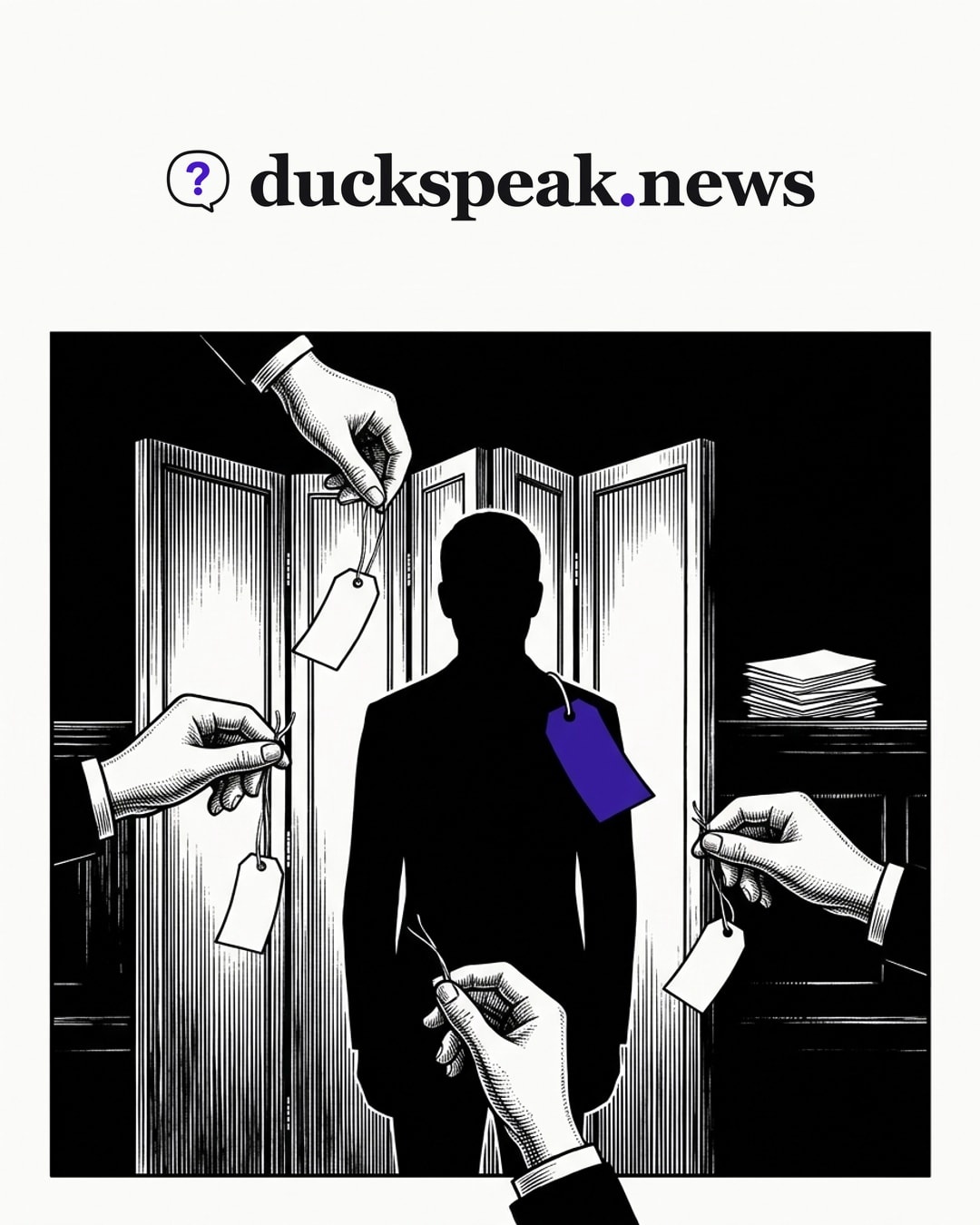
A man with no name, described four ways
The High Court has anonymised the claimant, so every outlet had to pick words to stand in for him. Those words are where the framing sits. The Guardian’s headline calls him a ‘Well-known’Scare quotesScare quotes are quotation marks placed around a word an outlet won't stand behind, so it can print the word anyway. public figure [1]. The Mirror opens on a “famous” man [2]. The BBC drops the quotation marks and says “celebrity” in its own voice [3]. The Independent keeps “well-known” in quotes [4].
Quotation marks around a label do two things at once. They signal that someone else used the word, and they leave the reader unsure who. Quotation marks answer the question of who said it only if the reader can see who is speaking. In the Guardian’s text, “well-known individual” is never attributed to a speaker [1]. The Mirror’s body does attribute “famous” to the claimant’s barrister, but only in its fifth paragraph [2]. Meanwhile the BBC’s unquoted “celebrity” turns a description from a court filing into the outlet’s own fact [3]. We can’t tell from these articles which word the court itself used, so this is a point about attribution, not about accuracy.
An accusation with no accuser
The Guardian’s first sentence says the man “has been accused of inappropriate and exploitative sexual activities with girls and young women”Agentless passiveThe agentless passive is a sentence built so the action happens with no one doing it. [1]. The sentence does not say who accused him. The agent can be pieced together from later paragraphs: the news outlets’ own written submissions, citing “more than 30 sources with first-hand accounts” [1]. So the accuser is, in procedural terms, the two outlets in the dock, and one of them is the publisher of this article. The article names “the Guardian and ITN” as defendants, but it never tells the reader that the Guardian is reporting a case in which it is a party [1]. The Mirror at least spells out that GNM is “publisher of The Guardian” [2]. Readers weighing the Guardian’s account would want that stated plainly.
The agentless passive is a sentence built so the action happens with no one doing it.
One mild phrase, repeated
Three of the four pieces carry the phrase “inappropriate sexual activities” in or near their headlines or ledes [1][2][3]. The BBC’s lede has the man accused of abusing status to engage in “inappropriate sexual activities with a large number of girls and young women”Euphemism launderingEuphemism laundering is official or institutional vocabulary repeated across coverage until it stops sounding like a chosen frame and starts sounding like plain description. [3]. The Mirror attributes the wording to the media organisations’ lawyers [2]. So it is a phrase from a legal submission, and we can’t say whether it was chosen to soften or simply to summarise. But by the third repetition, it reads as the outlets’ own neutral description. “Inappropriate” is a word about manners, and the nouns next to it are “girls” and, in the BBC, “teenagers” [3]. Only the Independent uses a harder category, saying the allegations include that he “committed a sexual offence”, with no attribution for that framing [4]. The reader gets two registers of seriousness from the same hearing.
Numbers that do not line up (yet)
The Guardian reports “more than 30 sources with first-hand accounts” [1]. The Mirror reports reporters “have spoken to more than 100 people, including friends and colleagues as well as women with allegations against him” [2]. These may be compatible, since one counts first-hand accounts and the other counts everyone interviewed. Neither article explains the gap.
Who gets the last word on risk
The suicide-risk evidence is handled unevenly. The Guardian includes the expert’s caution that he “does not conclude either that suicide is inevitable if publication occurs, or that psychiatric treatment can eliminate all risk” [1]. The BBC gives the “significant, but not complete mitigation” finding [3]. The Mirror carries the barrister’s line that publication “would have a potentially fatal impact” and her description of the case as extraordinary, but no independent expert finding [2]. The Independent notes only that he “remains seriously ill” [4]. A reader of the Mirror alone would see the claimant’s framing more than the court-commissioned assessment.
The judge’s sentence that applies to the press
Justice Nicklin said, “Nor does repetition transform speculation into established fact” [4]. He was talking about online guesses at PPT’s identity. The Mirror and Independent quote it [2][4]. It also works as a test for the press: a label or phrase repeated across outlets becomes familiar, and familiarity feels like confirmation.
What a reader would need instead
6 checks to run on the next story like this one.
-
Who said each descriptor (“well-known”, “famous”, “celebrity”), and whether it came from the court, a party, or the outlet.
-
A plain statement, in the Guardian’s own report, that it is a party to the case.
Gap in the coverage
-
The named agent of the accusation: the outlets’ submissions, with the nature of the evidence stated.
-
The full wording of the allegations as put to the court, rather than a single softening phrase.
-
An explanation of the 30 versus 100 figures.
Gap in the coverage
-
The expert’s full conclusions on risk, in every report, not only some.
Gap in the coverage