

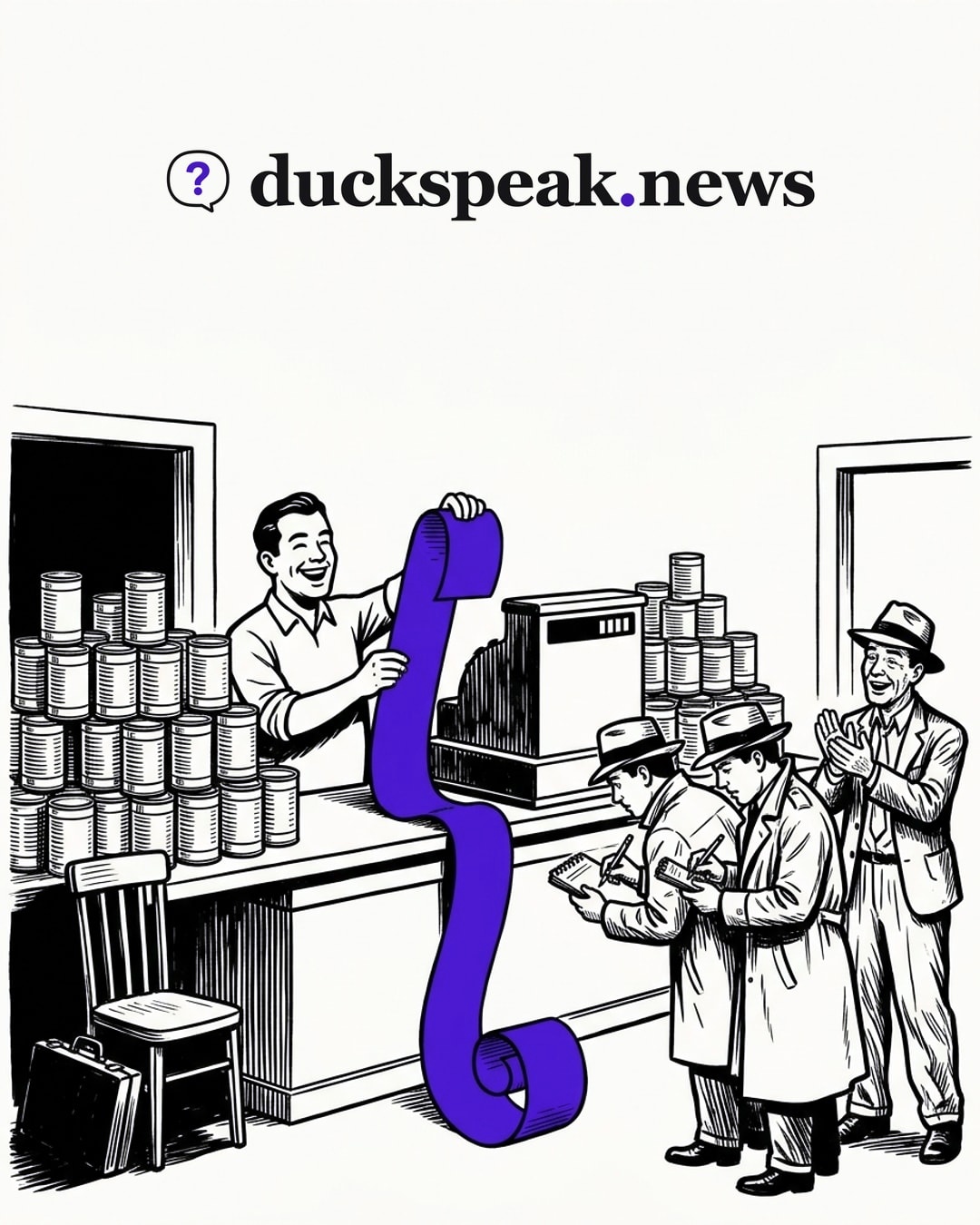
An earlier piece on this site watched the launch coverage of the stockpiling advice: a tin of beans sharing a page with a war clock, and one outlet’s admission that no particular intelligence lay behind it. This is the quieter sequel. The question is no longer whether to stock up but whether the nation obeyed, and two articles say it did, on the evidence of the retailers’ own sales reports.
The till is the only witness
The BBC’s first sentence promises investigation: a surge “according to figures obtained by BBC Newsnight” [1]. Read the verbs in the body and the provenance appears. Iceland “told the programme” its 40%; Robert Dyas “reported” its 160%; Maplin “said” its 92%, 284% and 106% [1]. Every number in both articles was supplied by a company selling the product it counts. Every quoted voice belongs either to the minister whose campaign it is or to a company whose takings the article reports; no independent voice appears anywhere in either piece. The entire evidentiary base is commercial self-report, wearing the costume of data.
A retailer announcing a demand surge is never only describing; it is also marketing. Maplin’s managing director offers “These are simple, affordable products that keep a household connected and informed when the power goes out” [1], a product description, and adds “it’s encouraging to see people taking the advice seriously” [1]. The minister supplies the same mood: “It’s encouraging that people are taking practical steps to be ready” [1]. The word “encouraging” reaches the reader only through mouths whose position improves if the buying continues, and neither outlet notes the overlap.
The causal claim is built from the same material. Both headlines say the rise came “after government call to stock up” [1][2], and “after” is chronology wearing causation’s clothes. The only sentence in either article that says why people bought is Iceland’s: “It’s clear consumers have listened to the government’s message” [1]. That is a supermarket reading its own weekend takings, repeated by both outlets [1][2]. No other explanation is weighed; a reader is invited to treat a coincidence of timing as a measured national response, on the word of the till.
Percentages without floors
None of the numbers has a floor. Iceland’s 40% covers “the weekend” [1]; Robert Dyas’s 160% is “compared with last week” [1]; Maplin’s cover the days since the announcement, “compared with the same period last month” [1]. Three different baselines sit in one article, never reconciled, and The Independent repeats all three without remark [2]. No absolute volume appears anywhere, so 284% might mean five torches becoming nineteen, or five hundred becoming nearly two thousand. A percentage without a floor can be made to mean almost anything.
The one baseline clue in either article points downward. The tenfold surge at Sgt Prepper’s comes from its owner: “We were a small outfit on Wednesday” [1]. Ten times a small outfit is still a small outfit; the qualifying fact sits inside a quotation, and the headline’s “Sharp rise” [1] does not carry it.
Radios lead the sales story, yet the minister’s list, as the BBC renders it, is “three litres of water per person per day; tinned goods in the cupboard; baby food; battery powered torches and mobile phone charging packs” [1], with no radio on it. The BBC’s own hedge, that “Many of the items cited by Streeting appeared in the list of goods gathered by Newsnight” [1], concedes the mismatch quietly. The campaign’s full kit list may include a radio; neither article shows it, so a reader cannot tell which purchases track official advice and which track something the articles never name.
The significance is carried by adjectives. “Some major retailers have seen a dramatic increaseAdjective inflationAdjective inflation is a dramatic modifier ('fiery denial,' 'bombshell') bolted onto a flat, uncontested sentence to make it read as a conflict story. in sales of essential goods after the government called on the nation to stock up in case of a crisis” [1]. Nobody was asked whether the increase is dramatic, because nobody independent is in the piece; the modifier supplies the significance the numbers cannot. That is adjective inflation, and The Independent reaches for the same shelf: “spike” in its headline and first sentence [2], where the BBC has sales that “shot up” [1].
One story, two bylines
The Independent’s headline states the finding as its own: “Supermarket sales of essential goods spike after government call to stock up in case of crisis” [2]. Its first sentence does the same in its own voice, with no attribution: “Sales of tinned food, wind-up radios and torches have all spiked after the government told people to stock up in case of a crisis” [2]. The credit arrives later, once, in a subclause: “according to a report by BBC Newsnight”ChurnalismChurnalism is a press release, wire feed, or one outlet's unsourced reporting republished under several bylines and read by the public as independent confirmation. [2], attached to the Maplin figures. Every number matches the BBC’s, and the Streeting quote is identical word for word. This is churnalism: one outlet’s reporting republished under another byline and read as independent confirmation. The credit does exist, and that is worth saying; the mechanism is placement. The claim sits in the headline and the lede, the source sits in a dependent clause halfway down, and a reader who sees both headlines counts two outlets where there was one report.
Details mutated in transmission, as happens when a story is rewritten rather than reported. The Independent’s account of the advice adds “a three-day supply of cash” [2] to a list in which the BBC mentions no cash; the two articles give different versions of what the government advised, and neither flags the difference. It tells readers the public “is being urged to prepare for food shortages” [2], a phrase that appears nowhere in the BBC’s account, whose emergencies are “a cyber attack or an extreme weather event” [1] and whose Streeting quote offers “flooding, power cuts or burst pipes” [1]; the article never says who decided on “food shortages.” Where the BBC prints Iceland’s “Our supplies of these products remain healthy” inside a quote [1], The Independent writes that the chain “reassured” it [2], a verb that turns a stock notice into calm, the launch coverage’s “alert not alarmed” register absorbed into the newsroom’s own vocabulary. The prepper shops and their tenfold and 650% surges are dropped [1], so readers of the shorter version never learn that the most dramatic multiples came from the smallest shops.
The adjective that settled the question
Both headlines name what spiked as “essential goods” [1][2]. Trace the word and it leads to the minister: his quote recommends “a few everyday essentials at home, from tinned food to torches” [1]. The campaign’s vocabulary has migrated out of his quotation marks into both outlets’ own voice, which is loaded-vocabulary adoption. What the adjective settles in advance is the one question a stockpiling story should ask: whether the buying is prudence or anxiety. Neither article asks it; the headline answers it with a word. The BBC hedges and loads in the same breath: “Sharp rise in sales of some essential goodsLoaded-vocabulary adoptionLoaded-vocabulary adoption is when a charged word coined by one side of a dispute ('raid', 'radical', 'ballooning') moves out of its quotation marks and into the outlet's own narration, so the argument is made before the evidence. after government call to stock up” [1]. The “some” concedes the rise is selective; the “essential” decides what the selection means.
What a reader would need instead
7 checks to run on the next story like this one.
-
Absolute volumes, or at least the baseline weeks, so a 284% rise has a floor under it.
Gap in the coverage
-
One comparison period, stated beside each figure, instead of three quietly different ones.
Gap in the coverage
-
A number from someone who does not sell the products: sector-wide till trackers such as Kantar and NielsenIQ survey retail sales across the market, and neither article contains a single figure that did not come from a seller.
Gap in the coverage
-
The campaign’s full list, printed once, so a reader can see which surges track official advice; the radio question would answer itself.
Gap in the coverage
-
An attribution for “food shortages” and for the cash advice: which words are the government’s, and which are a newsroom’s summary.
Gap in the coverage
-
Someone without a stake, asked whether the response is prudence or panic; every voice currently answering has an interest in “encouraging.”
-
When two outlets carry identical numbers, a line saying whether the second checked them or relayed them.