

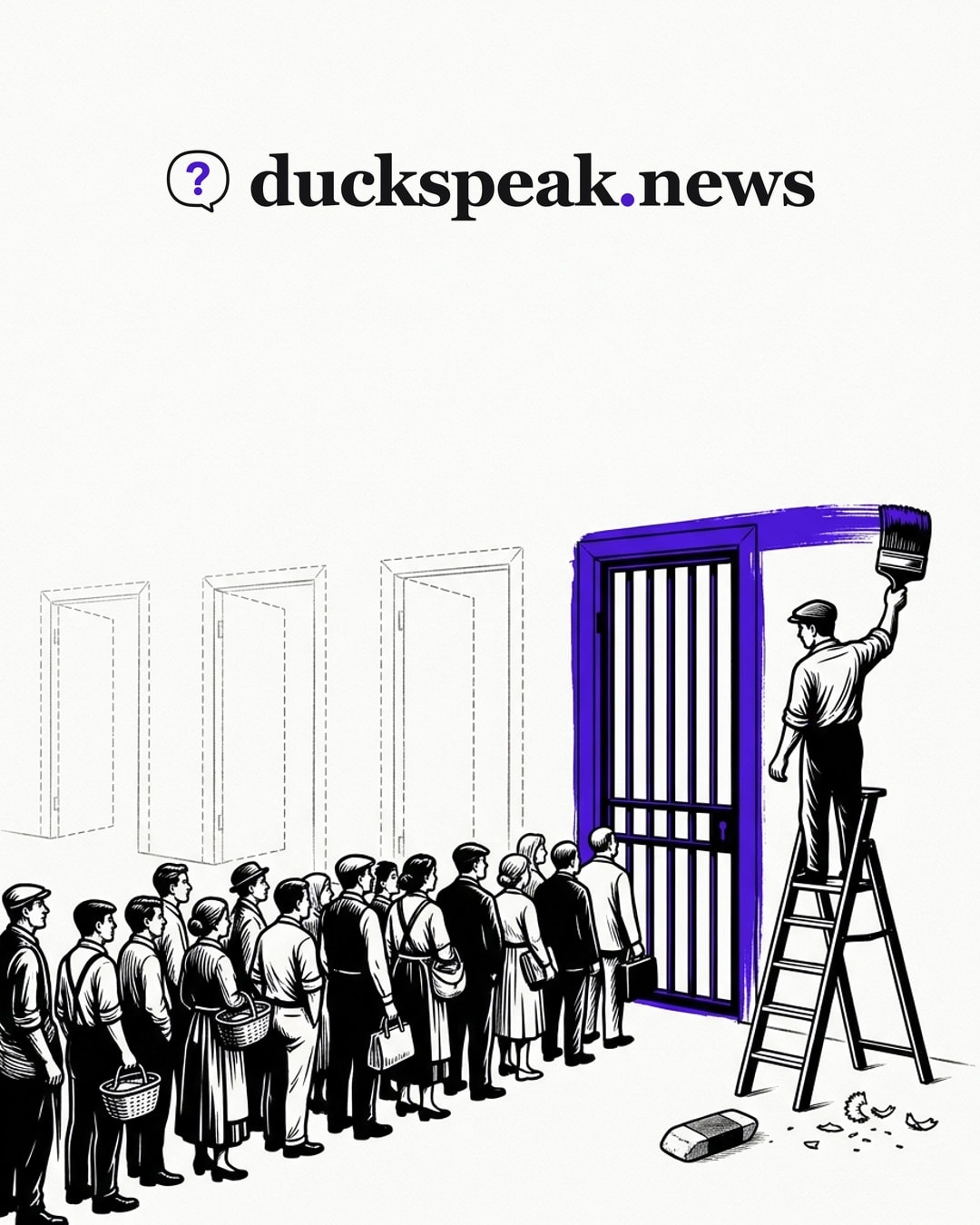
One option among four
Ofcom’s own announcement says it “identified four age assurance methods that are currently capable of being highly effective” at 16: photo ID matching, digital ID services, banking-based checks and facial age estimation [5]. Photo ID is one entry on that list. The BBC reports that the measures are “subject to government approval” and that Ofcom’s report “will now be considered by the government, with a decision due by the end of the year” [2].
GB News headlines the same event “Britons may be forced by Ofcom to show photo ID for social media platforms” [1]. Three things happen between that source and that headline.
The hedge that wears off
The headline says “may”. The first line of the body says “could” [1]. Then comes this sentence: “The move would see adult Britons forced to show photo ID to access platforms such as Instagram, Snapchat, Facebook and TikTok”Modal deletionModal deletion is dropping a hedge word like 'could' from a headline, turning a hypothesis the article's own body still calls conditional into a present-tense fact. [1]. The conditional has hardened into a plain prediction, and the same sentence appears again as a photo caption. A reader who skims the headline, the opening and the caption meets the claim three times, each time slightly firmer. That is modal deletion, and it matters because the reader never sees the moment when a possibility became a fact.
Ofcom’s record points the other way. It says some adults with existing accounts “will not need to complete an age check” if the platform already holds reliable information. It also says many adults are likely to be asked to prove their age using “the wider range of methods at age 18 identified in our existing guidance” [5]. Nothing in the GB News piece mentions either point.
A verb that carries the argument
The opening line reads: Britons could be “forced”Loaded-vocabulary adoptionLoaded-vocabulary adoption is when a charged word coined by one side of a dispute ('raid', 'radical', 'ballooning') moves out of its quotation marks and into the outlet's own narration, so the argument is made before the evidence. to show photo ID, “Ofcom has warned” [1]. “Forced” is the campaigners’ register, but here it sits in the outlet’s own narration. Loaded-vocabulary adoption works this way: the argument is made in the verb before any evidence arrives. Ofcom’s text describes companies asking users to prove their age, and users choosing among methods [5]. “Warned” also changes what Ofcom did. It recommended methods; it did not issue a warning about ID. The article never says who decides, and by the BBC’s account the decision belongs to government [2].
The article also says the regulator “has warned that current verification methods, such as facial age checks, are not accurate enough” [1]. Ofcom lists facial age estimation among its four methods. It adds that some technologies have a margin of error of a few years at 16, so services should use a second check [5]. A caveat about one method’s accuracy has been reported as a verdict on all current methods.
What the quotes leave out
GB News says 16 and 17-year-olds without a passport or driving licence “would likely need to take steps to obtain one” [1]. Ofcom’s announcement goes on to say that PASS cards are available free to 16 and 17-year-olds, often without existing photo ID [5]. GB News leaves that out. Silkie Carlo of Big Brother Watch says “hundreds of thousands of people without ID” will be locked out [1]. The article gives no source for her figure. Ofcom’s estimate is about 150,000 16 and 17-year-olds with neither document, though it adds that the figure rests on a non-representative school survey [5]. The two numbers may count different groups, and the article does not say. The “Orwellian” quotation comes from Carlo, and the subhead attributes it to campaigners. It still sits in the story’s opening frame, before the regulator speaks.
The same slippage elsewhere
The pattern is not unique to one outlet. The Independent’s version says Ofcom highlighted “four techniques that prove “highly effective”” [3]. Ofcom’s phrase is “capable of being” highly effective [5]. “Prove” turns a capability into a result.
Its headline, “Children will bypass social media ban for under 16s, Ofcom warns”Headline asserts, body hedgesThe mother pattern behind scare quotes, modal deletion, and the commitment-free statement: a headline states a claim as settled fact while the article underneath it quietly hedges, denies, or contradicts it. [3], states a certainty. The body quotes Ofcom saying it was “inevitable” that some under-16s would get around the checks [3]. Ofcom itself says “some children will succeed” [5]. The headline drops “some”, and a reader who stops there takes away that the ban cannot work. Ofcom’s chief executive says the reverse: “It can work if social media firms do highly effective age checks properly” [3]. This is the headline asserts, body hedges pattern.
The Independent’s explainer says a consultation “was “declared one of the biggest national conversations”Agentless passiveThe agentless passive is a sentence built so the action happens with no one doing it.” [4]. That is an agentless passive: the article does not say who declared it. The next sentence says “the government also claimed” that two-thirds of young people agreed, and the “also” hints that the government made the earlier claim too, though the article does not say so [4]. The 90 per cent of parents figure has no stated source. Readers are left unsure who is vouching for the “overwhelming public backing” the article reports [4].
The agentless passive is a sentence built so the action happens with no one doing it.
What a reader would need instead
5 checks to run on the next story like this one.
-
The decision-maker. Ofcom assessed methods; the government decides what the ban requires, with regulations promised before the end of 2026 [2][5].
Gap in the coverage
-
The full list. Photo ID is one of four methods, and Ofcom says a layered approach may be most effective [5].
Gap in the coverage
-
The alternatives for those without ID. These include free PASS cards, banking checks and digital ID [5].
Gap in the coverage
-
Who is speaking. Campaigners’ words such as “forced” and “Orwellian” belong in quotation marks, not in the outlet’s own narration [1].
-
Plain verbs about certainty. “Can”, “capable of” and “some” are part of Ofcom’s meaning. Where a headline drops them, check the body.
The BBC’s account is not flawless; it too leaves open how many adults would be affected, citing Ofcom’s own lack of a “firm number” [2]. But it keeps the conditionals and names the decision-maker.