

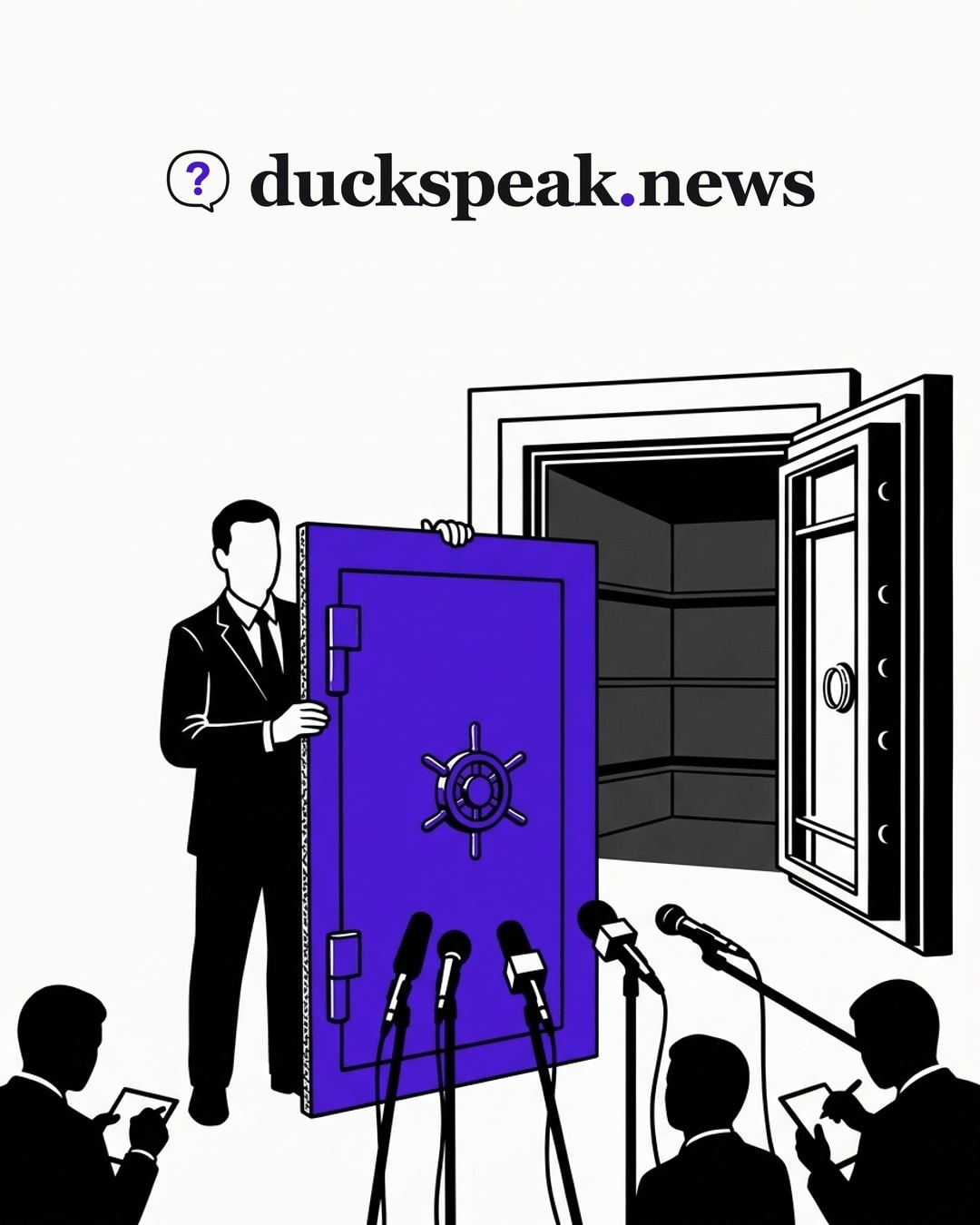
One sentence, four meanings: “safe”
The same reassurance travels through almost every account of the Binance incident: user funds are “safe.” The outlets differ in how much they let the reader see what that word is resting on.
NPR quotes a spokesperson: “Rest assured that user funds are completely safe” [5]. In the same article it says “Binance had not explicitly confirmed that funds had been pilfered” [5]. The Independent says the company “maintains that users funds are safe” [3], a verb that at least marks it as a claim. France Info is the most useful on this. It reports that Binance first said funds were “totalement à l’abri” (totally sheltered), then announced it would cover “toutes les pertes” (all losses) [1]. The article itself calls these “plusieurs messages contradictoires” (several contradictory messages) [1]. If funds were safe, there would be no losses to cover. A reader who only skims the quote learns the first message and misses the contradiction.
Attribution: from “reportedly” to “North Korea”
GB News’s headline calls it “the largest bank heist in human history” [2]. That is a phrase from Ari Redbord of TRM Labs, an analytics firm that is also the source of the North Korea attribution [2]. The headline puts a vendor’s superlative in the outlet’s voice. The Independent’s lede does attribute it (“labelled … by one insider”) [3], but its closing sections treat the TRM attribution as settled background.
CBS’s headline: “$6.3 billion Binance hack was likely work of North Korea, intel firms sayPresuppositionPresupposition embeds a huge, unstated fact as an assumed background detail instead of reporting it, so the question of how we got here becomes structurally impossible to ask.” [7]. The sentence takes for granted that this was a “hack” by an outside attacker, which is the company’s framing, and then hedges only the culprit. Yet NPR notes Binance’s own first statement was about “a potential security issue” [5], and Tether’s CEO spoke of “a potential Binance exchange hack” [5]. The BBC is the most careful: “It is not yet known who is behind the attack, but some analytics firms have pointed to North Korea - though this has not been confirmed” [4]. It also records that North Korea “has always denied any involvement” and that Binance “has not directly responded” on the link [4]. GB News gives TRM’s “high confidence” quote but only notes that North Korea’s missions “have not yet commented” [2], which reads as if silence were the expected next step.
Two sourcing points matter here. First, CBS and The Independent give the FBI’s earlier Bybit attribution as precedent [7], but that is a different incident. Second, the TRM post is a commercial analytics firm’s judgment, not a government finding. Only the BBC and The Guardian (“There is speculation”) [8] keep that distinction visible.
The company’s vocabulary becomes the outlet’s
Outlets adopt “incident” and “breach” and “security issue” from Binance’s statements, and the reader sees them repeated in headlines: NPR’s “potential security issue” [5], ABC’s “security breach” [6]. The Guardian’s live blog even ends on the company’s own words, quoted at length: “We will weather this storm” [8]. That is a stock phrase, and it ends the block as a note of resolve rather than a claim to test.
On the same blog, a law firm warns that Binance’s user terms “contain limits to Binance’s liability” and that it sees “no commitment on using the Secure Asset Fund,” calling the company’s promise “blandishments” [8]. ABC repeats the promise that “Binance will cover all losses from the SAFU fund” [6] with no such check. This is a “We are still gathering the facts, and will share more directly as we have them.”Commitment-free statementA commitment-free statement is an institutional quote that concedes a problem in feeling-language while specifying no agent, no deadline, and no way to check later whether it happened. [6]: no deadline, no named person, and no way to verify it. Where the same company has numbers (a “45 hours” resumption window [4], “within 48 hours” [2]), outlets pass them along unchallenged, and the figures differ.
Context that only some readers got
NPR is the one outlet that says plainly that Changpeng Zhao pleaded guilty to a felony over money laundering, was pardoned by President Trump in 2025, and that “Zhao and Binance have been key supporters of some of the Trump family’s crypto enterprises” [5]. CBS gives the plea and the pardon but not the Trump enterprises link [7]. The BBC adds a 2024 lawsuit alleging the company helped send money to terrorist organisations [4]. The Independent and GB News omit all of it [2][3]. Any reader asking whether to trust Binance’s promise to make users whole should want that background. The sources do not show that it affects this incident, and we do not claim it does; the point is that it is available to some readers and not to others.
Market “nerves”
The Independent writes that “Nerves have been frayed by the record-breaking hack,” which “drove down bitcoin” [3]. That is “Nerves have been frayed”Market personificationMarket personification writes a financial market as a sentient being with fears and moods, so it can be soothed or blamed like a person instead of named, institution by institution. [3]: a price move is given feelings, and the named sellers are not given. The BBC more carefully says crypto rises and falls “at the whim of buyers and sellers” [4], yet that too hides who these are. By contrast, a Guardian analyst gives specific levels and sees “a retest of summer lows” [8], and the same live blog notes silver and Intel falling that day, which cuts against assigning one cause.
What a reader would need instead
5 checks to run on the next story like this one.
-
A clear split between what Binance says, what TRM and Chainalysis infer, and what a government has found. Only the BBC and The Guardian keep that split reliably.
-
The contradiction between “funds are safe” and “we will cover all losses” stated up front, as France Info does in its body.
Gap in the coverage
-
Who will verify the promised payout, and when: the sources name no regulator or auditor, only a promised “Proof of Reserves” [6] that Binance itself will publish.
-
Binance’s legal and political history, as NPR and the BBC give it, in every account.
Gap in the coverage
-
The $6.3bn figure itself is the company’s estimate [5][6], which France Info says is “estimé” (estimated) [1]. Even the Zhao quote in that article puts the loss nearer “un milliard” (a billion) at one point [1], a gap no one explains.
Gap in the coverage