

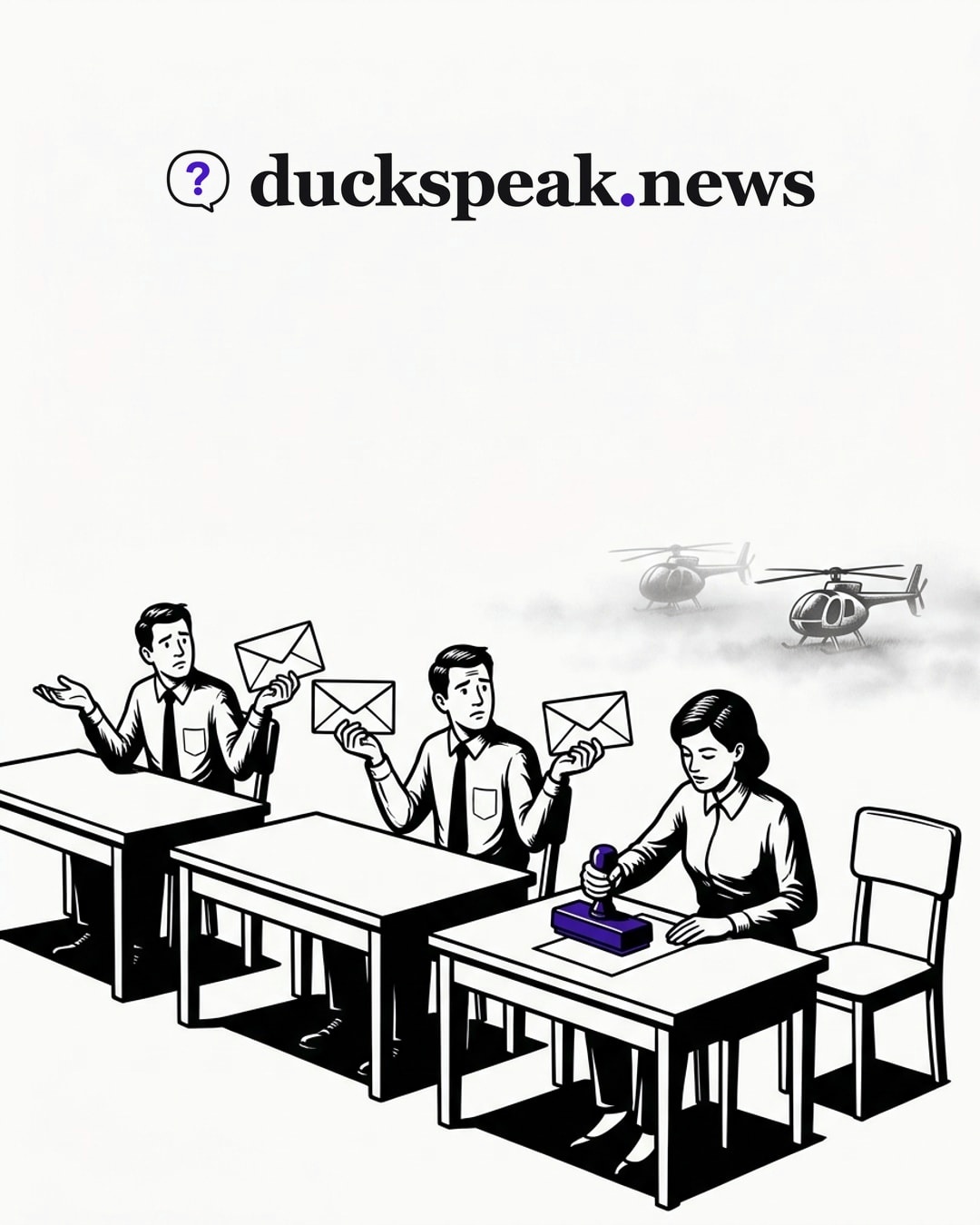
Same crash, different certainty
Four outlets covered one collision near McMinnville, Oregon. Three of them say, in various ways, that the outcome is unknown. One says three people are dead. The gap is the most useful thing in the coverage, and none of the pieces explains it.
CBS News writes that there was “no immediate word on their conditions” [1]. Fox News says the FAA “did not provide information about possible injuries or fatalities, leaving the conditions of the three people aboard the aircraft unclear” [2]. The New York Post says “Officials declined to say whether any of the pilots and passengers on the helicopters were injured or killed” [4]. GB News, by contrast, opens its headline and first line with “Three people have died in Oregon” [3].
Read side by side, a reader could conclude the American outlets were cautious and the British one was ahead. That may be right, but the sources given do not settle it. GB News attributes the crash location to the sheriff’s office and the identification process to “US authorities” [3], yet never says who confirmed the deaths. The “Three dead” claim sits in the headline and the first sentence with no named source attached. That is worth noticing, and it is not proof of error. It is a missing attribution on the most important fact in the story.
Verbs that decide what you picture
The New York Post says the helicopters “smashed into each other” and that one “crashed into” the other [4]. It adds that the aircraft “plummet[ed] to the ground” and that photos showed “crumpled helicopter debris in a pile” [4]. Yet in the same piece officials will not say whether anyone was hurt. The vocabulary does the work the facts have not yet done: it paints a fatal scene while the sourcing says nothing about casualties.
There is also a quiet factual tension. CBS says “The circumstances of the collision were unclear” [1], and Fox quotes the airport manager saying he “could not confirm what activities they were conducting or how the collision occurred” [2]. The Post’s “smashed” and “crashed into” assign a mechanism (one aircraft striking the other) that no cited official describes. Only a witness account, relayed through Fox12, speaks of the aircraft crashing “mid-air” [4].
Condolence language that commits to nothing
GB News quotes the training school: “Jerry Trimble Helicopters is deeply saddened to confirm that one of our aircraft was involved in an aviation incident this afternoon,” and “Our hearts and thoughts are with the individuals involved, their families, and everyone affected by this event” [3]. This is a textbook “deeply saddened to confirm that one of our aircraft was involved in an aviation incident”Commitment-free statementA commitment-free statement is an institutional quote that concedes a problem in feeling-language while specifying no agent, no deadline, and no way to check later whether it happened. [3]. It admits ownership of an aircraft, in feeling-language, and names no one, no cause, and no next step. “Involved in” does not say who flew, what happened, or whether anyone died. “Individuals involved” and “everyone affected” are equally open.
For the reader, this matters because the statement sits in a story headlined with three deaths. The company’s own words never confirm a death. The outlet leaves the juxtaposition to carry the confirmation. A reader may take the school’s grief as corroboration of the headline, when on its face the quote corroborates only that the school’s aircraft was in a collision.
The outlet also does not tell the reader what is checkable here: whether the school has said anything further, or whether the training arrangement (student pilot, instructor) is confirmed by anyone other than the sheriff’s briefing as paraphrased.
Small inconsistencies nobody flags
GB News gives the aircraft as “a 2018 Airbus AS350B3” [3], while the other three outlets, citing the FAA, say Airbus H125 [1][2][4]. These may be the same helicopter family under different designations; the sources do not say. GB News also says “the other pilot was piloted by 38-year-old Tyler Sturdevant” [3], a garbled sentence that leaves unclear whether he flew the Airbus, and which of the two aircraft carried the British student. It places the town “nearly 40 miles south west of Portland” [3], where CBS and the Post say about 35 [1][4]. None of this is dramatic, but it shows how little cross-checking sits behind a fast story.
Meanwhile Fox pads its short report with links to unrelated crashes (“TWO NAVY JETS CRASH MIDAIR…” and a San Jose dashcam video) [2]. Placed beside the Oregon account, they invite the reader to see a pattern of aviation accidents that nothing in the Oregon reporting establishes.
What a reader would need instead
4 checks to run on the next story like this one.
-
A named source for the death toll, and the time it was given. GB News attributes other details to the sheriff and a press conference [3] but not this one.
Gap in the coverage
-
A clear statement of which facts come from the FAA, the sheriff, the NTSB and the company, and which from the outlet itself. The Post’s “critical incident” quote is the sheriff’s office’s phrase [4], not a casualty finding.
Gap in the coverage
-
The NTSB, which the FAA says will lead the inquiry [1][2][4], is the body that publishes preliminary findings. Until it does, “how the collision occurred” is, as the airport manager said, unconfirmed [2].
Gap in the coverage
-
Matching aircraft designations and consistent facts across the piece.
Gap in the coverage
Until then, treat vivid verbs and sympathetic corporate statements as atmosphere, not evidence.