

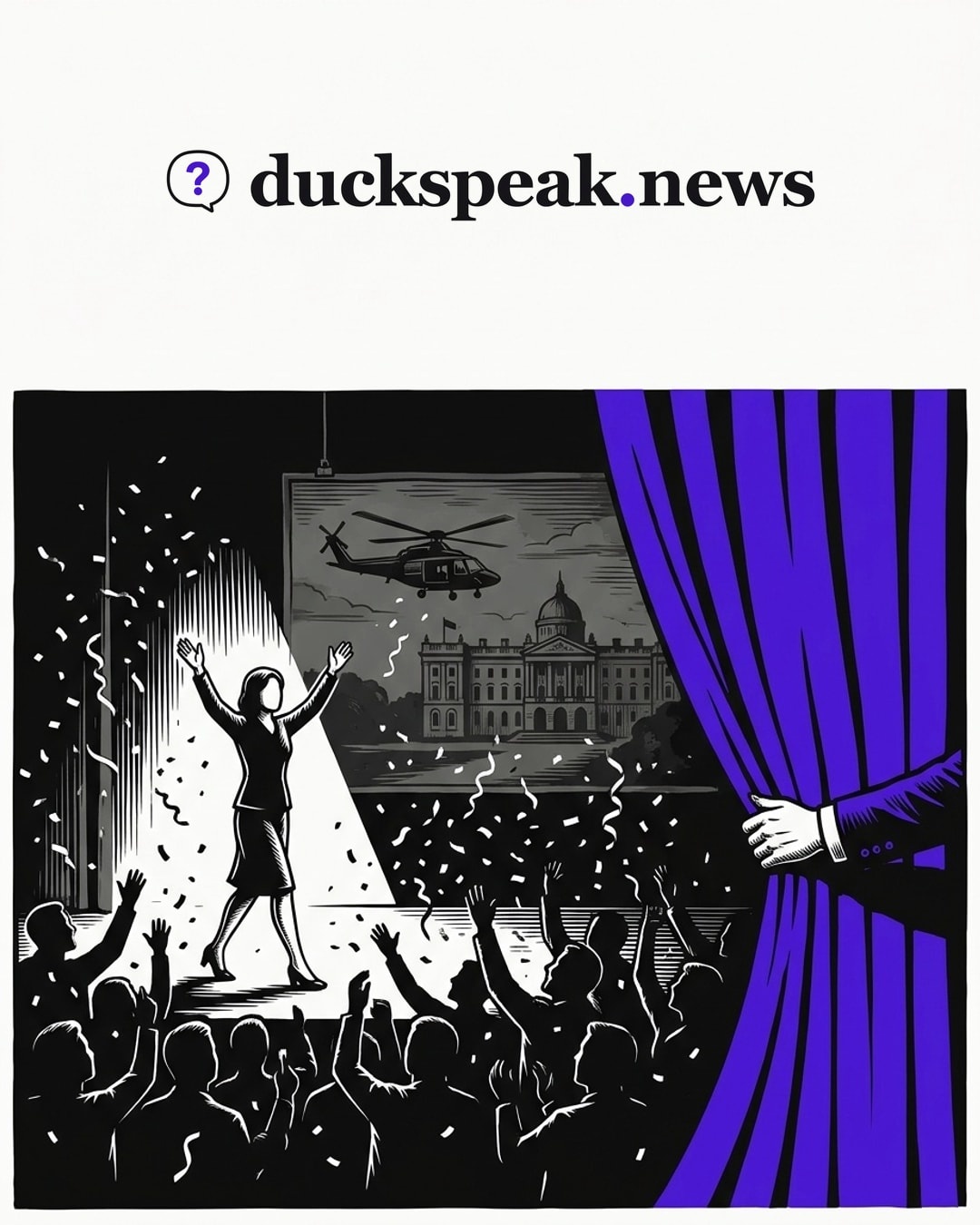
A giant fact tucked into a subordinate clause
In all four articles, the weightiest event in the whole affair is never news: it is scenery. CBS News lodges it in a chronology sentence, right after the Nobel prize: “Roughly one month after she departed the country, U.S. military forces captured Maduro and left his deputy, Delcy Rodríguez, in controlPresuppositionPresupposition embeds a huge, unstated fact as an assumed background detail instead of reporting it, so the question of how we got here becomes structurally impossible to ask.” [1]. RFI does the same in a time clause: “Au pouvoir depuis la capture du président Nicolas Maduro par l’armée américaine en janvier” (in power since the capture of President Nicolas Maduro by the US army in January) [3]. This is a presupposition: the capture of a head of state by a foreign army is given as settled and known, and the reader slides over it to reach what the article considers the news, the return of an opposition figure.
The capture is real, and that is precisely what makes the device interesting. An invented fact would have to be reported and argued over; a real fact can simply be set down. The truth of an event does not entitle it to be mere scenery: the question “how did we get here?” remains a question, even when the reader thinks they know the answer. The sign to watch for: an enormous upheaval that appears only in passing, inside a clause of time or circumstance.
The same move recurs in the dispatch on the demonstration, where the country’s status fits into a relative clause: “Washington, qui tutelle désormais le pays” (Washington, which now holds the country under tutelage) [2]. The word is heavy: tutelage is the regime for minors and the legally incapacitated, not for a sovereign state. Nothing explains what it covers, who exercises it or on what basis. And again in the account of the press conference: “Il a depuis été capturé par les États-Unis, où il est aujourd’hui jugé” (he has since been captured by the United States, where he is now on trial) [4]. Tried by which court, on which charges, on what legal basis the operation was carried out: none of the four articles dwells on it. CBS later adds “Since Maduro’s ouster”Agentless passiveThe agentless passive is a sentence built so the action happens with no one doing it. [1], a word that, unlike “captured”, no longer says who ousted whom: here the mechanism joins the agentless passive.
The agentless passive is a sentence built so the action happens with no one doing it.
Tutelage, pressure, auspices: who decides?
The reader following RFI’s three articles is handed three different vocabularies for Washington’s role: negotiations “soutenues par Washington” (backed by Washington) and a president “qui gouverne sous la pression de Washington” (who governs under pressure from Washington) [3], then talks held “sous les auspices des États-Unis” (under the auspices of the United States) [4], after the “tutelle” (tutelage) of [2]. Backing, pressure, auspices, tutelage: these are not synonyms, and nothing tells us which one is accurate.
Paradoxically, it is CBS that says the most, but through Rubio’s mouth. The Secretary of State speaks of deadlines “under the timelines that we’ve established” for changing “the infrastructure of the elections” [1], and asserts that “The United States has significant influence over the direction that these talks go” [1]. A foreign government is thus setting the deadlines for replacing another country’s Supreme Court and electoral council, with sanctions relief as leverage. CBS’s headline, meanwhile, is about permission to return. CBS deserves credit for noting that Rubio “did not directly address whether immunity had been offered” [1]; but the article never says what these “agreed to” timelines consist of, or who signed them.
Obstacles without an author
RFI writes that the transition negotiations took place without Machado, “dont le prix Nobel a été exclu” (from which the Nobel laureate was excluded) [3]. Excluded by whom? By Delcy Rodríguez, by Washington, by the opposition taking part? The reader cannot know, even though that is precisely the political question. Same move in the same article: “alors que les États-Unis ont été suspectés d’avoir empêché son retour” (while the United States was suspected of having blocked her return) [3]; we do not know who held the suspicion. It should be noted in RFI’s favour that the 22 October dispatch, after an “en aurait été empêchée” (was reportedly prevented), asks the question openly: “Par les autorités à Caracas ou bien par Washington […] : ce n’est pas clair” (by the authorities in Caracas or by Washington […]: it is not clear) [2]. There the uncertainty is named rather than smoothed over.
CBS, by contrast, gives only one version. Its headline, “Venezuelan officials allowed Maria Corina Machado to return, Rubio says” [1], is properly attributed, but the article nowhere mentions what RFI reports: Machado “avait accusé le gouvernement de Delcy Rodríguez d’empêcher son retour, après sept tentatives infructueuses” (had accused Delcy Rodríguez’s government of blocking her return, after seven failed attempts) [3]. The CBS reader has only the Secretary of State’s word to judge an affair in which Washington itself is under suspicion.
The spectacle in the outlet’s own voice
An asymmetry of register also runs through RFI. Delcy Rodríguez calls the return a “show”, and that word stays in quotation marks, presented as a jibe she “fustigé” (lashed out with) [3]. But in its own voice, RFI speaks of a “spectaculaire retour d’exil” (spectacular return from exile) [3] and then of a “retour en fanfare” (triumphant return) [4], and describes students “À la limite de l’hystérie” (on the verge of hysteria) and a “discours digne d’une campagne électorale” (speech worthy of an election campaign) [4]. The narrative adopts the spectacle it elsewhere quotes as a dig. In the opposite direction, the 2024 election becomes a “réélection controversée” (controversial re-election) [3] in RFI’s voice, while the following article specifies that the opposition denounced it “comme frauduleuse” (as fraudulent) [4]: “controversée” says neither who disputes it nor why.
What a reader would need instead
4 checks to run on the next story like this one.
-
The capture explained, not assumed. Maduro’s capture treated as a fact to be explained: the legal basis invoked, the court trying him, the conditions imposed on the interim government.
-
The content of the timelines. The text, or at least the content, of the “timelines” Rubio invokes [1]: who set them, who monitors compliance, what becomes of the electoral council and the Supreme Court.
Gap in the coverage
-
The authors of the obstacles. The names of those who kept Machado out of the negotiations and thwarted her seven attempts to return, with both sides’ versions side by side.
-
The terms of the oil deal. The terms of the oil deal that Machado criticises and that CBS mentions without describing [1]: they would show what Washington gets out of this transition.
Gap in the coverage
The European Union, quoted by RFI, speaks of “libres et équitables” (free and fair) elections [3]; those promises will be judged by verifiable commitments, with dates and named institutions, not by the size of the crowd.