

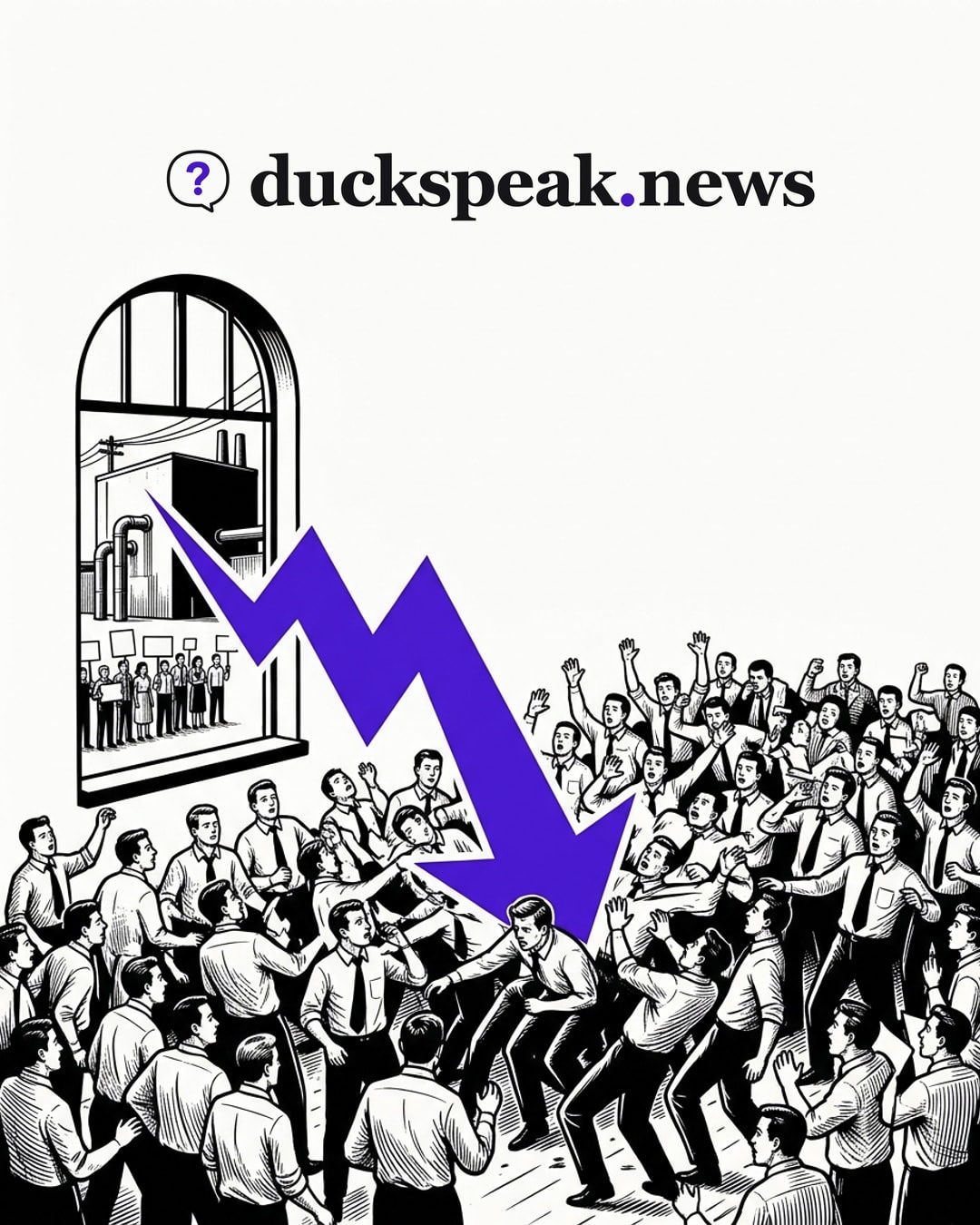
The voter as a shock
The midterms reach these four reports mostly as an event that happened to share prices. CBS News frames the result through an analyst’s phrase, “headline” risks around AI [1], and through an economist’s “midterms shock” [1]. The Guardian opens with the “blue wave” sinking “the AI investment boom” [4]. The people who produced that wave appear only as a variable. CBS mentions that data centres “have spurred widespread public opposition” [1] and stops there. The BBC notes “dozens of measures on ballots” aimed at restricting the facilities [2] without saying what any of them proposed. Only NPR gives a reason in a single clause: data centres “which many people worry will gobble up water and energy resources” [3].
No voter, ballot campaigner or elected Democrat is quoted in any of the four pieces. The quoted voices are analysts, strategists, an economist, and two tech executives. Those executives, in the BBC report, treat the result as a communications gap: Meta’s Dina Powell McCormick says the industry must “double and triple down on telling the story” [2], and OpenAI’s Greg Brockman says “you can’t just tweet and say: ‘This is going to be good.’” [2]. The BBC relays both and leaves the objections themselves unexplained, so a reader learns how the industry plans to sell data centres but not what communities were rejecting. It is the Brave New World reflex: dissent becomes a conditioning problem, solved by better storytelling.
Markets with moods
The sell-off is told largely as emotion. The Guardian’s headline has “AI panic grips markets”Market personificationMarket personification writes a financial market as a sentient being with fears and moods, so it can be soothed or blamed like a person instead of named, institution by institution. [4]; CBS has stocks falling “as investors recoil” [1]; NPR calls the day “The sobering-up seen across markets” [3]. This is market personification: it gives a reader a single creature that panics and sobers up, instead of named institutions making decisions. The Guardian’s own blog shows what sits behind the mood when it quotes Reuters on hedge funds that “used borrowed money to back tech stocks” and now face margin calls and layoffs [4]. That is leverage unwinding at identifiable firms, a mechanical story, yet the headline keeps the psychological one. The same blog later adds, in its own voice, that “markets are famously emotional” [4]. To spot the move: ask, whenever a market “fears” or “recoils”, who actually sold and why.
NPR extends the same habit to a collective, stating that “investors fear he and his companies could also come under Democratic scrutiny” [3] about Elon Musk, with no investor quoted saying so. The article never says whose fear this is.
One cause in the headline, several in the body
NPR’s headline reads: “Fears about an AI crackdown after midterms sparks a $2 trillion routHeadline asserts, body hedgesThe mother pattern behind scare quotes, modal deletion, and the commitment-free statement: a headline states a claim as settled fact while the article underneath it quietly hedges, denies, or contradicts it. in tech stocks” [3]. That is headline asserts, body hedges: the body is far less sure. It says investors “started to come to terms with the potential consequences” [3], describes “what has already been a rough year of technology shares” [3], and concedes “It’s unclear whether the AI stock rout will continue” [3]. The word “crackdown” itself appears only in NPR’s narration; the analyst it quotes speaks of “AI regulation” and “a pushback on the buildout” [3].
The other outlets carry the same tension. The Guardian’s own reporting says technology stocks “have been dropping since early October” [4], quotes Capital.com’s Kyle Rodda that the AI trade “was already on shakier foundations” with disappointing earnings [4], and recalls its own September warning lights “flashing red” [4]. CBS quotes Capital Economics’ view that the boom “is in its final innings” [1]. A reader of the bodies meets a stretched market that found a trigger; a reader of the headlines meets voters who caused a crash. That second version is the one Donald Trump posted, telling voters “you only have yourselves to blame!” [4].
How big, and how many billions?
The verbs run hot. CBS writes “Stocks crater”Adjective inflationAdjective inflation is a dramatic modifier ('fiery denial,' 'bombshell') bolted onto a flat, uncontested sentence to make it read as a conflict story. and “The stock market tanked” [1] when the S&P 500 was down 3.9% intraday [1]. The fall was large, the worst since April 2025 by several measures [1][4], but adjective inflation here pushes it toward catastrophe. The Guardian supplies the corrective in its own fact check: there “seem to have been more than 70 larger falls on the DJIA since 1987” [4], while noting that in dollar terms the Nasdaq 100 loss was “the most on record” [4]. Both are true; headlines chose the dollar figure, which grows with the size of the market.
The BBC’s numbers do not agree with themselves. Its opening says Nvidia, SpaceX and Tesla lost “hundreds of billions of dollars in market value” [2], yet later it says Nvidia’s 9% slide knocked “more than $400m” off the firm’s value and Musk’s two companies lost “more than $300m” [2]. Readers cannot tell from the article which figure is right.
Who pays
NPR closes by warning that “Average Americans” holding 401(k)s are “vulnerable to a prolonged AI rout” [3], echoing Trump’s “Your 401(k)s have, therefore, dropped” [4]. The Guardian’s “Reasons not to panic” section notes the Nasdaq is “still up 4.6% YTD” [4], context the other outlets omit. Setting a ballot choice against savers’ pensions, without that context, lets the market’s loss stand in for the public’s.
What a reader would need instead
5 checks to run on the next story like this one.
-
What the ballot measures and Gina Hinojosa’s promised moratorium [2] actually contain, and what voters said about water and power use.
Gap in the coverage
-
Which institutions sold: the Guardian’s hedge-fund leverage thread [4] points to identifiable firms, not a panicking crowd.
-
The pre-election timeline, given in the bodies (declines “since early October” [4]), placed in the headline’s causal claim.
-
Consistent, checkable valuation figures, and percentage context such as the Guardian’s comparison with past Dow falls [4].
-
Year-to-date index levels beside any warning about retirement accounts.
Gap in the coverage