

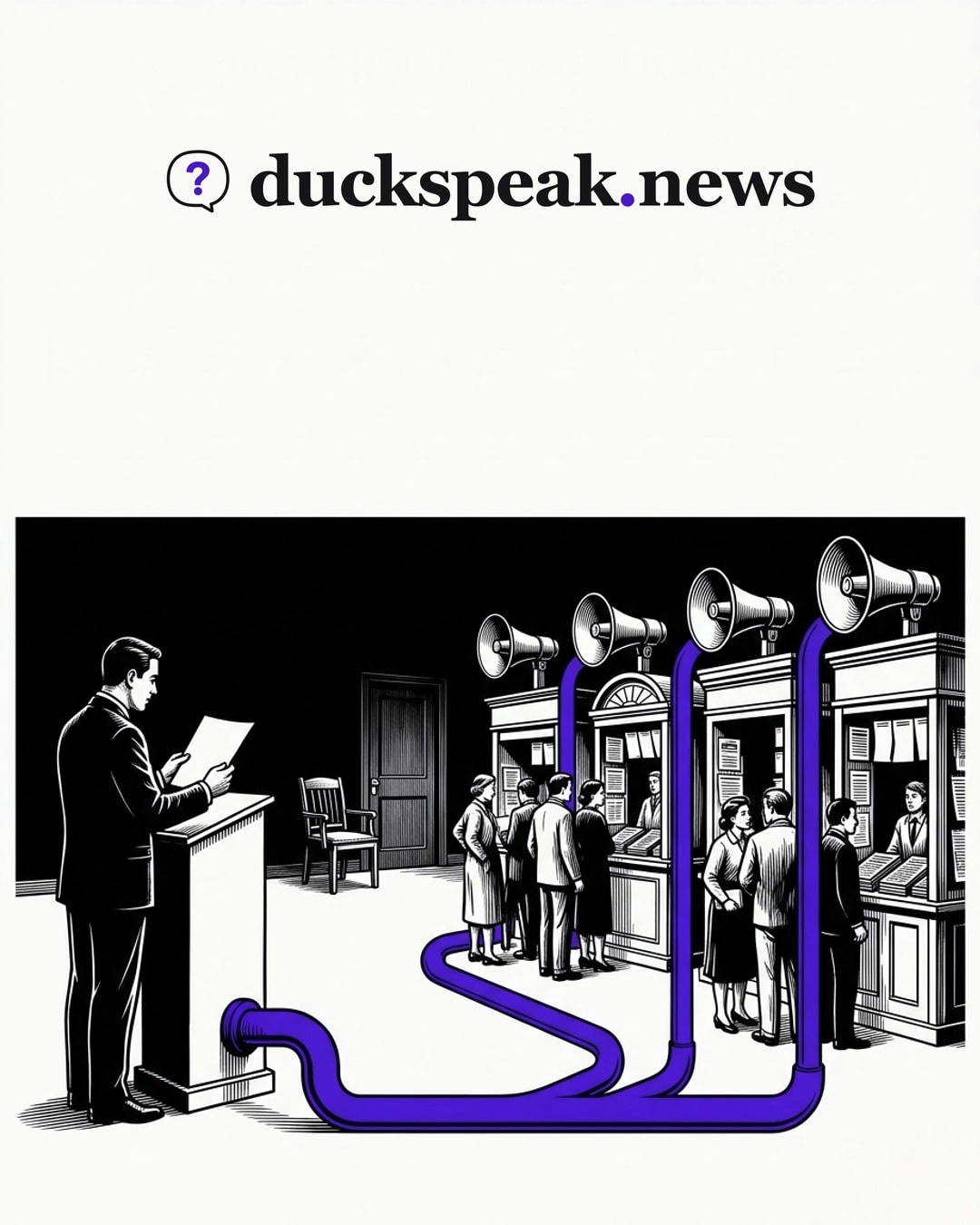
One account, read out four times
All four stories come from one place. ABC News works from “the newly unsealed indictment” [1]. The Guardian and NBC News work “according to a press release” from the US attorney’s office [2][4]. The New York Post runs a wire story under its own masthead, credited “By Associated Press” [3]. Each outlet attributes carefully, and that deserves credit. Side by side, though, they give the reader the same account four times. The victim list comes back almost word for word: “a pet food company headquartered in Florida”ChurnalismChurnalism is a press release, wire feed, or one outlet's unsourced reporting republished under several bylines and read by the public as independent confirmation. [1], “a pet food company in Florida” [2], again [3], and again [4]. The FBI quote runs in full in two of them, “As criminals continue to weaponize emerging technologies” [2][3], and the line about converting funds to cryptocurrency “in an attempt to conceal the source, ownership, and control of the stolen proceeds” is pasted into two more [2][4].
This is a mild form of churnalism. Nobody hides the source, but four mastheads can feel like four independent checks. Here they are one prosecutor’s filing, read aloud. Only the AP copy shows anyone asking the other side: “Lawyers for Soall and Sheetrit did not immediately respond,” and “It was not clear whether Hazan had an attorney” [3]. ABC, the Guardian and NBC give no sign they asked. A quick test for next time: count how many paragraphs end in “according to” the same document.
Same release, different sizes
Where the copies do differ, it is on the size of the scheme. The AP version says the trio “targeted thousands of companies across the world” [3]. ABC says “numerous companies” [1], the Guardian “various companies” [2] and NBC “several companies” [4]. “Thousands” and “several” describe very different operations. None of the stories quotes the indictment’s own wording, so a reader can’t tell which one is faithful to it. NBC alone adds “an investment bank in New York” to the victims and Hazan’s alleged boast that he had “laundered over $400 million in just the past three years” [4]. These details may well be in the release, but the other three left them out, and nobody explains why the numbers differ.
Where the allegation becomes the fact
The Guardian starts out hedged: the men “allegedly acted as a corporate executive” [2]. Then the hedge disappears. The men “were arrested for using AI”Certainty upgradeA certainty upgrade restates a source's claim in the outlet's own voice more firmly than the source made it: a hedge, a limit or a caveat in the original disappears in the retelling. [2], when what happened was that they were arrested on charges of doing so. A paragraph later: “The men ultimately stole more than $129m” [2], and then, with no attribution at all, “The men also stole over $11m from a UK tech company” [2]. That is a certainty upgrade: the prosecutors’ claim, which is still only a charge, comes out in the outlet’s own voice as a finding. Compare the same figures elsewhere. ABC writes “The scheme allegedly stole $4,829,580” [1], and NBC writes “The U.S. attorney’s office alleges the scheme stole” [4]. The Guardian has the same source; the difference is in the telling. A reader who skims the middle of its piece comes away with a conviction that no court has delivered. The AP headline in the Post leans the same way, an “AI scheme used to impersonate CEOs, attorneys to steal $129 million” [3], although “3 charged in” keeps it tied to the charge and the body says “accused of” [3].
The word that went missing
NBC quotes the US attorney exactly: “SI technology offers tremendous potential,” and adds that “SI” is “an abbreviation for super intelligence, the White House’s preferred term for artificial intelligence” [4]. ABC prints the same statement as AI technology “offers tremendous potential” [1], with “AI technology” placed outside the quotation marks. So it doesn’t misquote, but it quietly replaces the speaker’s word. The Guardian paraphrases it as “artificial intelligence had great potential” [2]. The statement’s closing warning about “the emerging threat of SI-enabled crime” appears only in NBC [4].
This is the reverse of the usual problem. The newsrooms didn’t adopt official vocabulary; they cleaned it up without saying so. The effect still matters. Readers of ABC and the Guardian never learn that a federal prosecutor is using a grander political rebrand of an everyday technology in a criminal case. Orwell’s point was that renamed words change what people can think about. You can only notice a renaming if someone shows it to you. The claim about the White House’s preference is NBC’s alone, and the other outlets neither confirm nor dispute it.
The headlines put AI at the centre. The details underneath are older tools: emails “purporting to be from the CEO,” calls where AI mimicked “the voice and sometimes the image” of executives, and a “handwritten script titled ‘Lawyer Call’” [3]. None of the stories says how much of the money depended on the synthetic voices rather than on ordinary deception.
Rocky Balboa in paragraph two
ABC gets the nickname into its second paragraph: Soall “called himself ‘Rocky Balboa’” [1]. The AP copy lists “‘Rocky Balboa,’ ‘Superman Cash’ and ‘Fat Boy’” [3], and NBC adds “Impossible Mission” [4]. The aliases come from the release and are real details. Put up front, they make a fraud case read like a caper, in the way Huxley warned of, where serious things arrive as entertainment. On the Post’s page, the story sits beside links to “‘monster’” and “Shocking moment” crime stories [3], which pushes it further toward spectacle.
What a reader would need instead
6 checks to run on the next story like this one.
-
Recovery: whether any of the $129 million has been frozen or returned. None of the four stories says.
Gap in the coverage
-
The defence: whether the defendants have lawyers, whether they contest extradition, and what they say. Only AP asked.
-
Scale: the indictment’s own wording on how many companies were targeted, since the coverage ranges from “several” to “thousands.”
Gap in the coverage
-
The victims: which institutions they are (hospital systems and a bank among them) and whether they will comment or say what controls failed.
-
Context: this is a well-documented type of fraud. The FBI’s Internet Crime Complaint Center publishes yearly loss figures for business email compromise, which would show whether $129 million is unusual. None of the stories names that category.
Gap in the coverage
-
Vocabulary: whether “SI” appears in the indictment itself or only in the press statement, and why a prosecutor’s office uses it.
Gap in the coverage