

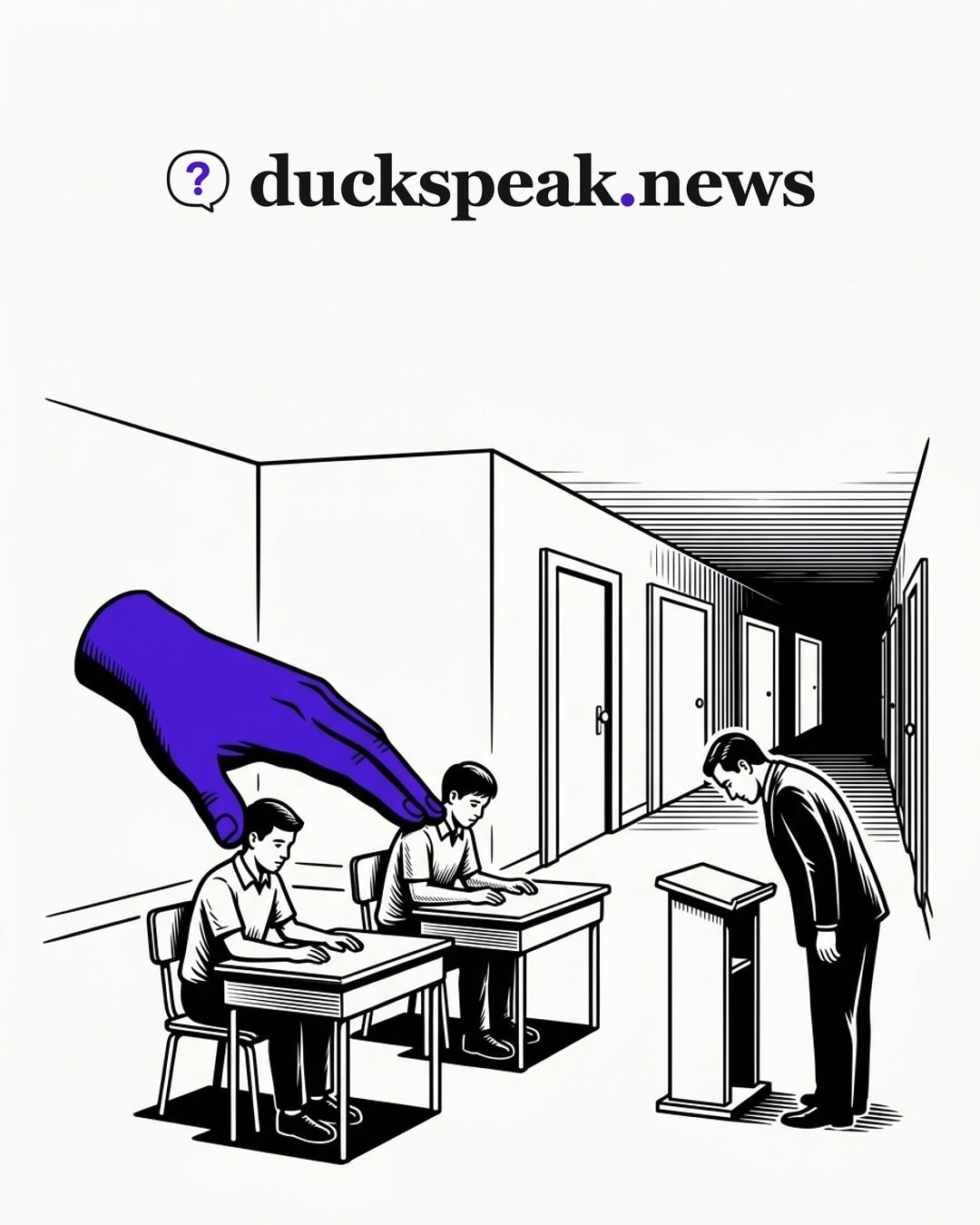
A pressure with no hands
All three headlines describe the same harm in the same grammar. The Guardian has refugees “who were told to study RussianAgentless passiveThe agentless passive is a sentence built so the action happens with no one doing it.” [3]. The Daily Express has “Ukrainian children told to study Russian in British schools” [1]. This is the agentless passive: the children are the subject, and whoever did the telling never appears in the sentence. From the headline, a reader can’t tell whether this was a teacher, a school’s policy, a council or a department.
The agentless passive is a sentence built so the action happens with no one doing it.
The apology works the same way. In the Guardian’s account, Gould says she is “really sorry that they were put in that position” [3]. The Express version goes further and makes the children the cause of their own situation: “I am deeply sorry they found themselves in that situation” [1]. One sentence names the people who did it. The 2024 letter from Kyiv’s education ministry, quoted in two outlets, says children were “being pressured by their school staff” [3]. No outlet takes that up. None says how many schools, how many pupils, whether any guidance from the Department for Education was involved, or why staff would steer pupils towards Russian at all. A government is apologising here, and none of the three outlets asks what it is apologising for: what its department did or failed to do. When a story is built around an apology, check whether the sentence says who did the thing being apologised for.
From “pushed” to “forced”
The only reporting from the room is the Guardian’s. There the minister says students were “pushed into having to do Russian” [3]. The children’s own accounts vary. Vitalii Andronik was “urged” [3]. Sofiia Chonka “just said ‘no’” [3]. The Independent’s standfirst quotes the word “pushed” [2], but its first line, in its own voice, says children “were forced to take a Russian GCSECertainty upgradeA certainty upgrade restates a source's claim in the outlet's own voice more firmly than the source made it: a hedge, a limit or a caveat in the original disappears in the retelling.” [2]. That is a certainty upgrade. The minister’s word, the ministry’s “pressured” and the children’s own stories all leave room for refusal, and one of the two children quoted did refuse. “Forced” leaves no such room.
The Express gets there by another route. Its quote from Gould reads “Many students were effectively forced to choose Russian” [1], the same move again. That wording is not in the Guardian’s version of the same remark. The Express does not say where it got the quote, and nothing in the material shows whether Gould said it in both forms. Readers should treat the Express wording as unverified, not as a second quote that confirms the first.
“Fury” nobody voiced
The Express headline begins: “FuryAdjective inflationAdjective inflation is a dramatic modifier ('fiery denial,' 'bombshell') bolted onto a flat, uncontested sentence to make it read as a conflict story. as Ukrainian children told to study Russian” [1]. Strictly, “fury” is a noun, but it is doing the job of adjective inflation. No one in the article is furious. Andronik “welcomed the announcement” [1]. Chonka talks about how “beautiful” it is to speak Ukrainian [1]. Ukraine’s minister calls the decision “another step” [1]. The strongest feeling anywhere in the coverage is the Guardian’s report that children found the suggestion “insulting” [3], and the Express does not use that word. The headline sells a row, while the article underneath describes a policy being welcomed. The quick test is whether you can find the person feeling the emotion in the headline. Here you can’t.
One set of interviews, three bylines
The Independent is open about where its story comes from: Gould’s quote is followed by “The Guardian reports” [2]. The Express credits the Guardian only for Andronik’s line. Its other material matches the exclusive closely: the same two teenagers, the same £340,000, the same 2024 letter, and Chonka’s line “It’s such a beautiful thing to be speaking Ukrainian when the Russians are trying to mute youChurnalismChurnalism is a press release, wire feed, or one outlet's unsourced reporting republished under several bylines and read by the public as independent confirmation.” [1], word for word as in [3]. This is a mild case of churnalism. Three outlets on one morning can look like three sources confirming a story. In fact there is one visit to St Mary’s school in west London, written up once and rewritten twice. The rewrites added a stronger verb and a headline emotion, and no new facts.
The Independent’s main addition is a long quote from education secretary Lucy Powell about “connections that transcend borders” [2]. That gives the reader ministerial language in place of an explanation of how the problem arose.
Why there was no Ukrainian GCSE
The nearest thing to an explanation is near the end of the Guardian piece: “The minister said exams board had been nervous about developing a new qualification for a relatively small cohort of studentsBuried ledeA buried lede is the fact that should have organized the whole story, relegated instead to the final sentence or hidden inside someone else's quote.” [3]. That is a buried lede. It points to a structural cause: qualifications seem to depend on whether an exam board judges a language worth the cost. If that is right, the gap had a reason, and other refugee communities could run into the same one. The Independent and the Express leave the sentence out entirely. The Guardian prints it and moves on. Inna Hryhorovych, whose trust is quoted in the Guardian, says she has been asking for this GCSE since 2014 [3]. Readers are not told why twelve years of campaigning, and a 2024 letter from a foreign government, ended with a qualification first taught in 2028 and first examined in 2029 [1].
What a reader would need instead
4 checks to run on the next story like this one.
-
Who did the pushing, and how often. The ministry’s letter names “school staff” [3]. A reader needs to know whether the Department for Education, Ofqual or any local authority ever counted the cases, and whether schools had a reason, such as exam results, to steer pupils towards Russian. None of the articles says, and none says anyone asked.
-
The accurate verb. “Pushed”, “urged” and “pressured” are what the sources say. “Forced” needs evidence that the coverage doesn’t give.
-
How exam boards decide. Ofqual regulates qualifications, and AQA and the other boards decide which ones to offer. If small cohorts are routinely turned down, that matters for every refugee community, not only Ukrainians.
-
Who reported it first. One newsroom was in the room. The others should say so, and quote that newsroom’s wording rather than a different version of it.