
 duckspeak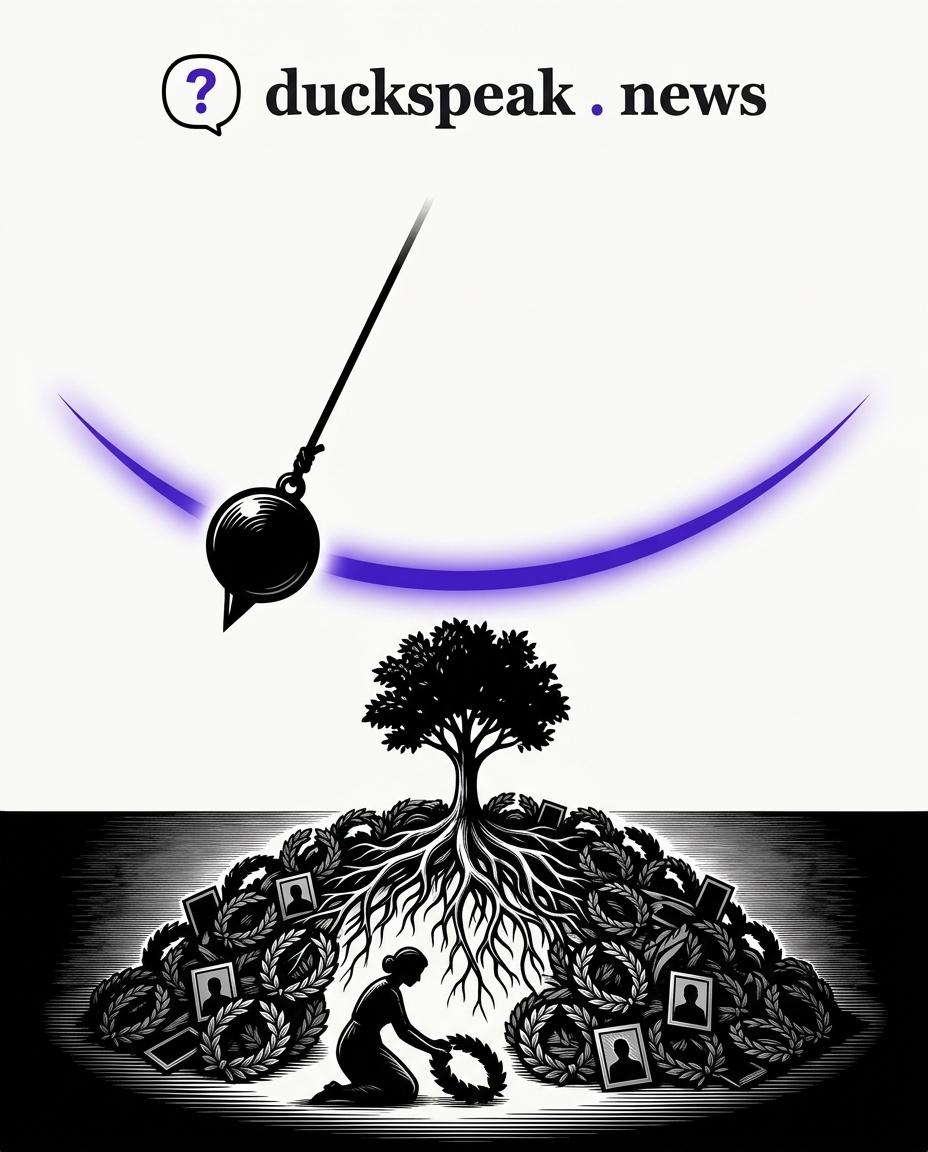
Gloria Steinem died Wednesday at 92, and NPR met the moment with three pieces: an obituary [3], a Fresh Air interview compilation [2], and a tribute roundup running “from Hollywood to Capitol Hill” [1]. The obituary does its job. The compilation is the best thing in the package, and I will come back to why. The roundup is what this critique is about, because the roundup is the piece built for circulation: its unit of content is the embedded social post, its register is gratitude, and it performs a quiet grammatical operation on everything it touches. (One assumption flagged for editors: I treat the roundup as the package’s front door on structural grounds, the embeds and the celebrity roster. Which of the three actually traveled furthest is not knowable from the texts and should not be asserted.)
The lexicon of the exceptional individual
Start with the words. The roundup calls her a “feminist icon” [1]. The obituary headline calls her “trailblazing” [3]. Rep. Katherine Clark, quoted in the roundup, calls her “a trailblazer and a titan for women and the progressive movement” [1]. Hillary Clinton’s tribute, quoted at length, says Steinem “pushed open doors not just for herself, but for literally millions of women behind her” [1]. Sen. Jim McGovern calls her “a bright light to the very end” [1]. Jameela Jamil calls her “a guiding light” [1]. Julianne Moore says her example “offers us all a moral roadmap” [1].
Notice the image family: trails, doors, lights, roads. Every figure is a path; every path has one exceptional person at the head of it and a queue of beneficiaries behind her. This is Great Man grammar, applied with full honors to a woman who spent her life arguing the opposite case in the same outlet’s archive. “Too often we think the tree grows from the top, from Congress,” she told NPR in 2022. “Trees grow from the bottom” [3]. Her account of how her own abortion became speakable is not a story about a titan opening a door. It is a story about a room: she sat in a church as a reporter, listening to other women testify, “and suddenly I thought, ‘Wait a minute, I had an abortion.’” The revelation, she said, “comes from people just telling the truth and discovering you’re not alone” [2].
The icon lexicon is not false, and that is the problem. It is prematurely closed. An icon is a thing you venerate, not a thing you interrogate; once the word lands, the available verbs shrink to honored, remembered, thanked. The Orwellian mechanism here is not a lie but a vocabulary. Praise words do what euphemisms do in reverse: they make follow-up questions feel like desecration. You cannot ask an icon follow-up questions.
The passive that ate the Supreme Court
The roundup’s narration states the fact of rollback once, flatly, in a clause about what Steinem lived to see: she “saw the Supreme Court affirm the right to abortion in Roe v. Wade in 1973 and decades later, overturn it, in 2022” [1]. The feeling about that fact is delegated to a mourner, and the mourner’s sentence is the most revealing in the piece: “I feel such pain that she left in a moment where it appears the rights she fought for us to have are being rolled back” [1].
Two operations in one clause. First, “it appears” hedges a legal event that NPR’s own obituary states as accomplished fact: “the Supreme Court overturned Roe v. Wade, ending the constitutional right to abortion” [3]. Inside one outlet, in one news cycle, the same event is simultaneously a completed judicial act and a weather condition that appears to be occurring.
Second, “are being rolled back” is the agentless passive. Rolled back by whom? The sentence does not say, and the roundup never does. The one passage in the tribute piece that carries the emotional weight of defeat deletes the doer. Orwell’s observation in “Politics and the English Language” is operative here: political writing reaches for the passive precisely when it needs the actor to vanish. Jamil supplies the metaphor that completes the deletion: Steinem “expressed disbelief to me as to how fast the pendulum is swinging back” [1]. A pendulum is the ideal political actor for tribute-speak, because a pendulum is nobody. No one votes; no one confirms; no one signs. Things simply swing.
The roundup’s own narration repeats the move in miniature: Steinem “is credited with helping increase the number of women in elected office” [1]. Credited by whom? The sentence has no answer, because the genre has no room for one.
For contrast, Steinem’s grammar, quoted in the obituary: “we either have decision-making power over our own bodies… or there is no democracy” [3]. Subject, verb, stakes. That is the sentence the tribute register cannot hold.
The euphemism gradient
The same event appears twice in this package, at two temperatures. In the roundup, Steinem’s abortion is a clause: she is credited with normalizing talk of “abortion, after sharing her experience getting one abroad in the 1950s” [1]. In the compilation, the same event is testimony: “I had been doing all of the foolish things that we then did [to terminate a pregnancy], like riding horseback, throwing ourselves down stairs… I was desperate. I really was desperate” [2]. She recalls the legislative hearing that the speak-out was organized to answer: “in the Legislature they asked 14 men and one nun to testify” [2].
A roundup cannot carry every detail, and no one should demand the stairs in an item built from Instagram posts. But the distance between the two renderings, inside one outlet in one news cycle, is the distance between tribute-speak and testimony, and it shows what the genre must smooth in order to function. “Abroad” is pastel. The stairs are an argument about law.
‘Continuing her work’
The roundup reports that the mourners are “vowing to continue her work” and posted about “the importance of continuing her work” [1]. The phrase appears twice. Nowhere does the piece say what continuing it would consist of, or who is currently stopping it. This is duckspeak in the strict Orwellian sense: a phrase quacked because it is expected, carrying sentiment and no operational content. To vow it is to have done it. The Huxleyan reading is sharper still. The roundup’s actual content, item by item, is friendship rendered in public: Thanksgiving with the Sussexes, advice given “with a cup of tea and an unrivaled cheekiness and wit,” a silver vulva ring passed from Steinem’s hand to Lena Dunham’s [1]. None of this is illegitimate; these were real friendships, honestly mourned. The question is what the genre does when it becomes the front door of a news package about a person whose life’s argument was structural. The vow is the consumption of the feeling. Post the tribute, feel the resolve, close the tab.
The obituary, to its credit, tries to give “the work” a shape: “When the caucus began, there were 15 women elected to Congress, 363 women state legislators, and only seven women city mayors. Today, those numbers have grown to 150, 2,476 and 428, respectively” [3]. But the counts arrive without denominators: no proportions, no benchmark, no standard against which growth is measured. A rising line is offered and the reader is invited to stop asking. (Editorial note: I have not verified these counts against outside sources; the critique concerns the absence of a measure, not the accuracy of the numbers.)
The Equal Rights Amendment, which the compilation says the National Women’s Political Caucus “lobbied for” [2], appears in the obituary only inside a 1978 photo caption about a ratification deadline extension [3]. What became of it is stated nowhere in the package. (Editorial note: this is an omission claim, checked against all three texts; they genuinely never say. A reader must leave NPR to find out, which is rather the point.)
The paragraph that resolves itself
The obituary contains one controversy and handles it in three sentences: Steinem “was briefly involved with a CIA-backed organization that sent American students to Soviet-sponsored youth festivals,” which “would become a point of contention for some feminists later in Steinem’s career. She defended her role, asserting that the CIA never attempted to alter the organization’s policies” [3].
Care is required here, because this is where a critique can slide into insinuation, and I decline the slide. The observation is formal, not factual. The obituary names a controversy, reports the subject’s own defense as its resolution, cites no other assessment, and moves on to the Playboy Club. The subject’s assertion is the last word on the subject. That is a convention of the obituary genre, not evidence about Steinem or the CIA, and the article gives the reader nothing further to go on. Which is the finding: the one contested episode in the career is introduced and closed inside a single paragraph, in a piece whose register otherwise admits no contest at all.
The release window
The roundup’s final news paragraph is a product announcement: “Steinem’s second memoir, An Unexpected Life, is set for release later this month” [1]. All three pieces close with the boilerplate that “NPR does not offer or accept money for coverage or interviews” [1][2][3].
There is no accusation here and I am not making one; the memoir note is factual and standard practice. But the juxtaposition deserves a sentence of the reader’s attention. A tribute piece assembled from celebrity gratitude ends by announcing a commercial product, above a disclaimer marking the precise boundary between coverage and money that the announcement approaches. Presumably the boilerplate exists because death coverage is a genre where that boundary has historically needed marking. In Huxley’s world this requires no conspiracy, only an ecosystem in which even death has a release window and grief is a marketing moment no one has to plan.
The antidote is in the archive
The irony that makes this package worth dissecting, rather than merely disliking: NPR’s own compilation contains the most precise critique of the roundup’s register that I could write, and Steinem delivers it herself, about the magazines of the 1960s. She and other women could not write politics, she recalls; they were “thought to be the experts on, you know, food, makeup, babies and celebrities” [2]. And when a feminist article was proposed, the editors answered: “If we’re going to write one article saying that women are full human beings, we’ll have to publish one right next to it saying they’re not in order to be objective” [2].
That sentence is the Newspeak mechanism named by its target, half a century in advance. “Objectivity,” deployed as a quota on truth: a word whose official meaning is fairness, operating as an enforcement mechanism for the status quo. The roundup is the gentler descendant of the same machinery. It does not say women are not full human beings. It accomplishes the same deletion more pleasantly: a structural analysis of power converted into an inspiration item; defeat phrased as a pendulum; work that will be continued by nobody in particular.
What a reader would need instead
Three things, all checkable outside the tribute genre. For the officeholding numbers, the Center for American Women and Politics at Rutgers tracks counts and shares of women in Congress and the state legislatures; the obituary’s raw figures could have carried a denominator in one line. For the state of the rights the mourners vowed to continue defending, the Guttmacher Institute tracks abortion policy state by state, which is where “rolled back” acquires agents, dates, and names. For the ERA, whose fate the package leaves inside a 1978 caption, the reader will have to leave NPR entirely.
None of this requires less respect for the dead. It requires more grammar: name the agents, give the denominators, and let the woman’s own structural vocabulary into the headline once. “Trees grow from the bottom” [3] is a better sentence than “trailblazing” [3], and it was sitting right there.