

The package
Read the American coverage of the 9/11 quarter-century as a single package and it has a consistent shape. A steel beam toured the country for months and ended up at the Ellipse, where a president spoke beside it [2][6]. Chefs fed Ground Zero workers by barge for two months [4]. Michael Strahan watched the first tower burn from a window in Montclair [5]. Secret Service agents moved a president and a vice president out of harm’s way [3]. The NYPD unveiled a memorial wall at One Police Plaza [1]. Five of the six American pieces are from ABC, and the sixth is Fox [1][2][3][4][5][6]. The seventh article, from the BBC, is the only one about accountability, and it reads as though it were filed from a different planet [7].
Start with the most concrete artifact: the promo splice. Three of the ABC pieces stop mid-story to run the same paragraph: “9/11 Tribute in Light: Live from Lower Manhattan,” a one-hour ABC News multiplatform live special, premieres on Friday, Sept.11, at 8:00 p.m. ET across ABC, Disney+, Hulu, National Geographic, ABC Owned Television Stations livestreams and ABC News Live [3]. It recurs in the chefs piece and the steel beam piece [4][6]. In the Secret Service story it lands between the director weighing “the possibility of a decapitation attack” and two agents racing into the North Tower [3]. In the chefs story it lands between a man finding a dictionary page in the debris and his explanation that it “came straight from heaven” [4]. The Strahan piece promotes a second special, “9/11: United We Stand,” on ABC, Disney+ and Hulu [5]. Every ABC piece closes with the same stamped sign-off, “24/7 coverage of breaking news and live events” [2][3][4][5][6]. Fox does the same work in its own idiom, interrupting the chief of department’s remarks with an all-caps announcement of “EXTENSIVE 9/11 ANNIVERSARY COVERAGE FROM GROUND ZERO, PENTAGON AND SHANKSVILLE” [1].
This is the Huxley half of the mechanism, and it is not subtle. The anniversary is a programming event. The grief is real, and the grief is also the lead-in. A news story that pauses a survivor’s anecdote to list six platforms is a feelie with a news budget.
One register
Then the emotional frequency, which never varies. “New York is strong, New Yorkers are strong” [4]. Derek Jeter: “Our job was to bring joy, especially to New York at that time” [5]. Letterman: “There’s only one requirement of all of us, and that is to be courageous” [5]. The Secret Service piece closes on an unnamed agent’s reflection that “the chain of command stayed unbroken, the leaders stayed alive, and the country knew someone was still standing guard” [3]; the piece is written by a retired Secret Service agent, as its footnote discloses, and its most thematic line belongs to no one in particular [3]. Note what that story treats as its stakes: the Continuity of Operations Plan, Presidential Decision Directive 67, the survival of the command structure [3]. The state’s continuity is narrated as the country’s protection, and the emotional payoff is an unattributable sentence confirming that it went smoothly.
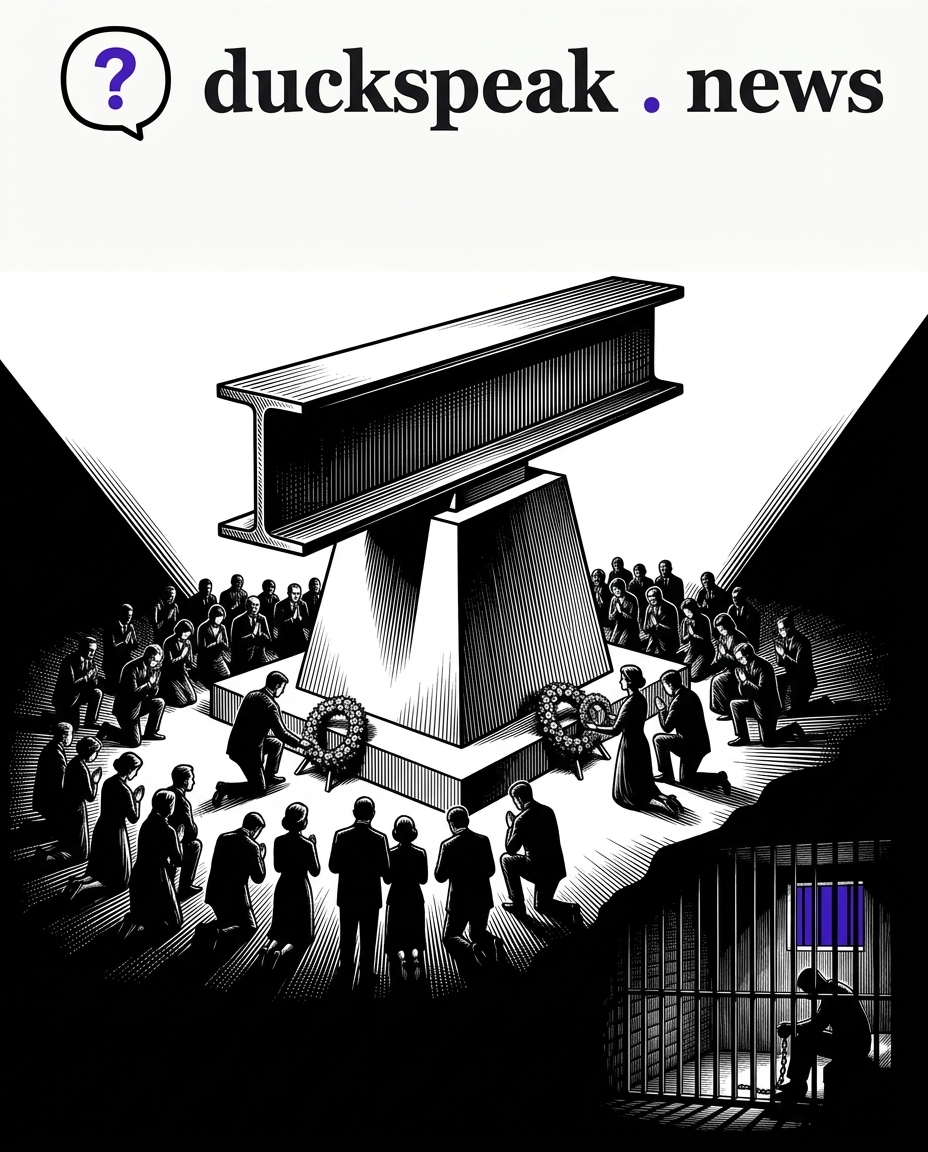
The steel beam piece is the fullest liturgy. Children were “praying over this steel” [6]. “It once held up the Twin Towers, it once held floors and walls, and now it holds the gravity of that day” [6]. Frank Siller says the steel “embodies his soul, and the souls of so many” [6]. None of this is false. The chefs really cooked, the families really grieve, the beam really is a relic. The critique is not of the mourners; it is of the arrangement. Veneration is the only register on offer, and in a cathedral nobody asks questions. Orwell’s Two Minutes Hate was engineered emotion on a schedule. This is its mirror: engineered grief on a schedule, and the schedule is the programming calendar.
The number without the cause
The Fox piece looks like the exception, because it carries the hardest numbers in the American package: “more than 469 members” of the NYPD lost “to illnesses connected to their service after the attacks,” and more than 1,700 retired with World Trade Center disabilities [1]. It also contains the truest sentence in the entire American coverage, from the department’s chief chaplain: “Sept. 11 did not end on Sept. 11” [1]. But the frame is inheritance. “Whatever rank we reach, whatever command we lead, we are standing on the foundations other people built” [1]. “The faces in this building will be different, but these names will still be here” [1]. The illness deaths are folded into legacy, the long tail of sacrifice, rather than treated as a policy failure with a paper trail.
What paper trail? Here the evidence in front of us is thin, and we should say so rather than smooth it over. The BBC’s own page links to a story headlined “New Yorkers were ‘lied’ to about toxic air after 9/11 attacks, says Mamdani” [7]. That is a headline, not article text; the coverage does not establish what Mayor Mamdani said, or where, or when. What is verifiable is this: Fox quotes Mamdani at length at the memorial ceremony [1], the same mayor, and the American package reports an illness death toll in the hundreds [1] while carrying no mention anywhere of the air-quality assurances given to the people who worked the pile. The number is printed; the cause is not; the question is not asked.
The frame absorbs everything
ABC’s Ellipse story shows the commemorative frame absorbing whatever passes through it. Trump warned of the country turning a “communistic way”; ABC notes the remarks “briefly dipped into the political” and returns, immediately, to the beam [2]. He recounted two firemen who “grabbed me under the arms” and ran with him from the site; ABC adds one honest sentence, that “It wasn’t clear from Trump’s comments precisely when the event he described occurred” [2]. The hedge is real; the frame is undisturbed either way. Partisan attack and self-mythology pass through the ceremony without changing its tone, because the tone is the product.
The story that is missing
Now the BBC piece, which functions as the control group. Its opening does what none of the six American pieces does: “a quarter of a century on, the trial of its alleged mastermind is yet to begin” [7]. Khalid Sheikh Mohammed “has now been held there for 20 years without ever being convicted”; the pre-trial process “has now been presided over by five different military judges”; a trial date was finally set for June 2028 [7]. Days after that date was set, the military judge threw out Mohammed’s confessions, having described his CIA treatment as “extraordinary physical and mental abuse” and ruled the confessions involuntary [7]. Prosecutors, the BBC reports, lose what they had described as their best evidence [7]. An international law professor told the BBC: “Every single issue has been litigated through the issue of torture” [7].
And here is the Newspeak artifact, sitting in plain sight in the BBC’s timeline: “During the George W Bush administration, the US admitted using ‘enhanced interrogation techniques’ to acquire information from suspects but said these methods saved lives and never amounted to torture” [7]. One official phrase, built to pre-empt the word it replaces. Two decades later a military judge describes the same conduct as extraordinary physical and mental abuse, and the case continues without its central evidence [7]. The families see the mechanism exactly. Stephan Gerhardt: “If we would’ve not tortured them, the legal implications here would’ve been much, much simpler. They probably would’ve been sentenced to death a long time ago” [7]. Brett Eagleson: “a sense of betrayal from the US government,” and “They’ve botched every single part of this trial” [7].
None of the six American pieces mentions the trial, Guantanamo, or torture. Not in passing, not in a paragraph. The event where a president pledged to “never forget” [2] and the special called “United We Stand” [5] sit in the same portfolio as a silence about the only live 9/11 story in which the US government is the actor under examination.
The mechanism
This does not require a conspiracy, an editor’s memo, or bad faith in any single story. It requires a register. “Never forget” functions here the way slogans function in Orwell: it names memory while structuring omission, holding the fact and dropping it in the same motion. You cannot print “Sept. 11 did not end on Sept. 11” [1] and, in the same body of coverage, carry nothing about a trial that has not begun because the state tortured the defendants into unsuppressable evidence [7], unless the slogan has come to mean its own performance. The remembering is the annual content. The content is the forgetting.
What a reader would need instead: the BBC account, which names its sources, from the military judge’s ruling to the Edinburgh law professor to the author of a book on the case, and lets the families speak of betrayal rather than only perseverance [7]. Also the commission proceedings themselves, which the BBC describes as open enough that relatives enter a lottery to attend and reporters watch through thick glass [7]; the record exists even when the anniversary package has no slot for it. For the illness toll, the NYPD’s own figures as reported by Fox [1] are the starting point, and the question worth asking is who assured the responders the air was safe.
The steel beam will keep touring [6]. The specials will keep premiering across six platforms [3][4][5]. The wall will hold the names [1]. And at Guantanamo, a man the US government calls the mastermind of “the most egregious criminal act on American soil in modern history” [7] will wait, a quarter century in, for a 2028 trial date that the families themselves are bracing to see slip [7]. The chaplain was right. Sept. 11 did not end on Sept. 11 [1]. The anniversary coverage is the forgetting, performed annually.