

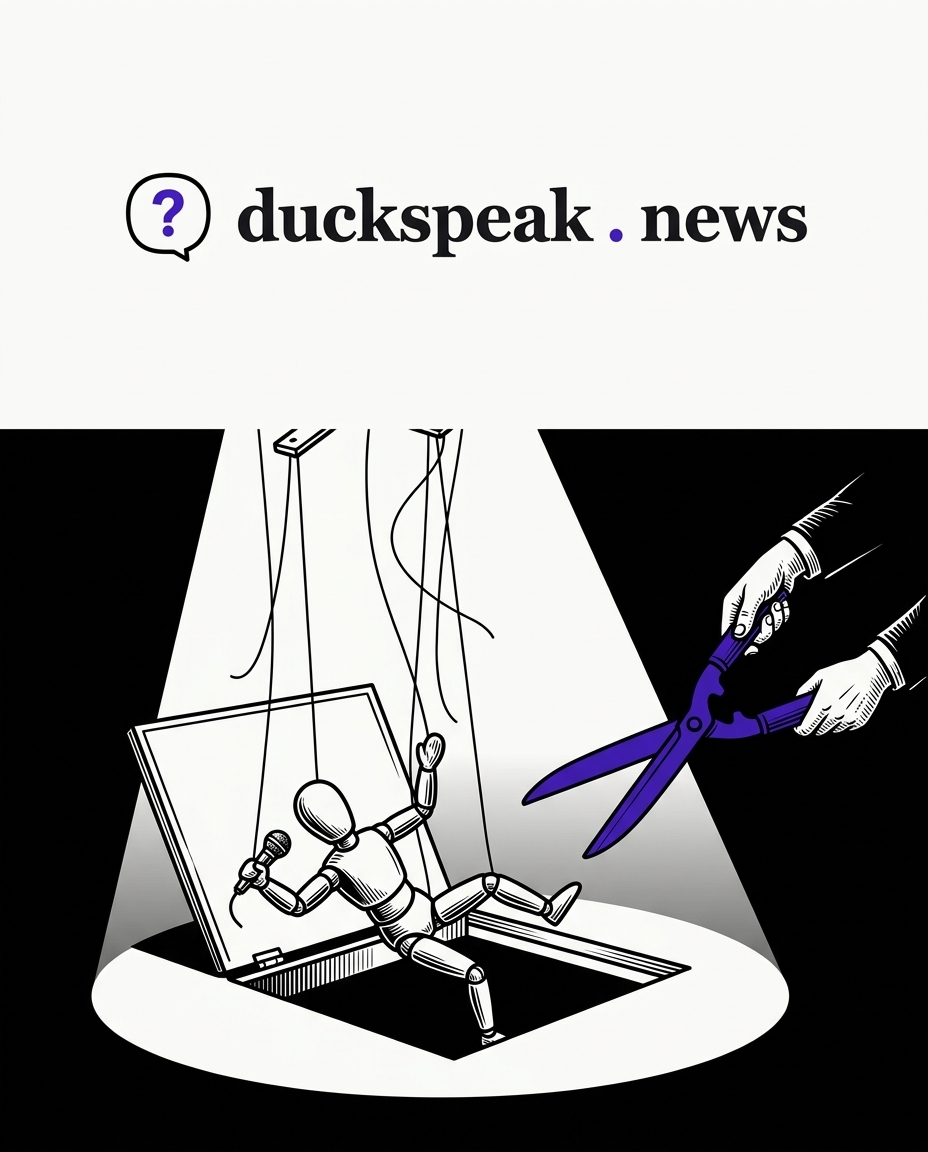
Nobody dropped Macklemore
Three outlets on two continents produced the same headline grammar within hours. BBC: “Macklemore dropped from Ed Sheeran tour after ‘free Palestine’ speech” [2]. The Guardian: “Macklemore dropped from Ed Sheeran’s US tour after ‘free Palestine’ speech” [4]. Rolling Stone: “Macklemore Dropped From Ed Sheeran Tour After Onstage ‘Free Palestine’ Statements” [5]. Passive verb, no agent, and an “after” clause that assigns the cause to the speech itself. Robert Kraft, the billionaire who confirms inside three of these articles that he barred the rapper from his stadium [1][2][4][5], appears in none of the six headlines. Rolling Stone’s follow-up at least names “Venue, Promoter” as the decision-makers [6]; the other five name no one. BBC’s follow-up is a pure denial of agency: “Ed Sheeran says it was ‘not my decision’ to drop Macklemore from tour” [1]. The Guardian’s swings the other way, headlining “backlash over removing Macklemore from tour” [3], attributing to Sheeran an act its own article reports was the venues’ and promoter’s final call [3]. Not Sheeran, then, except when he is. Not Kraft, though he says so himself. Nobody dropped Macklemore. He was dropped.
This is duckspeak in its purest form: not coordination, but reflex. Three newsrooms reached for the same construction because the construction was already lying there.
The agent is known, named, and on the record
Macklemore’s statement, as quoted by Rolling Stone: “Ed also told me that Kraft had rallied some of the other stadium owners and collectively they gave him an ultimatum: if Macklemore stays on the tour, you will not be allowed to play in our venues” [5][6]. Kraft confirmed his own ban, saying his stadium would not “provide a platform for hate speech” [1][2], but, as the BBC notes, “he did not address the claim that he’d asked other venues to put pressure on the tour” [1]. So the question of coordination is open, and documented as open [1][5][6]. The headlines resolve it anyway, in the direction of nobody.
The hedging inside the copy is stranger than the headlines. Rolling Stone reports that “several venues allegedly told the trek’s promoter that they would not allow the rapper to perform” [5], in an article that prints the promoter’s own on-record statement: “we have been notified by venues on the upcoming U.S. tour dates that they will not allow a concert to take place with Macklemore on the lineup” [4][5]. The Guardian does the same, writing of “the venues that allegedly objected” [4] paragraphs after quoting that same confirmed notification [4]. When the actor is a stadium owner, a confirmed notification becomes an allegation. The BBC opts for massage vocabulary instead: “some venues put pressure on the tour promoters to have him removed from the line-up” [1]. In the same article, the Israeli American Council “launched a petition demanding his removal” [1]. The demand is called a demand; the ultimatum is called pressure.
The BBC’s body copy states the full causal chain, and then the headline amputates it: “His comments drew criticism from Jewish groups, after which some venues put pressure on the tour promoters to have him removed from the line-up” [1]; “After days of press coverage, Macklemore announced on Monday that he had been dropped” [1]. Speech, backlash, ultimatum, removal: four links. The headline keeps the first and the last and drops the two in the middle, which is where every decision-maker lives. Note that third link, “after days of press coverage”: the coverage is in the chain, and the outlet describes its own link in it as weather.
“Political” is the bouncer at the door
What Macklemore said, verbatim, appears in all six articles: “Free Palestine” [1][2][3][4][5][6], and “Criticism of Israel, criticism of apartheid, being against genocide, is in no way a criticism of you” [1][2]. The BBC sorts this into a category: he “was ejected from the line-up after making pro-Palestinian statements” [1]; he was criticized “after saying ‘Free Palestine’ at two concerts and making political speeches” [2]. Even the verb “ejected” [1] conjures a hand without naming one. Once the speech is “political,” the exclusion writes itself. The Israeli American Council supplies the rule: this was “not a political rally, not a protest, and not an activist event” [2]. Sheeran supplies it too: “Those who come to my shows do not expect a political forum” [1][6].
This is the Newspeak mechanism Orwell described from the inside: you do not need to forbid a statement if you can reclassify it so that forbidding it requires no argument. And the valve turns one way only. Kraft, who “created the Foundation to Combat Antisemitism” in 2019 and is “a longtime supporter of the state of Israel as well as its ally in the White House, Donald Trump” [4], is a political actor barring a performer from a stage he owns. No article calls that act political. The BBC’s Kraft is the billionaire owner of Gillette Stadium “who once hired Ed Sheeran to play at his wedding” [1]; the Guardian’s Kraft is a Trump ally and Israel donor [4]. Both are facts. Only one biography explains why the stage changed hands.
Even Sheeran’s own statement concedes the objection was to form rather than content: “I was informed this stance was based on how Macklemore conveyed part of his message during his performance, rather than on everything that was said” [3]. And Macklemore’s account locates the actual variable: “What I said at MetLife I have been saying on stages around the world for almost three years… So why is it an issue now? Because now I’m sharing the stage with one of the biggest artists in the world” [4]. The words were constant. The reach changed. The headline formula, dropped after speech, inverts this: it treats the constant as the cause and hides the thing that moved.
“I am not complicit,” transcribed everywhere, examined nowhere
Every outlet quotes Sheeran’s “I am not complicit” [1][3][6] and his “suffering and pain caused on both sides is a human tragedy” [1][3][6]. None observes that the tour continues without Macklemore, or that accepting an ultimatum is itself a decision. Macklemore’s rebuttal is quoted and left unconnected: “there is no neutral position between the oppressor and the oppressed” [1][2]. Sheeran’s “activists on both sides” [3][6] performs an equivalence the events do not support: one side had signatures; the other had the deeds. The outlets sequence these quotes like tennis rallies and never let them collide.
The boilerplate paragraph as auto-rebuttal
The BBC inserts its standard paragraph, “Israel rejects allegations of genocide. It says its troops conduct self-defence operations in Gaza and the occupied West Bank in accordance with international law,” immediately after Macklemore’s words about apartheid and genocide [1][2]. Placement does the work of rebuttal. The death toll is attributed to “the territory’s Hamas-run health ministry, whose figures are considered reliable by the UN” [1][2]; the “Hamas-run” label arrives before the reliability concession, so the hedge leads and the trust trails. The Guardian offers only “according to some estimates” [3], vaguer than the BBC’s named source. Rolling Stone alone, in a parenthesis, reports that “Humanitarian groups and a United Nations commission have said Israel’s actions in Gaza constitute a genocide” [5]. A reader who finishes the BBC or Guardian pieces never learns that a UN commission has said this on the record. Macklemore’s own analysis, that conflating “Free Palestine” with hatred of Jewish people “protects Israel from accountability” [2], is the sharpest sentence in the episode, and it runs once, in one outlet, unexamined.
The Huxley layer
The BBC gives a paragraph to the backlash against Pink, “critics taking aim at everything from her parenting style to past comments about women like Paris Hilton, Britney Spears and Christina Aguilera” [2]. The structural fact, stadiums refusing a performer, is sandwiched inside celebrity furore. This is the Brave New World function: the story is not suppressed, it is drowned in adjacent trivia until a blacklist reads as showbiz.
What a reader would need instead
Rolling Stone alone reports that most of the objecting venues “are owned and, in many cases, operated by cities, states, or other government entities, potentially raising First Amendment issues if the venues barred Macklemore over his statements” [5]. Government-owned stadiums excluding a performer for protected speech is a constitutional story. It gets one sentence, in one outlet, in no headline, and nothing at all in either BBC piece.
Also at the tail of Rolling Stone: the tour’s final venue, Raymond James Stadium in Tampa, “earlier this year hosted two shows by Ye,” whose promoter “included a clause in his contract prohibiting Raymond James Stadium from canceling the gigs based on the rapper’s past public statements or viewpoints”; the shows “went ahead as planned” [5]. Rolling Stone even marks the fact “Pointedly” [5], then leaves it in the closing paragraphs. The Guardian mentions the Ye shows in a sign-off line [3][4]; the BBC never mentions Ye at all. A rapper with what the Guardian itself calls “a history of antisemitic statements” [3][4] played the stadium; a rapper who said “Free Palestine” was confirmed out of it by the venue’s own authority, the Tampa Sports Authority [5]. If “hate speech” is the stated criterion for exclusion [1][2], Tampa is the test case, and it points the other way. No outlet makes the comparison the story.
Critique’s caveat
The Guardian reports that opener Aaron Rowe “announced that he would be withdrawing from the tour” [3]; both Rolling Stone pieces still list “Lukas Graham and Aaron Rowe” as the continuing openers [5][6]. Both cannot be current. Separately, three outlets note that Kraft did not answer the claim he rallied other owners [1][5][6], and none reports asking the other named stadium owners directly. The central factual question, coordination or coincidence, is documented as open across six articles and investigated in zero.
The headline grammar is the verdict. “Dropped” happened to Macklemore the way weather happens to a field. The men who say they issued the ultimatum are quoted in paragraph nine and deleted from the grammar of the headline, and six articles across three outlets repeated the deletion without checking it. That is duckspeak: not a conspiracy, a reflex. The passive voice is the sound a decision makes when no one wants to be its subject.