

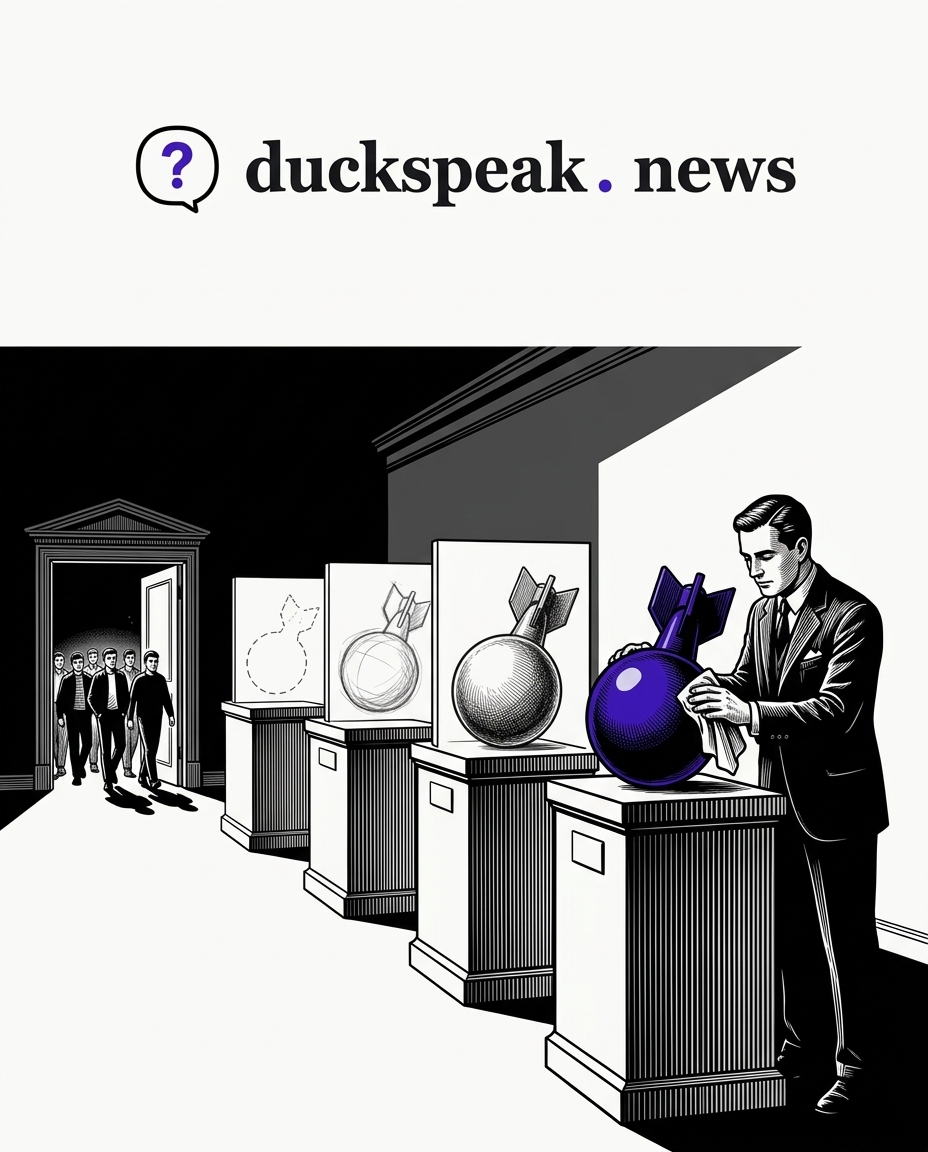
The new arrest is hedged within an inch of its life. The headline says “on suspicion of terror offence” [1]; the police statement says a 27-year-old was arrested “on suspicion of preparation of terrorist acts under Section 5 of the Terrorism Act 2006” [1]; a second man was merely “questioned under caution” [1]. Then comes the closing sentence of news copy, arriving with no attribution, no spokesman, no “according to”: “The Islamic Republic has categorically denied involvement in the terror plot” [1]. The terror plot. Not the suspected plot, not the alleged activity, but the plot, a thing that now simply exists, which Iran is made to deny. Every verb hedges; every noun convicts.
The noun gradient
One event, four nouns, hardening as the page proceeds. The police noun is the vaguest: the arrest concerns “activity that took place close to RAF Fairford on Sunday” [1]. The headline noun is “incident” [1]. The photo caption has Burnham saying Iran played “a part in the plot” [1]. The final line has “the terror plot” [1]. Activity, incident, plot, terror plot: the gradient runs opposite to the evidence, since the further the noun travels from the police statement, the more established it sounds. Nowhere does the report say what the activity was. The only concrete image in the piece is a farmer who “alerted the emergency services after spotting three suspicious vehicles accompanied by a group of masked men” [1]. Everything else is nouns doing work that facts have not yet done.
Note where the adverbs went, too. The accusations all travel on hedges: “suspicion” [1], “possible” [1], “indications” [1]. The one “categorically” in the report attaches to Iran’s denial [1]. The adverbs are honest; the nouns are not. And the one sentence with no attribution at all is the one that states the plot as fact.
Who is saying any of this
The attribution is broken in a way a reader cannot repair. Burnham is quoted at length [1]. The very next paragraph begins: “The Prime Minister’s comments came just a few days after US Secretary of State Marco Rubio said…” [1]. Either the report has mislabeled Burnham as the Prime Minister, or it refers to comments by the actual Prime Minister that it never quotes or introduces. The visible text does not resolve which, and we flag it rather than smoothing it over. Either way the effect is identical: the reader cannot reconstruct which officeholder claimed what. That matters, because the article never states Burnham’s office at all (he is the Mayor of Greater Manchester, an identification the report omits), and a regional mayor’s “strong indications that Iran played a part” [1] carries different weight than a prime minister’s. The Iran attribution rests on a conference aside delivered to GB News’s own political editor [1], plus Rubio’s “clearly involves the hands of a foreign actor,” where “clearly” does the work evidence would do, and where the report itself notes he “did not specify which country” [1].
The most honest sentences belong to the police. Senior National Coordinator Vicki Evans: the investigation is “hugely complex,” teams are “interrogating multiple lines of enquiry,” and they are looking at “all possible angles,” including “possible foreign state involvement” [1]. Two “possibles” in one clause. That is what an open investigation sounds like. Against it, Burnham’s retreat is accidental philosophy: “I hope you’ll understand that I don’t say more at this point, but I wanted to confirm what we can say” [1]. The object of the confirmation is what can be said, not what is known. The sayable is the news.
The nationality that does the naming
The first five men arrested were identified only as being “in their 20s and from London” [1]; no nationality attached. The sixth arrest attaches one, “a dual UK/Iranian national” [1], and it becomes the first descriptive word in the headline: “British-Iranian” [1]. Counter Terrorism Policing released the nationality itself, so this is not invention; the work is placement. Rubio declines to name a state [1]. Evans says “possible foreign state involvement,” unnamed [1]. The officials withhold the country; the headline supplies it, via a passport. The WATCH NOW banner completes the move: “Andy Burnham says ‘strong indication’ Iran played part in RAF Fairford incident” [1]. The hedge survives into the banner, but the name arrives anyway. An earlier piece on this site traced how the first wave of Fairford coverage turned five uncharged men into “the Fairford bomb plotters” inside a guest’s quote, and renamed the base’s raids “defensive”; this page is the next step, because the Iran link has moved from quoted speculation into headline furniture.
The bail nobody notices
Buried mid-report: the five men arrested after the farmer’s call, first on suspicion of explosives offences and later terror offences, “were released on police bail earlier this week” [1]. Five arrests, zero charges. Three paragraphs later the report refers to “the terror plot” [1]. The tension sits in the article’s own copy and goes unremarked. If the plot is a plot, someone is presumably in it; so far no one has been charged with being in anything.
What a reader would need instead
First, the primary record: Counter Terrorism Policing’s own statements, and eventually the Crown Prosecution Service’s charging decision. “Suspicion” under Section 5 of the Terrorism Act 2006 [1] is an investigative step, not a finding, and the report’s nouns should not outrun it. Second, the office behind each claim: which officeholder says Iran played a part, and on what basis; the report names Burnham and Rubio while omitting Burnham’s office and garbling the Prime Minister reference [1]. Third, the facts under all four nouns: what the “activity” at Fairford actually consisted of, since a reader of this report learns of an incident, a plot, and a terror plot, but never an event. Fourth, the American context: the report quotes the US Secretary of State on a Gloucestershire police matter and has Burnham invoking “our colleagues in the United States” [1], without ever explaining what the United States has to do with RAF Fairford; the earlier piece on this site supplied that context, and this report’s readers are left to supply their own. By the time a charging decision arrives or does not, the noun will have done its work. That is how presupposition travels: not in what a report claims, but in what it assumes the reader already believes.
More on RAF Fairford on this site:
- 1 October 2026 Defensive Purposes, Such as Striking: How the Fairford Coverage Renamed a War
- 7 October 2026 The ‘Bomb Plot’ With No Bombs
- 8 October 2026 Safe, Routine, Defensive: The Euphemism Stack at RAF Fairford
- 13 October 2026 Certainty Ratchets; the Evidence Is Still Petrol