

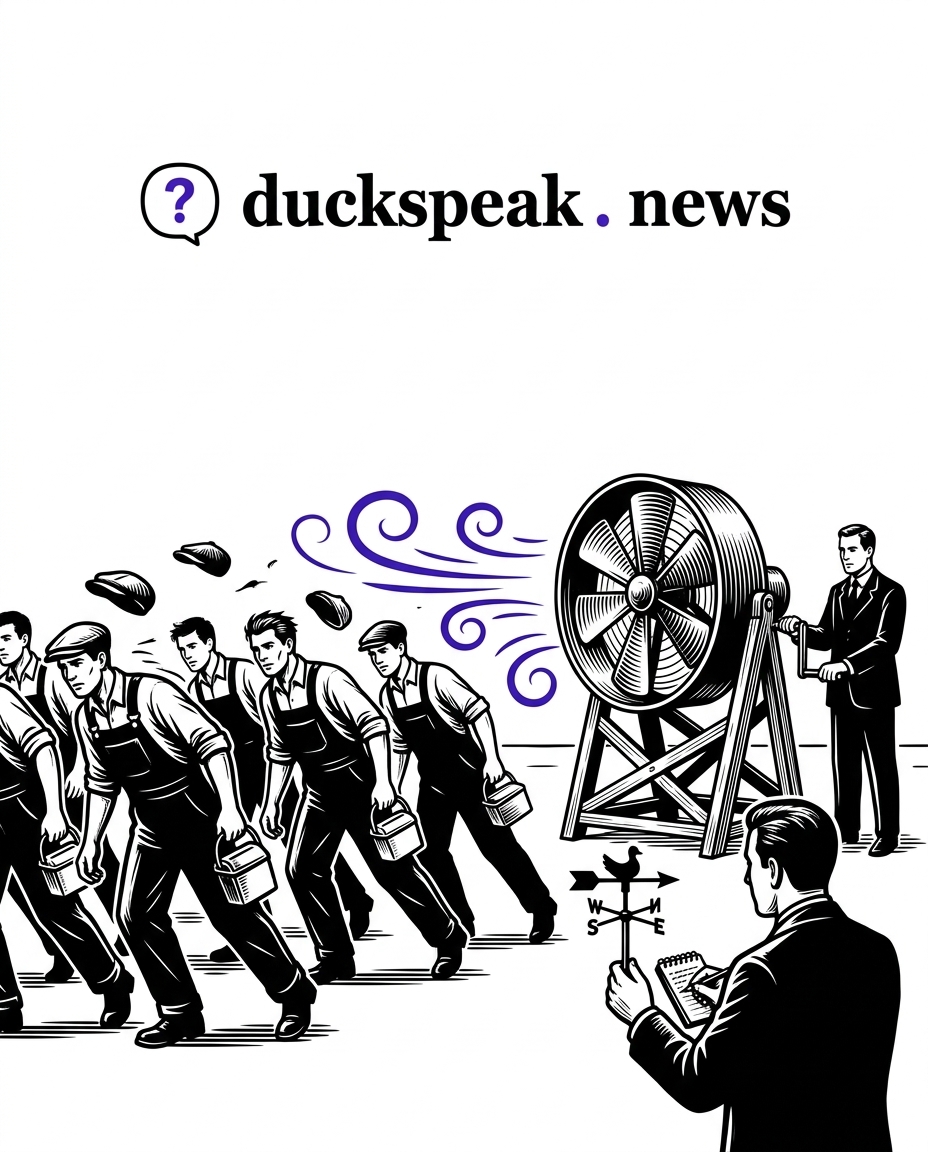
ABC News and CBS News published the same fact set: employers added 29,000 jobs in September [1][2], unemployment rose from 4.1% to 4.2% [1][2], and the number landed below the forecasts, 84,000 in one telling [1], 90,000 in the other [2]. What differs is the lexicon. Read side by side, the two pieces show how a soft shared vocabulary can do more work than any opinion column: it decides, before the analysis begins, who in the story is allowed to act.
Inflation arrives as climate
The signature word, in both outlets, is “headwinds.” ABC: “Despite these headwinds, the labor market has proven sturdy so far this year” [1]. CBS: businesses are “holding off on hiring amid headwinds such as surging energy prices and higher inflation” [2]. Wind is the perfect Newspeak substance. It has no author, no beneficiary, and no address; things simply happen “amid” it. The only named author of the inflation in either piece is a war: “The Iran war drove up gasoline prices and catapulted inflation to a three-year high” [1], with CBS agreeing that “soaring energy costs pushed up consumer prices” [2]. The causal chain begins abroad and ends in the sky. No domestic decision appears in it.
The Federal Reserve enters only as a responder, always in the vocabulary of intention: its hike “aims to dial back price increases” [1]; the central bank “is focused on driving inflation down to its 2% annual target” [2]. Aims, focused. When the same institution’s policy touches people, the verbs change register. Unemployment does not rise; it “ticked up” [1] and was “up slightly” [2]. The policy “risks a downshift in hiring and an uptick in the unemployment rate,” though “such fallout typically takes hold after a lag time lasting several months” [1]. A downshift is what a skilled driver does; fallout is what the wind leaves behind. The policy’s costs have no human noun in either article. No one is described as losing work to the hike; an uptick occurs. Neither outlet translates the 0.1 point into workers [1][2], and neither says which industries produced the 29,000.
Strength, repurposed
The sharpest shared move is structural. In both pieces, the labor market’s health is presented as the reason for the policy that slows it. ABC: “The combination of elevated inflation and a resilient labor market prompted the Fed to raise interest rates” [1]. CBS: “A stable labor market gives the Federal Reserve more room to raise interest rates in the coming months” [2]. Your job security, in this sentence, is the central bank’s raw material. Note the allocation: the institution holding the brake pedal gets “room,” and the people on the other end of the brake get a lag time.
ABC, to its credit, states the mechanism plainly: a rate increase “raises borrowing costs for consumers and businesses, which in theory should slash inflation by slowing the economy and eating away at demand” [1]. Demand is a word for people buying groceries; the policy works by cooling them. Two paragraphs later, the same article concludes, “By some measures, the economy remains robust” [1]. The reader is asked to hold three propositions at once: the robust thing prompted the brake; the brake slows the robust thing; and the slowing, when it registers, will be a tick. That is the doublethink architecture, built not from lies but from adjectives kept in separate rooms.
The lag sentence deserves its own note. By placing the policy’s costs in “a lag time lasting several months” [1], the frame pre-assigns whatever comes next to the lag rather than to the lever. It is an alibi written in advance, in the passive voice of weather.
The yardstick nobody shows you
CBS’s headline says the economy is “missing economic forecasts” [2]; ABC says hiring “grew much less than expected” [1]. Expected by whom is the quiet problem. ABC prints 84,000 [1]. CBS prints 90,000 and names FactSet [2]. The two outlets disagree about the benchmark by six thousand jobs, and neither flags the gap. The gap may be innocent; this critique is speculative on that point, since different forecast panels can produce different numbers. But the “miss” is the organizing fact of both stories, and the yardstick is a private firm’s guess that the reader never sees defined. ABC’s reassurance case has the same shape: an analysis by financial services firm Raymond James found job growth “exceeded Raymond James’ expectations” [1]. The firm appears as neutral expert and as grader of its own predictions in the same paragraph.
The reassurance arc
Both pieces run the same arc: bad number, pivot word, comfort. ABC pivots on “Despite these headwinds” [1] and lands on GDP growth and consumer spending’s “largest monthly increase since March 2025” [1]. CBS pivots to outplacement firm Challenger, Gray & Christmas: layoffs down 40% from a year earlier, “the lowest level in four years” [2].
Notice what the arc compresses. ABC gives exactly one sentence to consumer sentiment falling “close to the lowest level ever recorded in the 74-year history” of the University of Michigan’s survey [1], then a full paragraph to an investment firm’s sturdiness analysis. CBS buries the fact that wage growth “has lagged inflation for five consecutive months” [2] in a subordinate clause, then hands the Fed’s “room” its own topic sentence [2]. Five straight months of falling real wages is the labor market as workers experience it. In this layout it is a supporting detail to the central bank’s capacity.
The only plain sentence in either article is borrowed. “The plain fact is that inflation is too high and has been for too long,” Fed Chair Kevin Warsh said at a press conference [1]. The plainness belongs to the official whose policy the surrounding prose spends its energy upholstering. The journalists’ own sentences never get that direct.
The comfort is also timed. CBS closes with “This is breaking news and will be updated” [2]; ABC’s page ends on “24/7 coverage of breaking news and live events” [1]. The frame is delivered while the number is still warm, and the update promise covers facts, not framing. This critique addresses the versions on the record. ABC’s forward-looking anchor is likewise not the Fed’s published reasoning but CME Group’s FedWatch Tool, which ABC itself describes as “a measure of market sentiment” [1]. Sentiment, labeled as such, stands in for the institution’s own record.
What a reader would need instead
- The primary record. Both pieces summarize the Bureau of Labor Statistics’ monthly report [1]. The reader needs the release itself, the document against which every adjective here (“sharp,” “slightly,” “sturdy”) can be checked, including whatever it says about revisions and sector composition, which neither piece reports.
- The Fed’s own words. Warsh’s press conference is quoted for one sentence [1]; the policy’s stated conditions and costs live in that record, not in a betting market’s implied odds.
- The consensus, defined. Which economists, surveyed by whom, and why the expectation is 84,000 in one outlet [1] and 90,000 in the other [2]. If the miss is the headline, the yardstick is the story.
- The wage line, promoted. Five months of real wage decline [2] should not live in a subordinate clause.
- The sentiment line, expanded. The University of Michigan publishes the survey ABC cites [1]; “close to the lowest level ever recorded” deserves more than one sentence of context, or the reassurance paragraphs do not deserve theirs.