

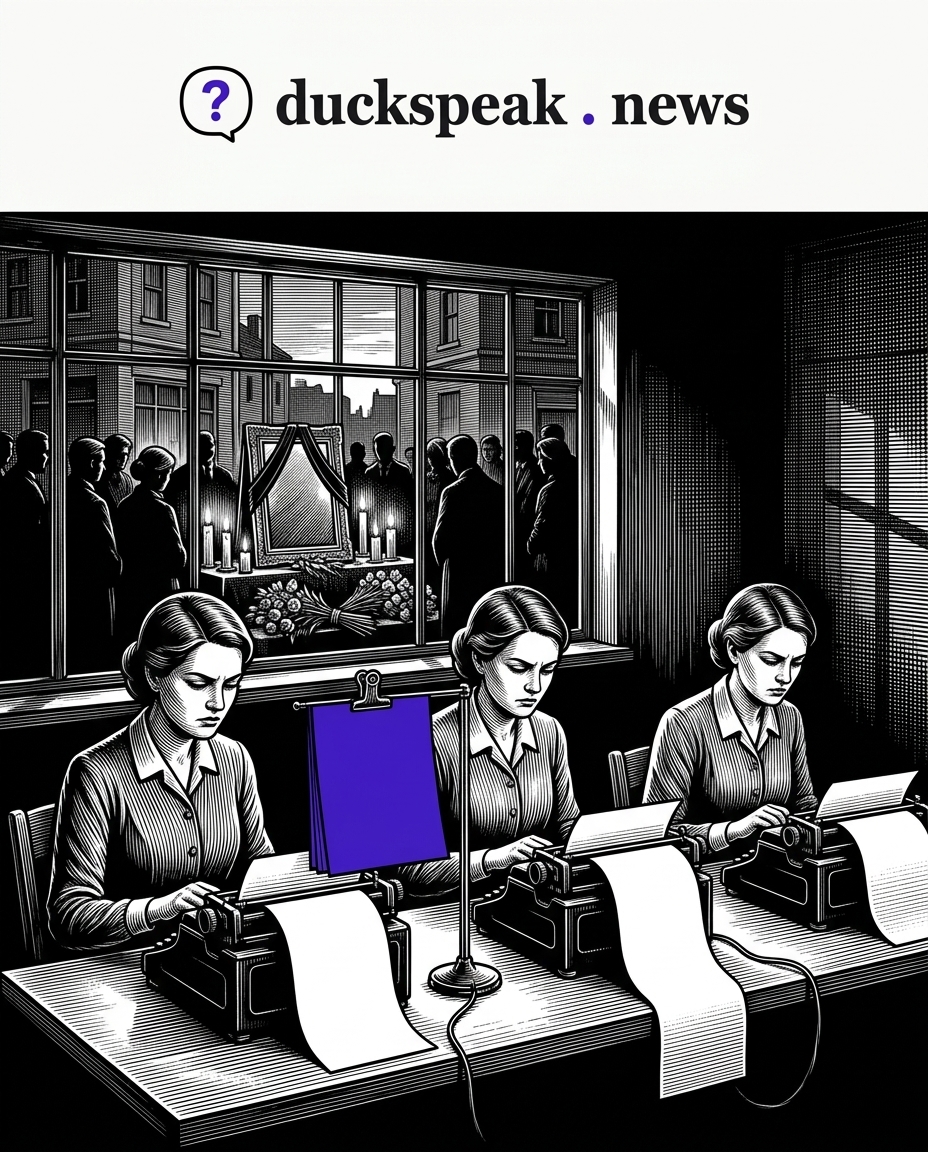
On Friday evening a 40-year-old man was shot dead near the junction of Braybrook Street and Erconwald Street in East Acton, where between 40 and 50 people, including children, had gathered for a memorial service. By the next day three UK outlets had the story: the Daily Mirror, The Independent, and GB News. Read them side by side and you are reading one article in three typefaces. The same call time (7.47pm, or “just before 7.50pm” if you are The Independent) [1][2][3], the same junction, the same Detective Chief Inspector Brian Howie quote, the same appeal number, CAD 7011/2Oct [1][2][3]. The only visible difference in sourcing is that GB News also prints the Crimestoppers number [3]. Everything else suggests a single underlying Metropolitan Police press release, retyped three times. We only have the three articles, so that last step is inference; but identical quotes and an identical CAD reference make it a safe one.
The only named person works for the state
Across all three pieces, exactly one human being has a name, a title, and a voice: Detective Chief Inspector Brian Howie [1][2][3]. The dead man is “a 40-year-old” [1], “the victim” [3], “the injured man” [3]. He has an age, a wound, and no other properties. The witnesses are a quantity: “between 40 and 50 people, including children” [2]. Forty to fifty people were present at a killing, and not one of them is a source in any of the three articles; they exist as an aggregate, addressed only through the police appeal for footage and dashcam clips [1]. Orwell’s Ministry would recognize the arithmetic. The citizen becomes a statistic; the officer becomes the author. The state speaks in full sentences; the dead man appears as a number.
“Senseless”: the word that closes an open case
By the Met’s own account the investigation is wide open: no arrests [1][2][3], no suspect description anywhere in the coverage, a post-mortem not yet carried out, the cause of death only “believed” to be a gunshot wound [1][2][3]. Yet the emotional framing arrived fully closed, and the word doing the closing is “senseless”, DCI Howie’s word, carried by all three outlets [1][2][3]. The Independent went further and lifted it out of the quotation marks into its own news voice, reporting that a mourner “was shot dead in a ‘senseless act of violence’” [2]. Once a police condolence formula sits in a paper’s lede, it stops being the police’s feeling and starts being the story’s fact.
“Senseless” is not neutral. It asserts, in advance of any evidence, that the killing had no motive worth understanding: no feud, no retaliation, no pattern a reader could follow. It converts an unexplained death into an incomprehensible one, which is a different and more comfortable product. Open investigation, closed narrative; the reader is handed grief and relieved of questions in the same sentence.
The Independent’s headline adds a second invention: “manhunt” [2]. Its own body reports no arrests and describes no quarry [2]. A manhunt with no described target is a mood, not an operation. The same headline also calls the dead man “a mourner” [2], a warm fact the police statement does not contain; he was a man present where a memorial service was taking place. The paper chose the warmer word because the real ones, his name and his relationship to whoever was being remembered, were not available to it.
Headline inflation, three dialects
Each outlet dramatizes the shared source in its own accent. The Mirror’s headline has the man shot “in front of 50 people” [1]; the police said between 40 and 50 people were “present” [1]. Presence becomes audience; a range becomes a round number. GB News upgrades the police’s “large number of people” into “a large crowd of families” [3], which is more domestic and more innocent, and pairs it with a headline killing “in crowd” [3]. None of these additions is a lie. All of them point the same way, toward spectacle, and all of them come from the outlet rather than the evidence.
The memorial is the story, and nobody asked whose
Here is the strangest omission. A man has been shot dead at a memorial service, and across three articles not one of them asks: a memorial for whom? The meaning of the scene depends entirely on the answer. If the service was for a previous victim of violence, this may be the second chapter of one story, the kind of connection that turns a local killing into a pattern worth reporting. If it was for someone who died of illness, it is a different story. We do not know, and the outlets do not say they do not know; the memorial functions as atmosphere, a poignant set detail, rather than as the central unexplained fact sitting in the middle of every version of the article. To be fair, the police statement they were working from does not answer the question either. But a wire rewrite not asking is a wire’s nature; a newsroom not asking is a choice.
What a reader would need instead
- The underlying record. The Met publishes its own news appeals; setting any of these three articles beside the force’s release would show how much of the “reporting” is retyping. (The single-release theory above is inference from the three texts, flagged as such.)
- The answer to the memorial question: who was being commemorated, and whether the service connects to earlier violence. Local reporting, community figures, or the family would know; none of the three asked.
- The victim as a person: his name once released, and something of his life beyond “40-year-old man”.
- Context instead of mood: the Met itself publishes recorded crime data for London, and the Office for National Statistics tracks offences involving firearms in England and Wales. Whether this killing fits a trend or breaks one is checkable; none of the outlets checked.
- A witness. There were forty to fifty of them. One quoted mourner would have made these three articles different products.
Until then, the coverage has told us exactly what the state chose to say, in three fonts.