

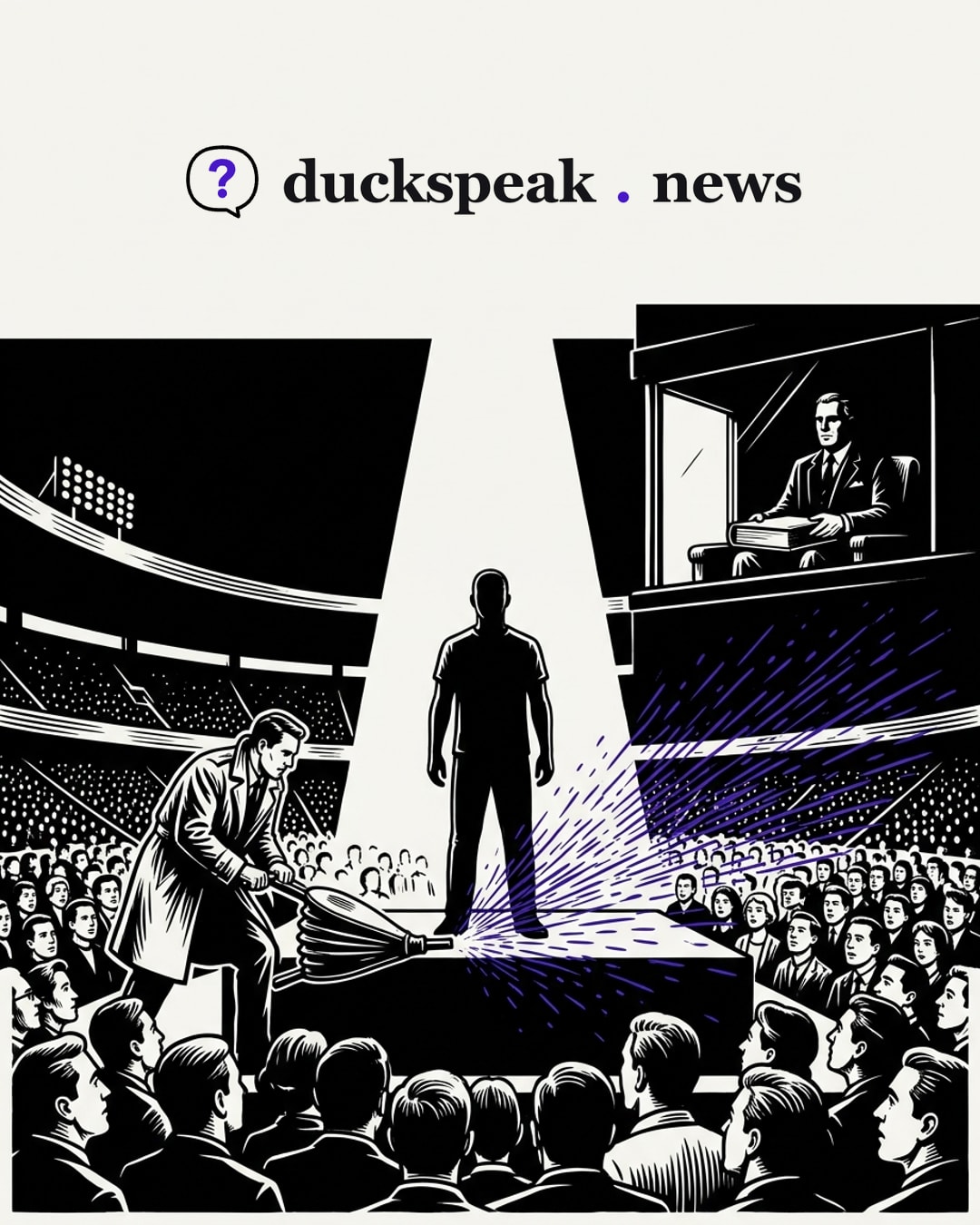
On Friday night Zach Bryan walked onto the stage at Gillette Stadium wearing a shirt that read “Free Palestine,” and members of his band wore clothing supporting the same cause [1][2]. Gillette is the stadium whose owner, Robert Kraft, barred Macklemore from performing over what Kraft called “a broader history of antisemitic rhetoric and imagery” [1][2]. CBS adds a detail Fox never prints: the shirt’s full text also read “An appeal to heaven,” with a pine tree logo [2]. The setup is as close to a controlled experiment as news offers: the venue’s stated rule, the exact phrase that triggered it, and a performer whom neither article connects to any history of the kind Kraft invoked. Two outlets were handed a test of a billionaire’s speech rule. One covered it as weather; the other covered it as trivia.
The debate, sparked on schedule
Fox’s headline does the conversion before the first paragraph: “Zach Bryan sparks debate after wearing ‘Free Palestine’ shirt at venue that barred Macklemore” [1]. The act becomes its reception; the reception becomes the story. Inside, the formula completes itself: “Bryan’s shirt immediately ignited a debate online, with social media users split over whether the singer was making a courageous political statement or bringing politics into a concert where fans simply came to hear music” [1]. “Split” does quantitative work, and no quantity is offered; four anonymous comments are curated, roughly balanced, and the evenness is asserted rather than counted.
Look at the two options the “split” is given. Courageous statement, or politics where fans came for music. Both accept that this is a story about politics at concerts. The third reading, that the shirt tests the venue’s own standard, is excluded from the framing, though it is present in the article, inside a quoted comment: “Kraft should cancel tonight’s show. Same standard he held Macklemore to” [1]. The sharpest structural question in the story enters the coverage as fan chatter. The article’s own voice, meanwhile, retreats into fog: “His shirt appeared to some to be a pointed message at the venue” [1]. Some. The owner barred a performer over this phrase; the wearer wore the phrase at that owner’s stadium; the connection “appeared to some.” Attribution dissolves precisely where inference is easiest.
The verb that still refuses an agent
An earlier piece on this site, “Nobody Dropped Macklemore,” dissected the “dropped after speech” headline grammar across three outlets. What is new here is that the formula no longer needs the excuse of headline compression. CBS writes, in body copy, “Macklemore was dropped from musician Ed Sheeran’s ‘Loop’ tour after saying ‘Free Palestine’ last month” [2], and then reports, a few paragraphs later, that “New England Patriots owner Robert Kraft, who also owns the stadium, called Sheeran to tell him Macklemore would not be allowed to perform at the venue” [2]. The agent is named, on the record, in the same article. The grammar forgets what the paragraph remembers.
Fox manages both directions at once. A photo caption asserts that “Macklemore was kicked off Ed Sheeran’s stadium tour over his ‘Free Palestine’ remarks” [1], assigning the act to Sheeran, whose denial (“Sheeran later said removing Macklemore was not his decision” [1]) runs in the body of the same piece. The body then reaches for the passive anyway: Macklemore “was dropped from the remaining U.S. dates of Ed Sheeran’s tour after his politically charged performance” [1]. The caption blames a man who says he did not do it; the body blames no one; the owner who says he did it is quoted further down. Fox even names the weather itself: “The controversy comes amid the fallout surrounding Macklemore” [1].
What Fox leaves out of the backstory
Fox’s Macklemore backstory ends at backlash: the MetLife performance “garnered backlash,” the rapper defended it, and announced a “Free Palestine Tour” [1]. CBS carries the story two steps further. First: “Every other supporting act for Sheeran’s tour dropped out in solidarity with Macklemore” [2]. Fox’s readers are never told the openers quit. Second, the donation duel: Macklemore “pledged to donate $1 million to support Palestinians” and “called on Kraft to match his donation,” whereupon “Kraft issued a statement in which he said he had already spoken to Sheeran about matching the pop star’s own $2 million donation pledge” [2]. Read plainly, Kraft’s reported statement answers a challenge about Macklemore’s million with a fact about Sheeran’s two million. Whether anyone matched anything is not reported. The sentence is compressed, and this critique flags its reading as the plain one rather than the only one. CBS transcribes the pivot without remark, and adds a quiet irony without noticing it: the Sheeran shows Kraft’s rule was issued to govern “were canceled due to a nor’easter” [2]. The rule was announced for dates that drowned.
Filed under entertainment, next to the quiz
Fox runs the story in its entertainment vertical, and the packaging is framing. Around the text sit the cross-promotions: “ED SHEERAN CONCERTGOERS WARN ARTISTS ABOUT SHARING POLITICAL VIEWS: ‘YOU’RE GOING TO ALIENATE’ FANS” [1], and “PUT YOUR ENTERTAINMENT KNOWLEDGE TO THE TEST AND SEE HOW YOU SCORE” [1]. The theme is pre-loaded: fans came for songs and got politics, so the alienation reads as the shirt’s fault. This is the Huxley function at its cleanest. Nothing is suppressed. A question about the enforcement of a speech rule at a billionaire’s stadium is wedged between a quiz and a newsletter signup until it reads as showbiz. The Orwellian valve is here too, briefly, since this site has covered it before: once the shirt is “political,” the objection writes itself, and Kraft’s barring of a performer from a stage he owns is called political nowhere in either article.
The shirt CBS explains and abandons
CBS does real work Fox does not: it identifies the shirt’s second line and its genealogy, citing a 2024 Associated Press article that “An appeal to heaven” dates to the Revolutionary War, was on the official maritime flag of Massachusetts until 1971, and “came from the belief that God would deliver the colonists from tyranny” [2]. Then it files the meaning as trivia. The shirt’s full text frames the Palestinian cause in the register of the American Revolution: an appeal against tyranny, in Revolutionary dress, on the stage of the man whose rule says the venue must not “provide a platform for hate speech” [1]. A performer with no cited history wearing the exact phrase the last performer was barred over is the cleanest test that rule will ever receive. Neither outlet frames Saturday’s show as the test. Fox notes Bryan “is scheduled to return to Gillette Stadium Saturday night” [1]; CBS notes “WBZ-TV reached out to Gillette Stadium for comment but has not yet heard back” [2]. What happened at the second show, and whether the stadium ever answered, lies outside both articles, and this critique flags it as open rather than guessing.
What a reader would need instead
The venue’s answer, on the record, to the question the quoted commenter already asked: does the standard applied to Macklemore apply to Bryan? Both outlets report outreach (“Fox News Digital has reached out to Kraft and Bryan for comment” [1]; CBS’s WBZ “has not yet heard back” [2]); neither prints the question itself, and the ritual of reaching out substitutes for posing it.
The full Kraft statement, since both articles quote fragments of it, and the follow-up on the donations: did Kraft match anything, or only point at Sheeran’s pledge?
The solidarity walkout, which Fox’s readers are never told about [2]. A backstory that ends at “backlash” and omits the openers’ resignation is a curated backstory.
The flag history CBS buries in its middle paragraphs, moved up to where the shirt is first described; it changes what the shirt is arguing, from a slogan into an appeal against tyranny in the venue’s own national idiom.
And the outcome of the second show, plus the question this site flagged before and that neither article advances: whether other stadium owners coordinated. The debate was sparked on schedule. The rule was never asked a question. Those are the same fact.