

On Monday night in Nebraska, the president said this, on tape, to a cheering crowd: “They can take out a city. Let them take out Los Angeles, let them take out San Diego” [1]. The AP transcript has “They could take out a city… Let ’em take out Los Angeles. Let ’em take out San Diego,” followed, “as the crowd laughed and cheered,” by “This is a very small price to pay, and it’s going to be over with very soon” [3].
The words are not in dispute. What the words mean is the whole story, and that is exactly where three outlets went soft.
The verb ladder
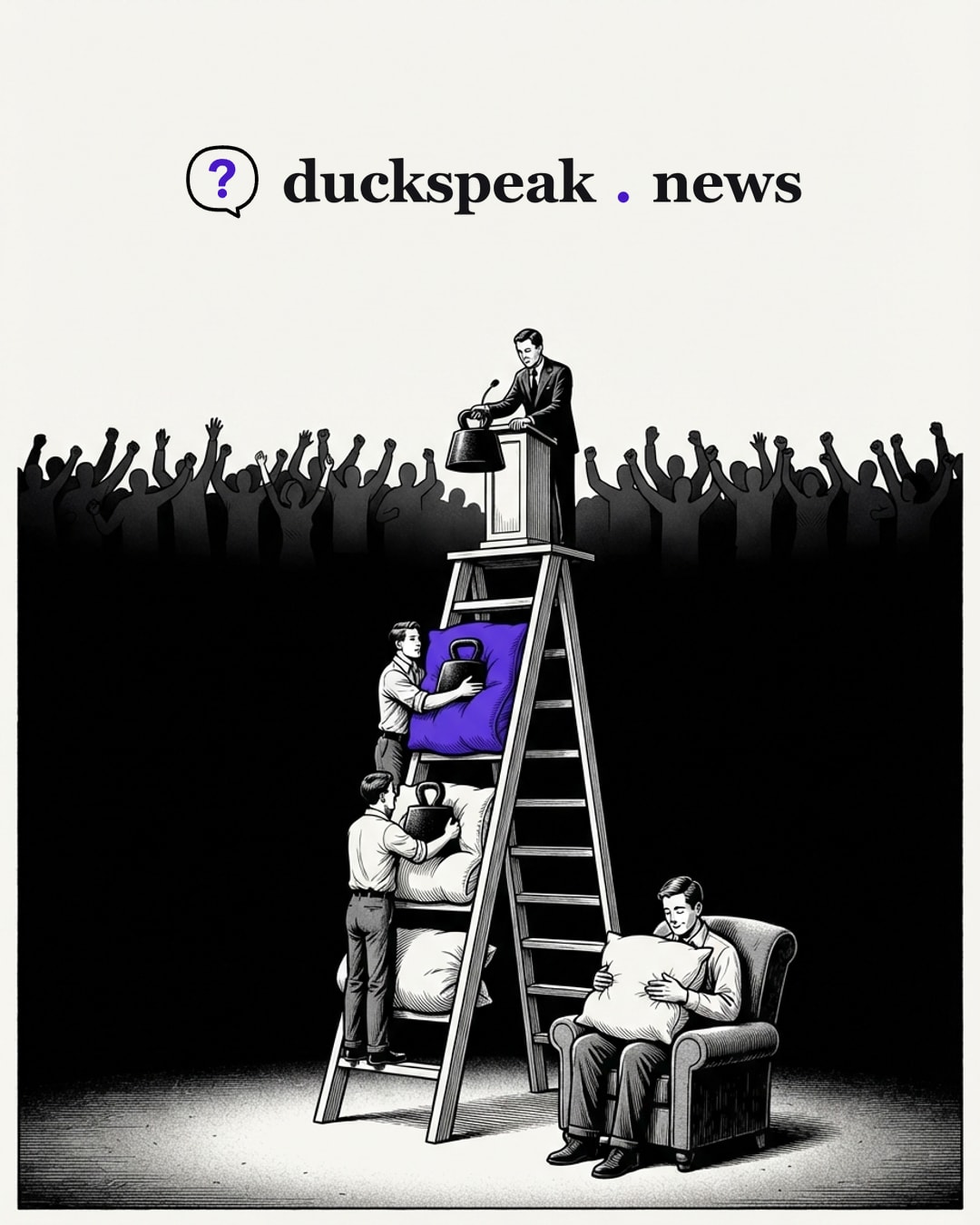
Put the headlines side by side. NBC News: officials “condemn Trump for saying Iran could ‘take out’ Los Angeles or San Diego” [1]. CBS News: “Trump suggests letting Iran ‘take out’ LA, San Diego” [2]. PBS NewsHour, running the AP: Trump draws cheers “for musing about Iran taking out U.S. cities” [3]. Saying, suggesting, musing. The verb is the verdict. A president who “muses” is harmless by construction; musing is what one does over coffee, not what a commander in chief does about two of his own cities while the war he calls worth the cost is still running. AP’s body copy adds another rung, “floating the idea that Tehran could ‘take out’ two major American cities” [3]. No coordination produced this ladder; three desks climbed it independently, which is the more interesting fact.
The body copy climbs further, and CBS is the champion of the form. Its lede says Newsom rebuked Trump “after he appeared to suggest letting Iran ‘take out’ Los Angeles and San Diego” [2]. Then “the president appeared to say” something about gas prices [2]. Then “Attendees appeared to cheer after his suggestion” [2]. Three “appeared”s in one short piece. The cheering is on video. NBC reports it flatly, “drawing cheers from the crowd” [1], and AP flatly, “the crowd laughed and cheered” [3]. Only at CBS does the crowd “appear” to cheer. When everything appears, nothing has quite happened; events become impressions, and impressions can be rebutted.
Then comes the sentence that should end the genre: “It was not immediately clear what Mr. Trump meant, although the White House’s rapid response account on X insisted after the fact that the president’s words were being misinterpreted” [2]. CBS had printed the verbatim words two paragraphs earlier. The clarity problem is not epistemic. The words are clear, the plain reading is alarming, and the hedge performs the softening the outlet’s own voice is not supposed to do openly. NBC manages the same maneuver in a different register: “Trump appeared to be making light of the potential for Iran to attack major American cities” [1]. Even the benign interpretation arrives wearing a wiggle word.
The rebuttal, printed as inventory
NBC and CBS both carry the White House response in full: the controversy “is not rooted in reality”; “He was clearly stating U.S. cities would have been threatened if a nuclear Iran hadn’t been stopped”; “America is safer because of the President. Iran has no nuclear, no navy, no air force, and no money” [1] [2]. Four claims in one breath, none of them examined. The tension sits inside the outlets’ own copy. NBC notes that “The president has argued the war was necessary to ensure Iran could not develop a nuclear weapon” [1]; the rebuttal’s “Iran has no nuclear” is the war’s justification and its victory lap in a single clause, and no one reconciles them. Meanwhile CBS’s own article observes that San Diego “has major military installations in and around it” [2], and NBC calls the city “a major U.S. Navy hub” [1]. The reason the remark lands is in their own paragraphs, but the White House’s inventory of what Iran lacks is never so much as priced.
The one fact-check in the batch comes from AP, and it is aimed at a different rally: Trump’s claim that North Carolina’s cities are “blood-soaked killing fields,” checked against FBI statistics showing the state’s violent crime rate “ranks in the middle third of states” [3]. That is real editorial work. It stops at the border of this story.
The price tag as Newspeak
The rally’s own framing deserves more than transcription. “Remember, with the war, it’s just artificial. It’s a little bit high. It’s a small price to pay for keeping the world safe, keeping our country safe” [1] [2]. “Artificial” is agentless: prices rose, but no one raised them; a war was ordered, but the costs simply occurred, like weather. And “a small price to pay” is the market absorbing the city. San Diego’s mayor, Todd Gloria, does the frame analysis in one breath: “San Diego is not collateral damage. We are not expendable. And we are never a ‘small price to pay’” [1] [2]. He is naming the lineage himself; “collateral damage” is the older euphemism in the same family, the one that turns the uncounted dead into accounting. The outlets quote him and move on. The analysis stays inside a Democrat’s mouth, where it can be filed as partisanship instead of as linguistics. CBS also relays, without note, that the president wanted “a ‘total victory’” [2], a phrase with no defined end state, which pairs neatly with a war promised to end “very soon” and never doing so.
There is also a discrepancy the outlets do not flag, and since the entire dispute is about meaning, the sequence is the story. In NBC’s and CBS’s transcripts, “small price to pay” arrives first, attached to prices, and the “take out” lines follow [1] [2]. In AP’s, the “take out” lines come first and “This is a very small price to pay” follows them directly, as the crowd laughs [3]. Those are different sentences doing different work. This critique does not have the tape and flags the ordering as unresolved; a reader deserves an outlet that noticed.
The crowd is the story
NBC: “drawing cheers from the crowd” [1]. AP: “the crowd laughed and cheered” [3]. CBS: “appeared to cheer” [2]. An audience in Nebraska cheered the hypothetical destruction of Los Angeles and San Diego, cities in the country that audience lives in, and all three outlets treat that as a stage direction. The story then becomes the rebuttal round: Newsom, Bonta, Bass, Gloria, Padilla, Schiff, each quoted, each on X [1]. That is the politics beat doing what it does. But the laughter is the event. A crowd conditioned to cheer the erasure of the other party’s cities is the Huxleyan detail, the spectacle working as designed, and the coverage files it under politics and moves on to the quotes.
Credit where due: NBC notes the war “would be over ‘very soon,’ something he has suggested dozens of times over the past several months” [1], the only repetition tally in the batch, even if it stops at “dozens.”
What a reader would need instead
- The rally video or a full sequenced transcript, with the “small price to pay” and “take out” lines in their actual order, since the three outlets’ transcripts disagree [1] [2] [3].
- An examination of the White House’s four-part claim, “no nuclear, no navy, no air force, and no money” [1] [2], rather than its transcription; AP’s own fact-check of the North Carolina line [3] shows the capacity exists.
- The crowd’s response treated as data rather than scenery: who cheered, at which clause, for how long.
- A count of the “very soon” promise rather than “dozens of times” [1]; a number is a fact, “dozens” is a vibe.
- The frame named in the outlet’s own voice: “a small price to pay” is a transaction in which cities are the consideration. Mayor Gloria said it [1] [2]; no reporter did.
The words were clear. The coverage’s job was to keep them clear. Instead it taught readers that even a videotaped sentence is a matter of opinion, and that the White House rapid response account’s opinion is one of the two available ones.