

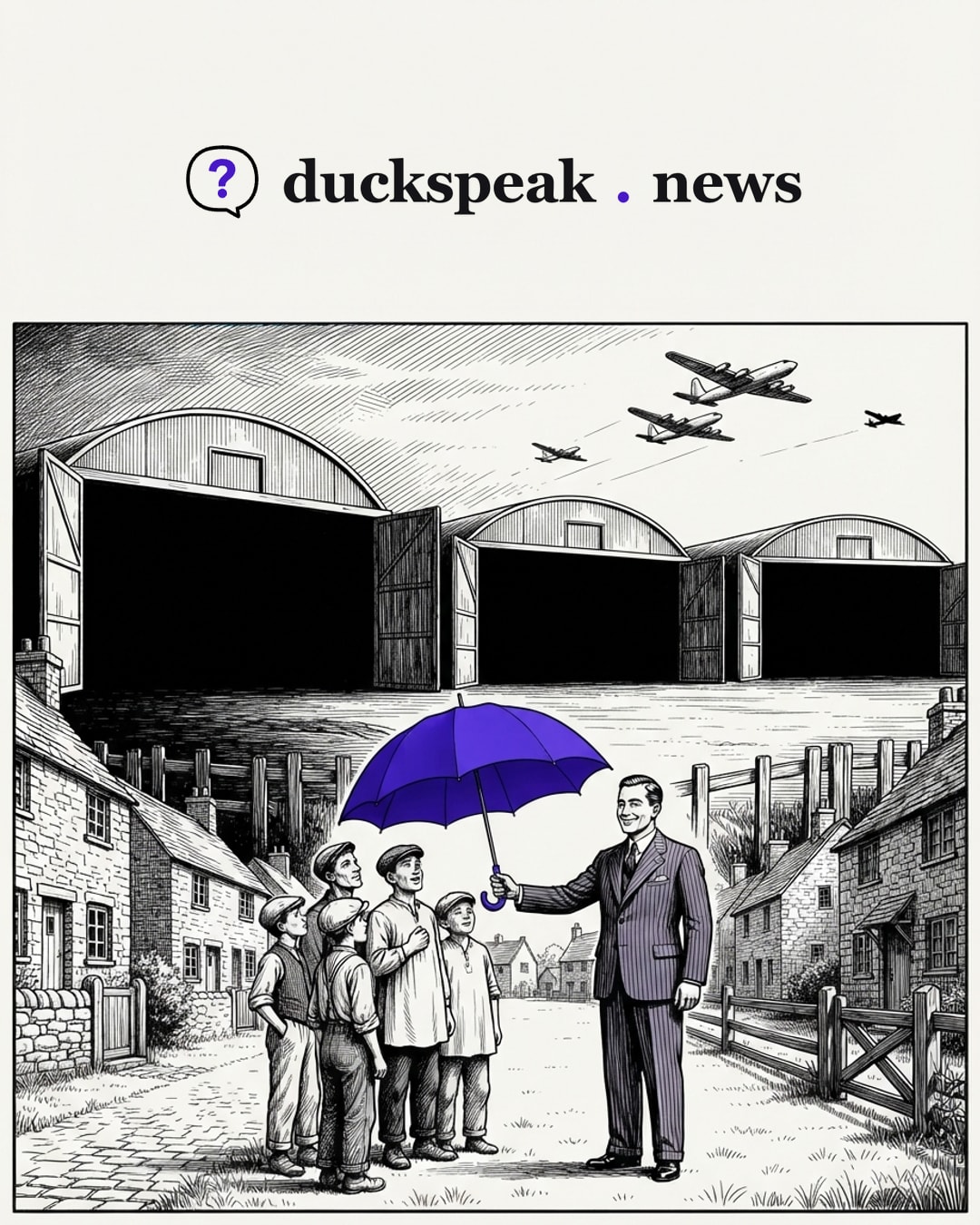
Two British outlets opened with near-identical headlines: the BBC’s “No 10 insists RAF Fairford is safe after US withdraws bombers” [1] and the Guardian’s “No 10 insists RAF Fairford is safe after US withdraws its bombers from base” [3]. The verb is the story. Nobody insists the sky is blue. You insist on what is contested, and what contested the claim was a dozen B-1 bombers leaving Gloucestershire so urgently that, in the Guardian’s words, “refuelling aircraft had to be scrambled to support their flights to the US” [3]. RFI reported that some aircraft took off without waiting for the tanker planes meant to refuel them [2]. The vocabulary is soothing; the runway is not.
The word “safe,” issued by people who weren’t briefed
Downing Street’s spokesperson said “yes” when asked whether the base was safe [3], declined to comment on “foreign nations’ military operations” [1][6], and pointed to President Trump having “praised our police, defence and security services” [1][6]. Several paragraphs into the Guardian’s account comes the detail that should have been the headline: “Other UK officials indicated they had not been briefed on US thinking” [3]. The assurance of safety is being issued by a government that, by its own officials’ account, has not seen the threat assessment that emptied the base. The word “safe” also never specifies for whom. The bombers are now safe, in America. The villagers of Whelford are still living beside the installation Iran has named as a target.
Routine, say the officials whose tankers were scrambled
US Secretary of State Marco Rubio called the movement a “regular rotation” [4], adding that it is “not unusual to see movement of assets to different parts of the world” [1][3][4]. ABC News, in the same piece carrying Rubio’s quote, reported that “another source familiar with the situation said that the B-1s’ departure was not a scheduled rotation” [4]. The BBC’s own sourcing concedes the point: “Whitehall sources have not disputed that the decision from Washington to remove the bombers was in response to the incident” [1]. Vice President Vance supplied the euphemism of the week, “out of an abundance of caution” [4]. This is doublethink in distribution: the same event is an emergency response to specific new threat details, per anonymous officials quoted by the New York Times and CNN and relayed across the coverage [1][2][3], and also a boring calendar item. Both framings sit in most of these pieces; almost none of them sharpen the contradiction. The Guardian deserves credit for explicitly contrasting No 10’s “yes” with the US military’s evident concern during “the hasty redeployment” [3].
Foiled, thwarted, van bomb: a noun gradient
The same event gets different nouns depending on the outlet. CBS News calls it “a security incident” [6]. The Associated Press copy on PBS calls it “an investigation into a planned terror attack” [5], asserting the plot as fact. The New York Post goes furthest: a “foiled terror plot,” a plan “stopped before it could be carried out,” a “thwarted attack,” and suspects who “appeared to have been plotting a van bomb attack against the airfield” [7].
The public record, as reported by these same outlets, is: police say they found “a quantity of an accelerant — gasoline — in three vans linked to the five suspects, but no explosives” [6]; six men were arrested and every one was released on bail, none charged [1][3][4][5][6]. The Guardian alone wrote that the bail releases were “raising questions about what they had been doing,” and that “developments in the UK have not so far matched the apparent level of the US warnings” [3]. “Foiled” asserts a completed attack that no charge, no explosive and no prosecution currently supports. The “van bomb” detail appears in no other account [7]; police found fuel, not a bomb. The Post’s hedges (“alleged,” “appeared”) are present in the body, but the headline noun is “foiled,” and headlines outlive hedges. This critique of the Post rests on a three-sentence breaking piece; that is thin ground, and it is flagged as such. But the gradient from “incident” to “foiled plot” is visible across the full sample, and it runs in one direction only.
“Defensive strikes”: the Newspeak that makes the threat motiveless
The BBC writes that the UK “approved a US request to use it for defensive strikes on Iran” [1]. RFI passes along “opérations défensives” [2]. The Guardian, plainer, says the base “had been used for US air force bombing runs against Iran” [3]; ABC says it was “used to launch strikes against Iran” [4]. This is the sharpest Newspeak on display: the operation that turned a Cotswolds airfield into a named target is labeled defense, so the threat to it arrives in the coverage apparently from nowhere, pure aggression against a neutral site. Iran’s July statement that “any base used for aggression against Iranian territory constitutes a legitimate target” [1][2][3] is then used as corroboration of a terror plot, when it is a statement about the base’s role in an ongoing war. The Guardian alone assessed the capability question, noting “it is unclear what level of threat Iran could pose to a military base in the heart of the UK” [3]. The AP account alone notes that Trump is weighing new strikes, promising “it’ll either be the easy way, or the hard way” [5]; the war continues, which is the context in which “defensive” and “safe” are being pronounced.
The villagers, at least, understood the causal chain: one told the BBC she was “thrilled” the bombers had gone, citing the noise and feeling “increasingly vulnerable” in recent weeks [1]. The BBC’s own follow-up headline reads “Peace for villagers as US bombers leave UK airbase” [1], and its sidebar offers “Three reasons Middle East oil supply is nearly back to pre-Iran war levels” [1]: the war as market recovery, the relief as peace. That is the Huxleyan close, and it is doing more work than the threat reporting.
Strong indications, from officials with no name
The Iran attribution rests on a laundering chain: anonymous US officials speak to the New York Times and CNN [2][3]; the BBC then reports that “US media reported a new threat” [1]. Each hop moves the claim further from anyone who would defend it in court. Prime Minister Andy Burnham’s “strong indications that Iran played a part” is repeated across four outlets [1][3][4][6] without any of them reporting what the indications are. The on-record counterweight is quieter: the UK’s counter-terror coordinator Vicki Evans describes an “immensément complexe” (immensely complex) inquiry following “tous les angles possibles, y compris celui du rôle d’un État étranger” (all possible angles, including the role of a foreign state) [2], which is an official way of saying nothing is established. Trump supplies the secret-knowledge genre: “We know who made the threat” [4]; “We know everything about them, we would not have released them” [3][6]. Unverifiable by construction, printed as quotes. Tehran’s denial is flattened by the BBC into “strongly denied any involvement” [1]; RFI alone carries the foreign minister’s actual words, that London is on a “fausse route” (wrong track) [2], and alone reports Netanyahu’s claim that Israel warned the UK in advance of an Iranian plot against a British base [2]. That is a significant claim by a third state, and its absence from the BBC, Guardian, ABC, CBS and AP accounts is a real omission; the material gives no way to know why, and this critique will not guess.
Department of War, “anywhere, anytime”
The Post alone calls the building “the Department of War” [7]; everyone else says “the Pentagon” [1][3][5][6] or the defense ministry [2]. When a state renames its war ministry, the name each outlet keeps is itself a framing decision, and most kept the softer one. CBS, meanwhile, prints the Pentagon’s statement without comment: bombers “routinely operate around the world to support global force readiness,” and airmen “remain ready to deliver precision global strike capabilities… anywhere, anytime” [6]. That is a threat to the planet, typeset as reassurance.
What a reader would need instead
The evidentiary state, stated plainly: arrests, bail, no explosives, no charges, and an investigation whose own leadership calls it complex and unfinished [2][4]. Counter Terrorism Policing’s on-record statements (Laurence Taylor on Sept. 28 [4]; Vicki Evans [2]) are the record; “strong indications” from unnamed sources is atmosphere.
The base’s role in the bombing campaign as cause, not background: Iran named it a target because bombers flew from it to strike Iran [3][4]. Whether the threat is real is exactly what is unresolved; that it has a context is not.
Who in the UK has actually seen the US threat picture [3], and what “safe” can mean when the assurance comes from officials who say they were not briefed.
The observable versus the framed: aviation watchers, the Military Air Tracking Alliance, observed the departure [5], and the Wall Street Journal reported it before the Pentagon confirmed it [6]. The open-source record beat the press release; a reader deserves to know which claims are observable and which are vocabulary.
And the distinction between a state threat assessment and a criminal case against six men on bail. The coverage blends them into a single atmosphere of menace, which is precisely the effect the vocabulary is engineered to produce.
More on RAF Fairford on this site:
- 1 October 2026 Defensive Purposes, Such as Striking: How the Fairford Coverage Renamed a War
- 1 October 2026 Six Arrests, No Charges, and ‘the Terror Plot’
- 7 October 2026 The ‘Bomb Plot’ With No Bombs
- 13 October 2026 Certainty Ratchets; the Evidence Is Still Petrol