

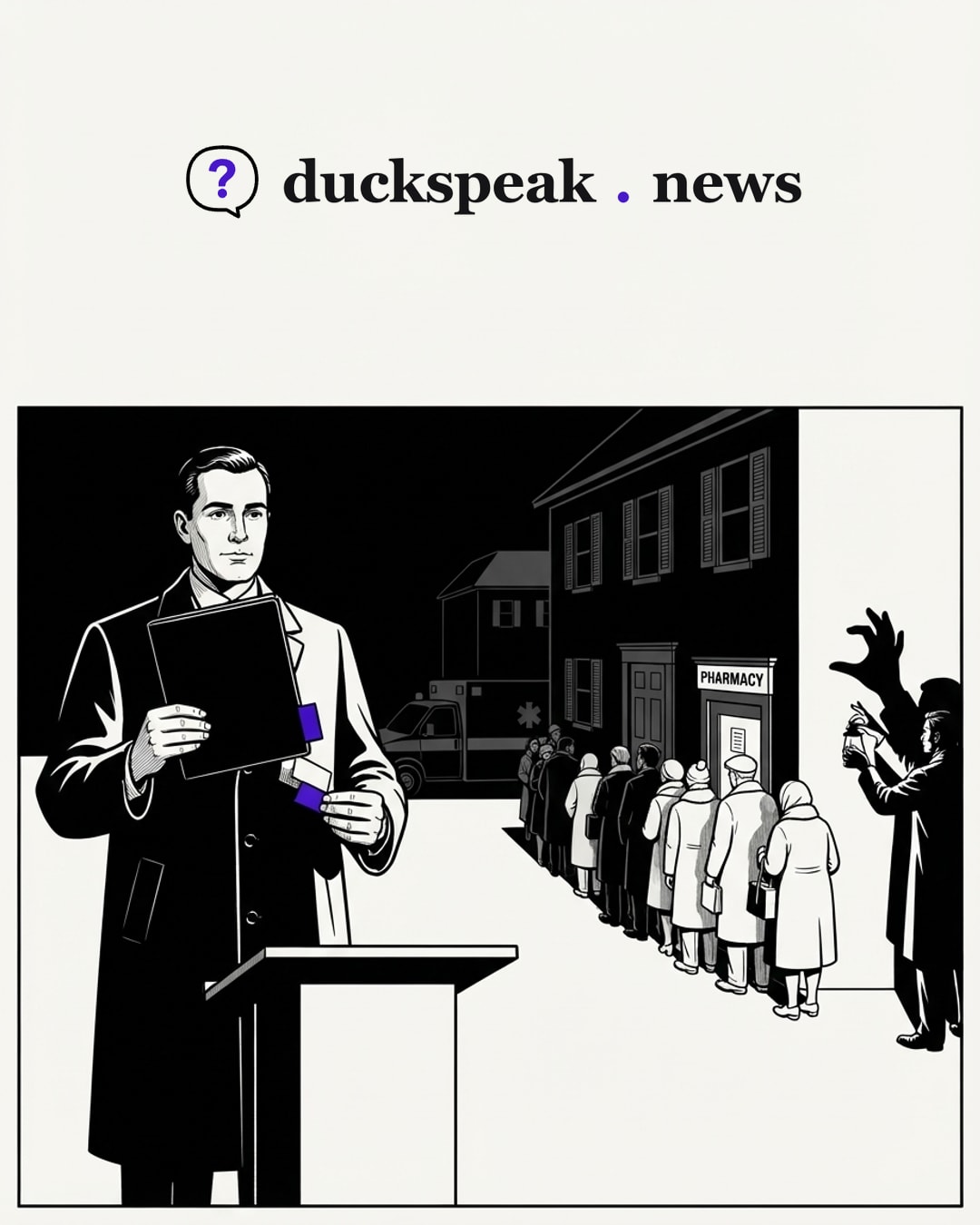
Overnight into 2 October, a 28-year-old technician named Darya Shipilova died of severe pneumonia at a hospital in Shelekhov, Siberia [7]. She worked at the Irkutsk Anti-Plague Institute. In the days after, seven outlets on two continents offered readers two usable stories: an official one in which nothing is nameable and everything is “stable,” and a speculative one in which the thing might be “far worse” than the plague. The verifiable middle, one dead woman, roughly 200 traced contacts, several quarantined hospitals and a pathogen that officially does not exist, was the hardest thing to find.
The sentence that traveled
Nearly every outlet in this set printed the same construction: “no microorganisms linked to the employee’s professional activities were detected” [6]; “no microorganisms in her body linked to her work” [3]; “aucun micro-organisme lié à l’activité professionnelle de la jeune femme n’a été détecté” (no microorganism linked to the young woman’s work was detected) [1]. The sentence is exquisitely built. It excludes one category of pathogen, the work-related kind, and says nothing about what was found. It answers a question nobody asked in order not to answer the question everybody is asking. Only France 24 read the construction aloud, calling it a way for the authorities to set aside the lab-accident thesis without saying so, while giving no further information about a death that “intéresse jusqu’à la Maison Blanche” (interests even the White House) [2]. The rest ran the sentence as though it were information.
The word that could not be spoken
France 24 also carried the sharpest observation of the week: the Russian authorities “ont surtout pris soin de ne pas prononcer le mot de ‘peste’, qui est pourtant sur toutes les lèvres dans cette région” (took care above all not to say the word “plague,” which is nevertheless on everyone’s lips in this region) [2]. That is the Orwellian core of the story. Officials who raised plague on Saturday morning deleted their messages afterward [2]. The governor declined to name the illness, referring to it only as “a dangerous infectious disease” [5]. The Kremlin’s Dmitry Peskov instructed the public to rely on official statements “rather than rumors or speculation” [4], and the outlets quoting him mostly failed to note that the “rumors” include officials’ own deleted posts and reporting by named Russian outlets: Meduza, People of Baikal, the Moscow Times [2][5]. The official vocabulary shrank until the noun disappeared, and what remained was a diagnosis-shaped absence: “pneumonia of unknown etiology” [1][5], “pneumonia of undetermined origin” [3][6]. An absence of diagnosis was printed as a diagnosis.
The one expert who named the anomaly received the least attention. Kevin Esvelt of MIT: “untargeted research-grade sequencing reliably identifies pathogens, and people seldom die of pneumonia without pathogens, let alone 28-year-olds… It would be surprising if they did not know the cause” [3]. That is an inference, not a finding, and Esvelt flagged it as such; but it names exactly what the official sentence is engineered to avoid. It ran in Fox News, under a headline about something else entirely. The confirmed layer is thin everywhere: NBC reports that even the woman’s name and age “have not been confirmed by officials” [6], and France Info prints a different transliteration altogether, “Daria Chipilova” [1]. The only firm facts are the ones officials chose to say.
Actions versus adjectives
Meanwhile the adjective “stable” traveled from the Russian public-health agency Rospotrebnadzor through the governor’s Telegram into a note the WHO relayed to the Associated Press, and out onto the world’s wires (“The epidemiological situation is stable and remains under monitoring” [4]; “is currently stable” [6]; “stable” [1][2]), while the same coverage quietly accumulated its opposite. A maternity ward and a pediatric center quarantined for three weeks [2]. FSB agents accompanying ambulances [2]. Pharmacies “prises d’assaut” (stormed) by residents seeking antibiotics [2]. All public events in the region canceled [5]. The head of the national watchdog, Anna Popova, flying 2,600 miles from Moscow to a “stable” region [5]. The governor addressing the story in third place in his Sunday bulletin, after rising bear attacks and the flu vaccination campaign [2]. Almost no outlet placed these facts next to the word “stable” and let the reader feel the friction. France Info is the purest case: its report is built from the governor’s Telegram statements and WHO background, and carries none of the dissonant details its national sibling France 24 published the same day [1][2]. One story, two products.
The inflation mirror
The vacuum did not stay empty. Fox News led with a headline warning the death could be “far worse” than the plague, built on a former arms-control envoy’s social-media post, “This may not be just ‘the plague.’ It may be far worse” [3], plus defector-era claims about antibiotic-resistant strains and Irkutsk’s role in the Soviet program. The body then disclaims its own headline twice: “The concerning possibility is still only a possibility,” and the State Department’s bioweapons assessment “does not establish any connection” to this death [3]. The New York Post went further: a “suspected plague outbreak” consisting of one unconfirmed case, “hundreds quarantined” where nearly 200 people were under observation [6], a broken test tube presented as “reportedly” fact, and the claim that COVID-19 “is widely believed to have started at a disease research lab in Wuhan,” an unfalsifiable consensus with no attribution [5]. The tube story is itself unverified; Meduza carried a rival version involving illness during travel in Thailand [2], and a senior Russian epidemiologist called the tube account “laughable” [5]. PBS, the soberest of the set, still imported the frame, noting the case “revived memories of the COVID-19 pandemic and allegations the coronavirus may have emerged at a Chinese lab” [4]. This is the Huxleyan half of the mechanism: plague is a story we already know how to consume, and fear sells as smoothly as reassurance. Both versions flatter the reader into passivity; neither requires anything of them.
What a reader would need instead
- The endemic baseline. Plague never left. From 2019 to 2025, ten countries reported more than 3,800 suspected cases and 423 deaths to the WHO, mostly in the Democratic Republic of the Congo and Madagascar [6]; the United States records about seven cases a year, the last fatal one in 2021 [7]. Against that baseline, one unexplained death in Irkutsk is a biosafety story, not a Black Death story.
- The single open question, stated plainly: what did the sequencing find? The WHO has asked Russia to identify the pathogen [7]; Russia has not invited WHO experts in [4]. That is the fact to watch.
- The names doing the actual reporting: Meduza, People of Baikal and the Moscow Times sourced the quarantines, the deletions and the pharmacy runs [2][5]. Their names deserve to travel as far as the governor’s adjectives.
- The experts who bounded the risk: “The response doesn’t fit plague,” Amesh Adalja of the Johns Hopkins Center for Health Security said [7]; “the chances that this becomes a larger outbreak, let alone a global pandemic, is exceedingly low,” former White House Covid coordinator Ashish Jha said [6]. The WHO’s own assessment: a “very low” risk outside Russia [4].
- The test for next week: if it is plague, antibiotics and the contact tracing already underway contain it; if it is nothing, the story was never the disease. It was the silence, and the several ways of printing it.