

Two outlets ran the same story about Hakeem Jeffries expressing confidence in Democrats’ House prospects, and “the same story” is meant literally. ABC News [1] and PBS NewsHour [2] published what is, paragraph for paragraph, identical text: the same lead, the same quotes, the same closing image of two leaders traveling. PBS credits the piece to Lisa Mascaro of the Associated Press in its byline block [2]. The ABC version carries no byline or wire service credit anywhere in the text [1]; whether attribution was stripped in syndication or simply not shown, we don’t know. What the material does establish: two mastheads, one text, and a reader who encounters both will reasonably conclude that two newsrooms independently reached the same conclusions. We can only see the two copies provided; how far this text travelled beyond them is a question for the trends dashboard, not something we will assert.
The claim is attributed. It is also unexamined.
To its credit, the lead does the grammatically honest thing: “Jeffries said Sunday his party is on track to win back control of the House” [1][2]. Attribution is the inoculation. But nothing in either version tests the claim. No poll is cited. No independent race rating appears. The only numbers in the story measure money and logistics: a “sizable cash advantage” for Republicans, $5,000 dividends, an estimated $1 trillion-plus, $90 Medicare payments, 40 districts across 20 states, eight added districts [1][2]. Not one of them measures what voters intend to do. What the story delivers is a mood with a dateline.
Skepticism, spent on one side
The wire’s doubt appears exactly once, and it is spent on Trump: his $5,000 dividend promise arrives with the hedge “though it’s not at all certain that Congress would unleash the estimated $1 trillion-plus for such an outlay” [1][2]. Fair enough. But “poised to take back the majority” and “The Republican gerrymandering scheme has failed” travel with no comparable hedge [1][2]. PBS sharpens the asymmetry by embedding its own sidebar, “A fact-checked guide to Trump’s talking points and falsehoods at midterm rallies” [2], into a story whose Democratic claims arrive with no fact-check apparatus attached.
The story even contains its own buried tension and declines to explore it. The narration says the Republican redistricting effort “backfired in some places” [1][2], which is a hedge; the quote amplified in the next breath is absolute: “The Republican gerrymandering scheme has failed” [1][2]. Hedge and absolute sit in adjacent paragraphs, unreconciled, and the Republican cash advantage is reported in the same space as Democratic momentum, and then the story moves on.
The sentence in the narrator’s voice
Tucked between the gavel math and the early-voting notice is this: “Republicans are under pressure because of high gas prices stemming from the war with Iran” [1][2]. No attribution. No source. Not even “analysts say.” A causal chain linking a war, pump prices, and electoral pressure, asserted as flat fact in the wire’s own voice. This is the quiet move that verbatim duplication makes powerful: because the text runs unchanged under two mastheads, the assertion reaches two audiences looking like something two newsrooms independently know.
The 2018 analogy is his, and it is the story’s spine
Jeffries “compared this midterm election to 2018” [1][2], and PBS put the analogy in its headline: “Jeffries says House Democrats aiming to repeat 2018 sweep by flipping Trump districts” [2]. ABC ran a parallel version, “Jeffries says House Democrats reaching to flip Trump districts” [1]. The comparison is the politician’s framing, adopted as structure. Whether 2026 resembles 2018 is a testable question; neither version tests it. Both headlines are technically honest in the “Jeffries says” convention, and both run on the confidence rather than the caution, even though the story records Jeffries’ own hedge that “anything and everything” is possible [1][2].
The mechanism
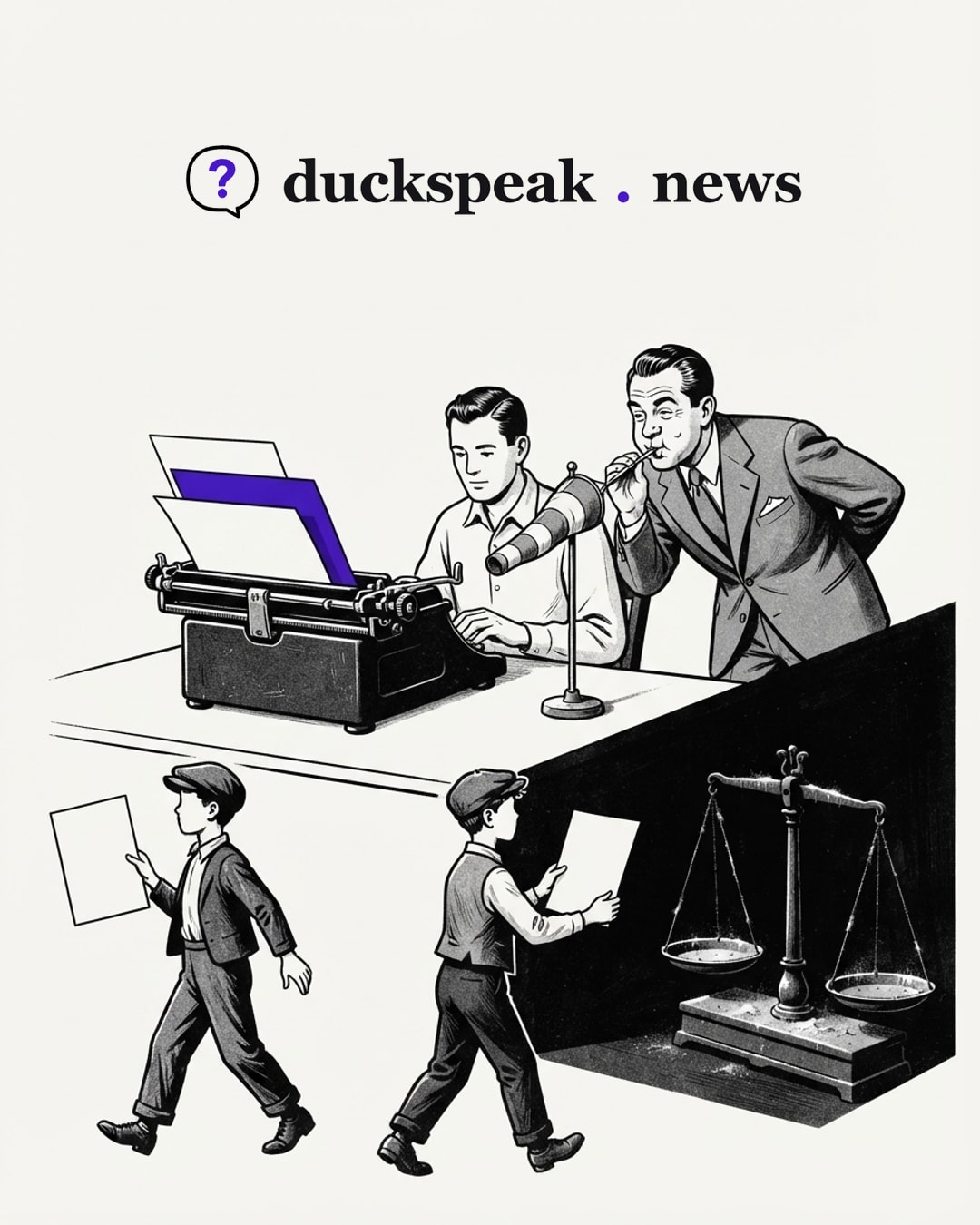
Nothing here requires a conspiracy; it requires wire economics. One newsroom’s framing choices become two outlets’ coverage, and the reader experiences that as consensus. The Huxley half is the product itself: “failing and flailing” [1][2] is alliterative candy, the “red-state sprint” [1][2] is vivid, and the mood, confidence and momentum, is the deliverable. The ABC version even closes with a promo for “24/7 coverage of breaking news and live events” [1], which is honest in an accidental way: the product is coverage, continuous and live, not knowledge. The Orwell half is smaller and colder. The story speaks campaign fluently, “expand the map,” “going on offense,” “shore up support from his base” [1][2], adopting the operatives’ vocabulary as its own. And ‘poised’ does the work of a forecast while wearing the grammar of a description. Nobody said a false thing. A claim was laundered into an atmosphere.
What a reader would need instead
- Independent measures of the House landscape: Cook Political Report’s race ratings, polling aggregates, and the actual names and 2024 margins of the eight districts the Democratic campaign arm added. The story names Kansas, Oklahoma, Virginia and Washington state [1][2] but not the districts.
- The size of the “sizable” cash advantage: how sizable, per whom, over what window.
- A source for the gas-price and Iran pressure claim, or its removal from the narrator’s voice.
- Clear labeling of wire copy and its provenance, so a reader can see that two headlines were one newsroom.
- The fact-checking energy PBS spent on Trump’s rally claims [2], applied symmetrically to “on track,” “poised,” and “has failed.”