

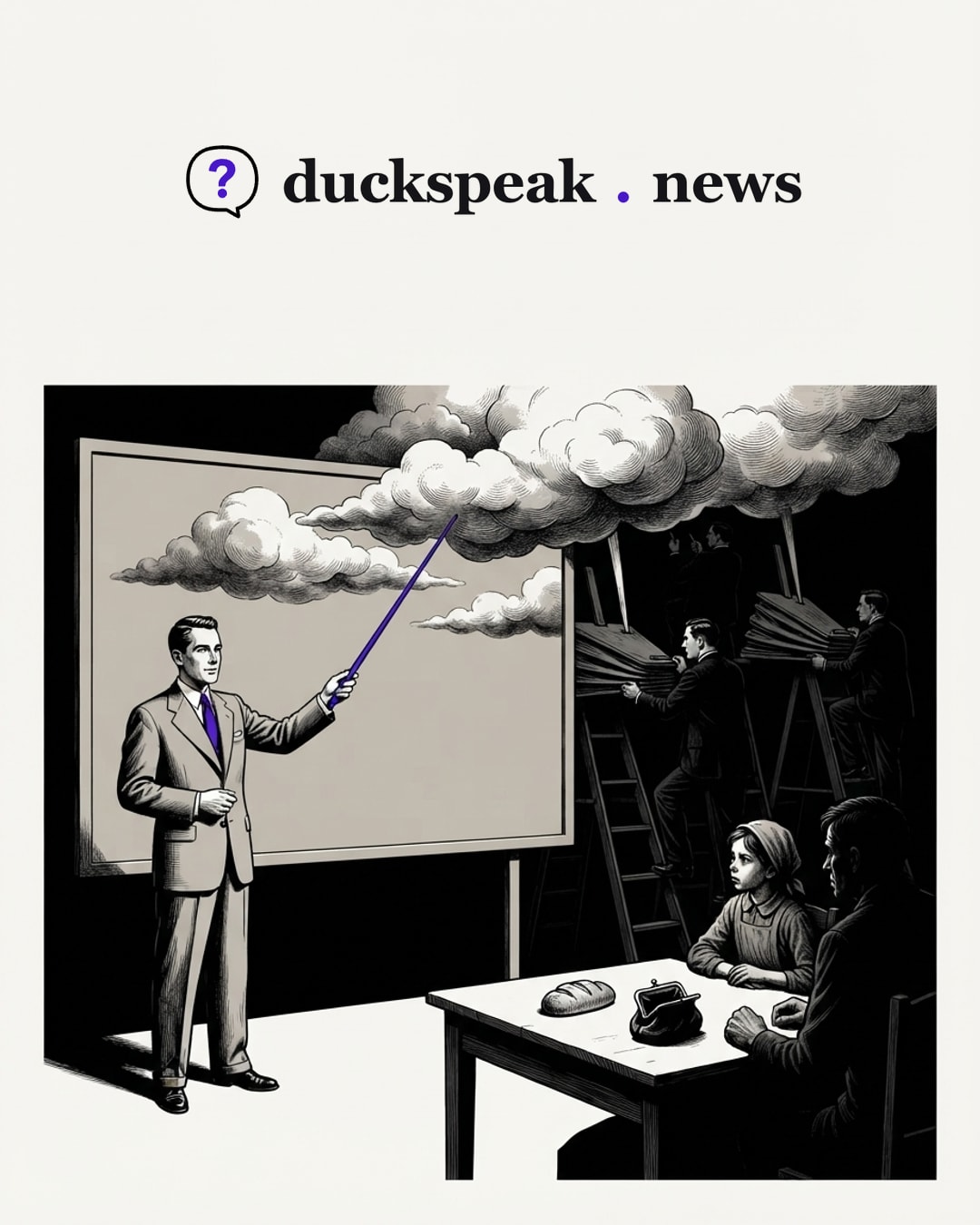
The headline on the PBS NewsHour item, Associated Press wire copy under the byline Eldar Emric, reads: “Serb separatist Dodik declares victory in Bosnia vote as ethnic tensions and EU hopes collide” [1]. Two abstractions collide; no party campaigns, no voter speaks, no wage appears. The lede names the three forces that shaped the vote: “economic pressures, the prospect of the Balkan nation joining the European Union, and ethnic tensions that have divided the country since its brutal 1992-95 war” [1]. Pressures, prospects, tensions: things that happen to Bosnia. What follows is competent wire reporting, and an exhibition of grammar doing politics.
The grammar of weather
Throughout the English copy, abstractions are the only actors. Dodik’s rhetoric “inflamed divisions with separatist rhetoric that have sparked fears of renewed instability” [1]; fears were sparked, by whom the sentence never says. The 1995 peace agreement was “an effort to manage the ethnic divisions between Muslim Bosniaks, Orthodox Serbs and Catholic Croats that gave rise to the war” [1]; the divisions gave rise to the war, not anyone who organized them. A tension divided the country; a division caused a war; fears were sparked. Nobody did anything, because nobody is available in those sentences to have done it.
The writers can write an actor when they choose: the same article reports that “ethnic Serbs took up arms to carve out their own state and join Serbia” [1]. That sentence has hands in it. The causal sentences do not, and the causal sentences are the ones explaining the election.
This matters because the agentless grammar is structurally the nationalist one. Dodik’s own argument, quoted in the same article, is that Bosnia “is dead,” “an impossible country. It doesn’t make any sense” [1]: division as a fact of nature, not a set of decisions. (The parallel is our inference, flagged rather than smoothed.) RFI, same day, writes a different grammar: “l’insistance répétée des grands partis sur une rhétorique de division ethnique héritée de la période de guerre a frustré certains électeurs” (the major parties’ repeated insistence on a rhetoric of ethnic division inherited from the war period frustrated some voters) [2]. In the French sentence, parties insist, rhetoric is a strategy, and voters are its critics. In the English one, tension is weather and everyone is terrain.
The economic pressures that never arrive
The AP lede lists “economic pressures” first among the forces that shaped the vote [1]. The body’s complete economic content is the phrase “One of the poorest countries in Europe” [1]: a rank, not a number. No wage, no price, no year. What the English reader gets instead is great-power theater: Dodik crediting Trump’s “magnificent victory” and Putin’s support [1], the Russian ambassador attending the final rally in Banja Luka [1]. None of that is invented; Dodik said it. But the selection is the message. The English-language reader is given the great powers and denied the price of bread.
RFI, same day, supplies what the lede promised: the average salary rose from 570 to 885 euros since 2022 while the cost of living rose by more than 50 percent, according to the union [2]. It lets a voter speak: Drazen Gvozdenovic, 40, an accordion teacher in Laktasi, asked for improvements “en matière de salaires et d’emploi” (regarding wages and employment) so people could live in peace without worrying about their essential needs [2]. The only voters the English piece shows are “some voters in Banja Luka” who “expressed concern that the new digital systems could confuse older voters” [1]; the electorate appears, briefly, as a logistics problem.
This is the Huxley mechanism, and it needs no conspiracy: an editor reaching for the Trump-and-Putin color instead of the wage numbers is choosing the frame that travels.
The census of nobody
Two sentences in the AP copy assign views to entire peoples, without a named source. “Bosnian Serbs view Mladic as a hero despite his conviction by a U.N. court over the massacre of more than 8,000 Muslim men and boys in Srebrenica in 1995, and other atrocities” [1]. Which Bosnian Serbs, how many, measured how? A named analyst, Dragan Bursac, is quoted for the modest claim that Dodik “is still in command. He is everywhere” [1]; the enormous claim, an ethnic census of opinion, gets no attribution. The bigger the claim, the emptier the attribution.
Then: “the country’s Bosniaks, Serbs and Croats largely vote along ethnic lines” [1]. Both outlets report turnout of 42 percent [1][2]: most of the electorate declined to vote along any lines at all. The sentence describes fewer than half of registered voters and claims the whole country, and RFI’s frustrated voters are evidence that part of the 42 percent wanted a different conversation [2].
The title that outlived the court
RFI’s sharpest detail is linguistic. Dodik was removed in 2025 for defying the international High Representative and barred by court decision from the Republika Srpska presidency for six years, yet remains someone “que son entourage qualifie toujours tout simplement de « président »” (whom his circle still quite simply calls “president”) [2]. The court changed the record; usage changed reality back. That is the Orwell mechanism in miniature, and only the French copy noticed it. The English copy has the analyst’s shrug: “these measures to ban him from political life are not working, and he is using them” [1]. Both outlets report the ban’s failure; one reports that the failure is partly a fact about a word.
Neither piece says what Dodik was convicted of defying. The English reader learns he was “convicted last year of defying decisions by the international envoy overseeing the 1995 peace agreement” [1]; the French, of “non-respect de l’autorité du Haut représentant international” (failure to respect the authority of the international High Representative) [2]. Which decisions, neither says. The conviction travels as a status, not as a dispute.
Small print, unreconciled
AP says turnout was 42 percent, “down by around 8%” from 2022 [1]; RFI says it fell “près de 10 points” to reach 42 percent [2]. Same election, presumably the same data, yet the drop differs by outlet; AP’s “8%” is also ambiguous between points and percent, though AP quotes the Central Election Commission’s raw total of 1,432,269 votes cast [1]. RFI, meanwhile, omits the delays AP reports at 201 of 1,957 polling stations in Republika Srpska [1], and AP’s account of the new scanners, brought in “to prevent irregularities or organized voter manipulation, which have cast doubt on the fairness of previous elections” [1], reports the doubt as fact without saying who cast it. Each outlet’s omissions are the other’s facts.
What a reader would need instead
- The two economic numbers and their union source [2], in the English copy, attached to the “economic pressures” its own lede promises.
- The mechanics of the ban: in power since 2006 [2], barred six years [2], campaigning from off the ballot; and the content of the envoy’s defied decisions, from the High Representative’s own record, since neither piece supplies it [1][2].
- Turnout arithmetic: 42 percent [1][2] means claims about how “the country” votes describe a minority of registered voters; the size of the drop needs checking against the election commission’s figures [1].
- Attribution for collective claims: who honors Mladic, at which events, in what numbers [1], not an ethnic census of opinion.
- A reminder that the PBS item is wire copy [1]: the frame was bought as well as written; another outlet, same day, kept what this one dropped.