

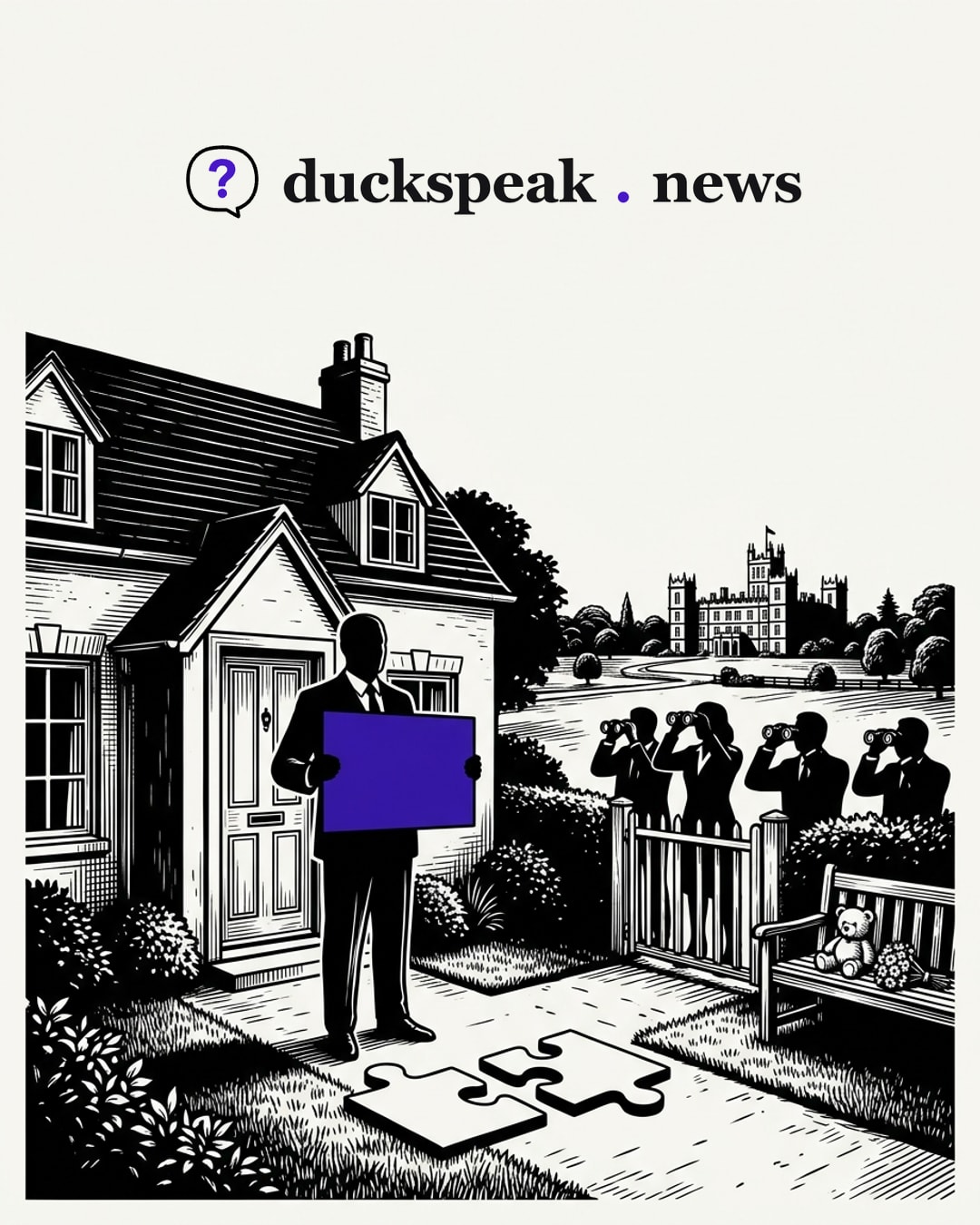
On Tuesday, Mark Cain, 45, was charged with the murder of Dr Hannah Terry, “also known as Hannah Cain,” a GP found dead at her home in Dersingham, Norfolk [1][2][3][4]. Four outlets ran the story: the Mirror, BBC News, the Independent, and GB News. The spine of all four is the same three sentences from the Crown Prosecution Service’s Michael Devaney, reproduced word for word in each piece: “The CPS has decided to prosecute Mark Cain for the murder of Hannah Cain following a police investigation into an incident at her home in Dersingham” [1][2][3][4].
The load-bearing word is “incident.” A murder prosecution becomes “an incident at her home.” Orwell’s appendix to Nineteen Eighty-Four coins “duckspeak” for speech “uttered from the larynx without engaging the higher brain centres”; four newsrooms received one press release and quacked it in unison.
The man with her surname
Here is what the copy contains. The victim: Dr Hannah Terry, 45, a GP at Grimston Medical Centre, a mother of three [1]. The accused: Mark Cain, 45, “of Fern Hill, Dersingham” [2]. The scene: her “address in Fern Hill” [3]. The Mirror reports that “The man, named as Mark Cain, 45, was charged with Hannah’s murder” [1].
Same surname. Same street, on the outlets’ own reporting. A tribute card at the scene calls her “a devoted mum” and signs off “your precious boys” [1]. A neighbour says “They are a lovely, lovely family” [1]. Children at a sleepover “were taken back to their parents’ homes by officers in the early hours” [1].
And in four articles, not one sentence states who Mark Cain is to Hannah Terry. Not husband, not partner, not relative, not stranger. The BBC gives us “a man” [2]; so does the Mirror [1], the Independent [3], and GB News [4]. To be explicit about the limits of this critique: it is possible the shared surname is coincidence, and it is possible the relationship is genuinely unconfirmed; the articles do not say. What is certain is that not one of the four remarks that the man charged shares the victim’s surname and, on their own reporting, her street. The facts sit in the copy like unassembled furniture. A reader who notices the surname must do the assembly alone; a reader who does not is left with a story in which a woman died and a man was charged, connection unstated.
Nobody does anything
Look at the grammar of the coverage. She “was found dead at her home” [3]. “A woman aged in her 40s was pronounced dead at the scene” [1]. “A man aged in his 40s was arrested on suspicion of murder” [1]. The children “were taken back to their parents’ homes” [1]. Nobody in this coverage does anything. Things happen. Orwell, in “Politics and the English Language,” called political speech “largely the defence of the indefensible,” built from euphemism and “sheer cloudy vagueness”; “an incident at her home” is a textbook specimen, a noun with no agent, no act, and no victim, pasted four times without a flicker.
Sandringham, strimmers, and a teddy bear
What fills the space where the relationship fact would go? Royalty, for a start. The Independent’s headline and opening line both promise Sandringham [3]; after that first sentence the estate is never mentioned again, and nothing in the piece explains what it has to do with anything. Sharper still, the Independent folds the royal estate into a sentence attributed to police (“near the Sandringham Estate, Norfolk Police have said”) [3], though no police statement quoted in any of the four articles mentions Sandringham at all. The word is pure newsworthiness signal, a royal postcode doing the work a fact would otherwise do.
The Mirror reports the house “is surrounded by the 20,000 acre Sandringham estate and is just over a mile from Sandringham House” [1], and a caption identifies Dr Terry as “the woman found dead in a £800,000 house in Norfolk” [1]. GB News is so attached to the proximity it renders it as a possessive, “the King’s Sandringham estate,” twice [4].
GB News also selects the neighbour quotes that say the quiet part out loud: “You read about things like this happening in other places. But nothing like it ever happens this close to home” [4]; “It’s the sort of place where if you forget to lock your car and leave it out all night, nothing will happen to it” [4]. That is the safe-village trope, and it smuggles in an assumption: that this kind of death belongs to other postcodes, other classes. The Femicide Census, which records women killed by men in the UK, has found year after year that most such deaths occur at home, at the hands of current or former partners. Whether that pattern holds here is precisely what these four articles do not tell us; the “safe place” quotes are printed without the one fact that would test them.
Then the procedural furniture: “White-suited forensic officers” [1], police “using strimmers and other equipment” [1], evidence “loaded up into the back of an unmarked police car” [1]. The Mirror tells us what tools the police used in the garden. It does not tell us who the man is to her. The BBC supplies “a teddy bear and flowers on a bench” [2]. All of it is true, and none of it is the story. This is the Huxleyan half of the problem: sensation in place of information, a bench and a bear where a fact should be.
The sleepover nobody sourced
The Mirror’s headline: “GP mum-of-three found dead while hosting kids’ sleepover” [1]. GB News puts the same detail in its own headline, in scare quotes: “found dead at home ‘while hosting children’s sleepover’” [4]. In the bodies, the sourcing dissolves. The Mirror: she “was said to have welcomed friends of her children in her home when she died” [1]; said by whom, the article never says. GB News: “The GP was reportedly hosting a sleepover” [4]; reportedly, per nobody in particular. The most emotionally charged fact in two headlines is the least-attributed fact in either story. The Mirror also has her “named locally” and “It is believed that children sleeping over at the house were taken back to their parents’ homes” [1]; belief without a believer.
Privacy, then the doorstep
The Mirror quotes Norfolk Constabulary: the family “have asked for privacy at this difficult time” [1]. The same article then reports, by name and street: “Dr Terry’s parents Stephen and Kathleen Terry also refused to comment at their home in Dersingham” [1]. The privacy request is quoted and then answered with a doorstep, in the same piece. The Independent and GB News also carry the family’s request [3][4]; only the Mirror converts it into a doorstepping note.
A paste that contradicts itself
One more symptom of copy nobody read. The Mirror quotes the police: “A Home Office post-mortem examination took place yesterday (Monday 5 October), the outcome of which is that the cause of death is pending further investigation” [1]. Later, the same article states: “Norfolk Police have not yet revealed the results of a post mortem by a Home Office pathologist which was due to be carried out yesterday” [1]. The statement says the examination happened and the cause is pending; the article says it was still due. Both cannot be true. GB News, meanwhile, opens with the charge and then reports that “On Tuesday, police confirmed a man in his 40s had been arrested on suspicion of murder” [4], though the arrest, on the Mirror’s and BBC’s accounts, was Sunday [1][2].
What a reader would need instead
- The relationship between the accused and the victim, or an explicit line saying it is unconfirmed. In a murder charge at a shared address, it is the organizing fact, and its absence should be visible to the reader, not silent.
- The cause of death, which on the police’s own statement is “pending further investigation” [1]; no mechanism of death has been established, and coverage that buries that invites assumption.
- Pattern context for the “safe village” quotes: the Femicide Census tracks UK women killed by men and finds, year after year, that most are killed by current or former partners, at home. Readers need the relationship fact to place this case against that pattern.
- The court reality: Cain appears at Norwich Magistrates’ Court on 7 October [1][2][3][4]; a charge begins a process, it does not end one.
- Attribution for headline facts. If the sleepover is “reportedly,” the report should say by whom, or the detail should stay out of the headline.