

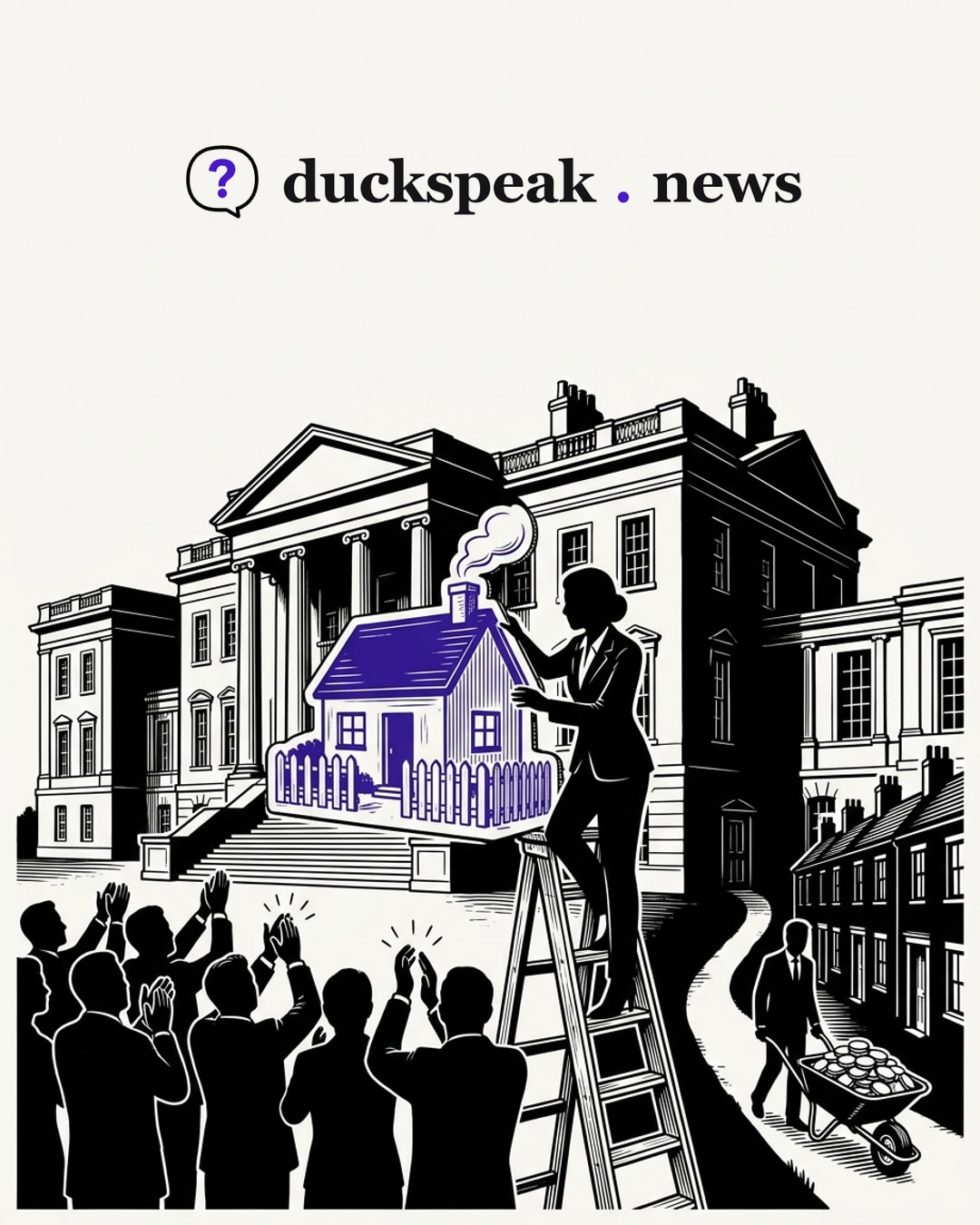
On Wednesday, three British outlets described the same pledge in the same three words. The BBC’s headline has Badenoch scrapping “inheritance tax on family homes” [3]; the Guardian reports, in its own voice, that the Conservatives “would abolish inheritance tax on family homes if elected” [1]; the Mirror has her planning to “slash inheritance tax on family homes” [2]. No newsroom coined the phrase. It is hers, verbatim: “We will legislate so no-one pays inheritance tax on their family home” [2]; “nobody will ever pay inheritance tax on their family home” [3]. The exemption is unlimited by value, and “family” is the adjective that makes an unlimited exemption sound modest and universal. This is how a frame becomes news: not through argument but through vocabulary adopted into headlines and neutral copy until it reads as description.
The word that erases the price tag
Everyone in this coverage effectively agrees on who the policy serves. The only economist quoted in any of the three pieces, the Institute for Fiscal Studies’ Stuart Adam, appears in the Guardian alone: “The biggest beneficiaries would be those with the highest wealth and the most valuable homes. These will mostly be people living in London and the south-east” [1]. Reform UK, attacking from the right, says only 2% of households would gain, most of them in London, citing Savills analysis [1][2]. Yet “family homes” survives in all three outlets, because it is the politician’s word and it flatters the policy.
The same move absorbs the mansion tax. The levy is the High Value Council Tax Surcharge, an extra charge on English properties valued above £2m, due from 2028 [3]. Badenoch folds it into her guarantee as “no mansion tax when you live in your home” [1]. The Guardian then reports, in its own voice, “repealing the mansion tax”, threshold unmentioned [1]; the BBC at least writes “dubbed the ‘mansion tax’” [3]. A £2m threshold is a fact; “your home” is a feeling, and the feeling won.
The claim and the fact that never met
Near the end of a 66-minute speech, Badenoch said inheritance tax “was supposed to be a tax on the super wealthy” but is “now a tax on ordinary middle-class families in every corner of our country” [3]. The BBC printed the claim. Paragraphs earlier it had stated that “In 2023-24, 4.72% of UK deaths resulted in an IHT charge” [3]. The two never meet. The Guardian carried the same number (“currently less than 5% do so” [1]) and the Mirror the same fact in friendlier arithmetic (“just one in 20 estates are hit by the levy” [2]); both placed it near the pledge, which is better, though the Mirror’s piece is a live blog, so “near” means in the sequence as published. Nowhere does an outlet’s own voice say what the number does to the claim. The refutation exists only as attributed criticism: the TUC’s Paul Nowak (“95% pay no inheritance tax at all” [2]), Tax Justice UK [1], Labour’s Bridget Phillipson [1][2][3]. When the arithmetic contradicting a claim is available only in an opponent’s mouth, the claim stands as one voice among several rather than as a checked assertion. The Guardian’s headline sharpens the asymmetry: “Tories accused of prioritising rich voters” [1]. Who benefits is an accusation; “family homes” is a fact.
A second join went unmade inside the BBC’s own copy. The policy “would cost around £6bn a year” [3]; inheritance tax “raised around £7bn” in 2023-24 [3]. Both numbers, one article, no meeting. Joined, they say the pledge would surrender most of the tax’s entire annual yield. The BBC even lists an explainer, “What’s in the Conservatives’ inheritance tax plan and who benefits?”, as a link [3]; the joining is deferred to a sidebar, and what that page contains cannot be judged from what travelled with the article.
“Savings” and “the welfare bill”
The Guardian: the £6bn cost “to be paid for by cuts the party says it has identified, including to the welfare bill” [1]. The BBC: “£71bn of savings that can be made to government spending, including welfare cuts” [3]. “Savings” and “welfare bill” are the register of housekeeping, and housekeeping has no victims. What the words describe is a transfer: money taken from benefit recipients, programs and people unspecified, and handed to the estates the IFS says are mostly the highest-wealth households of London and the south-east [1]. No outlet’s own copy states the transfer. The Guardian comes closest through a quoted campaigner (“deprive public services of cash” [1]) and the Mirror through the TUC (“leaving working people to pick up the bill” [2]), but in both cases the redistribution arrives as an opponent’s rhetoric, contestable by association, not as a fact of the ledger. Meanwhile the £71bn figure, which if real would imply cuts dwarfing the £6bn required, passes without assessment; the Office for Budget Responsibility, the institution that exists to adjudicate exactly this kind of claim, appears nowhere in the coverage.
Even the Guardian’s one genuinely original policy critique, that the plan risks “overheating the housing market, giving elderly homeowners an incentive to stay in large family homes rather than downsize” [1], is rendered as something “likely to raise fears”, fears raised by nobody in particular. The passive voice is where an outlet keeps a fact while declining to own it.
Money you “earn” by inheriting it
The Mirror quotes Badenoch promising to focus on “letting people ‘keep more of what they earn’” [2]. Inheritance tax is charged on the estate of someone who has died; the people keeping more are heirs who did not earn it. The slogan imports the moral grammar of income tax, your wages and your money, onto unearned transfers, and the distinction between earning and inheriting is the very thing the policy argument is about. It is printed without a word of note.
The ovation count and the arithmetic
The Mirror’s centre of gravity is the room: “the room just erupted”, “three consecutive standing ovations” [2]. The BBC supplies the M&S revival analogy and the “Paddington Bear prime minister” [3]; the Mirror the Iron Dome mockery and the “fantasy economics” jibes [2]. The Guardian observes that “Most of her speech, however, was devoted to attacks on her opponents” [1], an observation that describes a good deal of the coverage too. This is the Huxleyan half of the mechanism: the theatre is the meal, the arithmetic is the garnish. A reader who finishes all three pieces knows the standing-ovation count with certainty; whether the £71bn exists is a matter of what the party “believes” [3].
One small tell deserves preservation: the Mirror pastes Paul Nowak’s quote, in full, three separate times in one rolling article [2]. That is not conspiracy; it is the metabolism of live coverage, in which a press release becomes “reaction” and “reaction” becomes reporting, each repetition standing in for analysis.
What the pieces got right
To be fair to all three, the facts were in the building. The Guardian quoted the IFS and raised the downsizing distortion; the Mirror printed the single most clarifying datum in any of the pieces, that “married couples already have a combined tax-free property limit of £1million” [2], which means the “additional £1m” pledge sits on top of an allowance that already exists; the BBC supplied the 4.72% and the £7bn yield. The critique is not absence but assembly: the frame ran in the headlines and the outlets’ own descriptive voice, and the facts were left in paragraphs where they could not touch it.
What a reader would need instead
- The IFS distributional analysis at the top, not the bottom: who gains, by how much, and where. Adam’s quote [1] is the model, and the IFS publishes this work.
- HMRC’s inheritance tax statistics joined directly to the “ordinary middle-class families” claim: roughly one estate in twenty pays, and taxable estates concentrate in London and the south-east.
- The existing allowances stated beside the pledge: couples already pass £1m of property tax-free [2]; the pledge adds the home at any value plus another £1m.
- The £6bn cost joined to the £7bn yield [3], and the £71bn “savings” sent to the OBR, or at least to an economist, for assessment, with the specific welfare programs on the cutting end named.
- The thresholds restored to the vocabulary: a “family home” here means any home at any value, and the “mansion tax” is a surcharge above £2m [3].