

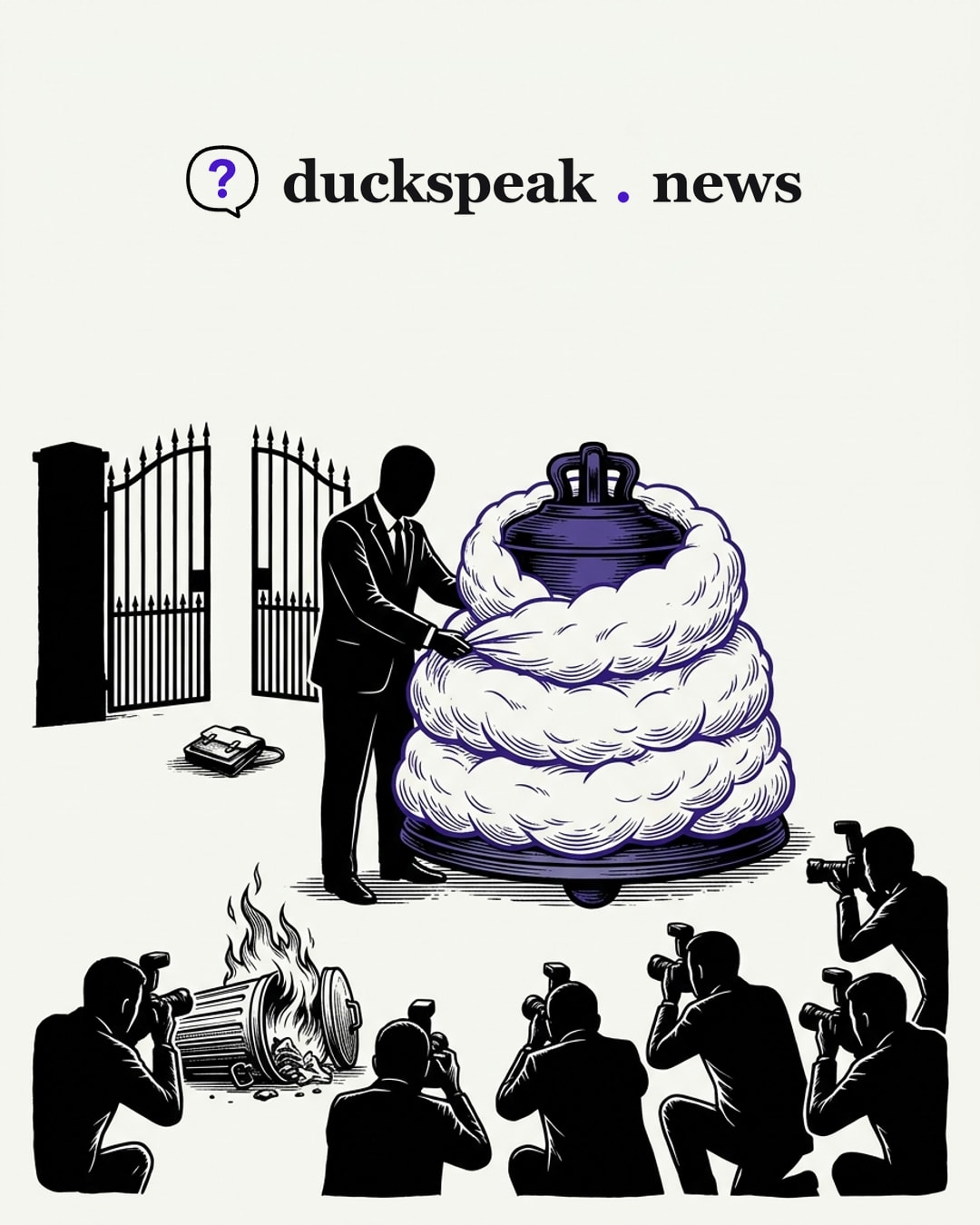
On Monday, near the Lycée Auguste-Béhal in Lens, a police stun grenade tore off a 15-year-old boy’s hand [6]. By Wednesday morning, Interior Minister Laurent Nuñez had suspended the weapon, but only “pour le mouvement lycéen” (for the student movement) and only until the facts of Lens had been “clarified” [3][4][6]. In the days between, the English-language press produced coverage of France’s school protests in which nearly every load-bearing word was supplied by the French state. This is not an accusation of conspiracy; it is an inventory. What traveled was the frame.
Two sentences on tour
Prime Minister Sébastien Lecornu told MPs that “extreme violence” had come “knocking on high-school doors, and must be condemned” [1]. PBS NewsHour rendered the line as “Extreme violence has knocked on the doors of these high schools, and this extreme violence must be condemned unconditionally” [2], under a notice that its transcripts “may contain errors”. NPR printed “ultra violence” [5]. Without the Assembly transcript, the faithful rendering cannot be settled from these six pieces; three renderings in three outlets suggests a line circulating as paraphrase rather than checked citation.
Notice the metaphor’s work: in Lecornu’s sentence, violence is a visitor at the school gate. It was riot police who came to the school gates with launchers [1][3][6]; the grammar reassigns the knocking to the teenagers.
The second touring sentence is Nuñez’s: the police response was proportionate in “almost all cases” [2][5]. The qualifier is a concession in plain sight. “Almost all” admits some cases were not proportionate, and no outlet printing it asked how many, or against what standard. The Guardian paraphrased it into softness, reporting that officers “had mostly acted proportionately” [1]. The ministry that deploys the weapons, certifies their proportionality, and runs the internal reviews is the same ministry [1][3].
The ledger with no weights
PBS NewsHour: “About 300 students and staff have been injured, as have some 700 police officers” [2]. It is a scale with two pans and no weights. One pan holds 215 teenagers and 85 school staff [1], among them a 14-year-old whose “jaw is sealed shut, he can no longer speak and he eats through a straw” [1], a 16-year-old who lost the use of an eye to what a prosecutor called “a defensive bullet of the blast ball type” [1], and the hand at Lens. The other pan holds 715 officers [1][5], severity unspecified in every outlet. The ledger implies equivalence; the specifics all run one way.
PBS also reports, without comment: “Authorities said 300 hostile individuals attempted to confront officers on a day where 56,000 students, parents, and teachers marched” [2]. Half of one percent of the march defines the clash frame, and the adjective “hostile” is the authorities’ judgment absorbed into the newsroom’s own sentence.
The numbers drift unreconciled: the interior ministry’s turnout is 200,000 plus 56,000 in Paris in one outlet [1] and 266,000 in another [5]; arrests are “roughly 6,000” [2], “more than 6,100” [1], “more than 6,500” [5]. Six thousand arrested children, “almost all of them minors” [1], and no outlet offers a historical baseline; the number is printed as weather.
The grammar of the maiming
The Guardian: “On Monday, a 15-year-old’s hand was blown off as protesters battled riot police in northern France” [1]. No agent; the hand was blown off the way a roof is. NPR: the boy “lost a hand Monday in an incident involving a police stun grenade” [5]; the grenade is an ambient circumstance of an “incident”, not an instrument in anyone’s hands. NPR then quotes Lecornu pledging that any “accidents” would be investigated [5]. “Accident” pre-assigns the verdict: no doctrine, no intent, only misfortune.
The French record contains the missing agent. Green MP Benjamin Lucas-Lundy, as France-Soir reports in translation, spoke of a 15-year-old who loses a forearm “parce qu’on a envoyé sur lui une arme de guerre” (because a weapon of war was sent at him), and demanded Nuñez’s resignation [6]; the minister replied that evoking war weapons was “n’importe quoi” [6]. France-Soir adds that the GLI-F4 was “classée matériel de guerre” (classified as war material), and its replacement, the GM2L, “reste classée en catégorie A2, donc toujours comme arme de guerre” (remains classified in category A2, therefore still as a weapon of war) [6]. The Guardian, to be fair, is the strongest Anglophone piece here; it names Amnesty, prints the mother’s quote, gives the prosecution figures. The critique is about grammar, not absence.
The euphemism chain
The weapon’s French name is “grenade assourdissante”: deafening grenade. France Info explains it produces a detonation “de l’ordre de 160 décibels” (on the order of 160 decibels), comparable to “une arme à feu bruyante” (a loud firearm), fired from a launcher [3]. The English press renders it “stun grenade” [4][5]. A device whose documented injuries include mutilations and hearing loss at Sainte-Soline in 2023 [3] becomes, in translation, a device that merely stuns.
The BBC performs the full chain in four sentences: a boy’s “hand was blown off” in Lens; the minister requested a pause; “rights groups have complained of police using disproportionate force”; and police unions “have said they need non-lethal options such as stun grenades” [4]. The hand and the phrase “non-lethal” are three sentences apart in the same piece, and nothing in the piece notices.
France Info supplies the pattern’s engine: for the ASSD model used at Lens, “ce qu’il s’est passé à Lens semble être le premier cas” (what happened at Lens seems to be the first case) [3]. Each model is a first case. The GLI-F4 tore off a hand at Notre-Dame-des-Landes in 2018 and injured people during the gilets jaunes; the GM2L mutilated at Sainte-Soline; the ASSD is novel [3]. The weapons rotate, the novelty resets, and the history never accumulates into the English-language frame.
The spectacle does the rest
The BBC’s page is headlined “Watch: Why French police have stopped using stun grenades on student protesters” [4]. The “why” is answered with the minister’s own words, and “stopped” overstates a pause scoped to one category of crowd and one pending inquiry [3][6]. Below sit three video links, among them “Watch: Bin on fire at school protests on the streets of Lille” [4]. The bin on fire has a thumbnail. The severed hand does not. This is Huxley’s mechanism rather than Orwell’s: no censor removed the maiming; the format simply has no slot for it. PBS opens its report “Along the grand promenades of Paris, police in riot gear, firing tear gas at protesters, many of them young teens” [2], and the travelogue cadence does the soothing.
What a reader would need instead
- The rulebook: the code de la sécurité intérieure allows these weapons only when “absolument nécessaire” (absolutely necessary), and the interior ministry’s own 2020 guidance concedes it is “jamais anodin de les utiliser” (never trivial to use them) given their “danger potentiel” (potential danger) [3].
- The inquiry’s scope: the IGPN, “la police des polices” (the police of the police) [3], must establish whether the boy picked up the grenade or it landed on him, and whether the shot was “réglementaire” (compliant) [3]. The child’s conduct is the first question; compliance, not harm, is the standard.
- The parliamentary machinery: the Laws Commission was scheduled to audition Nuñez on Wednesday afternoon [6]; a petition live on the National Assembly’s site since 5 October demands a ban on “armes mutilantes” (mutilating weapons) in student demonstrations [3]. The Guardian reported ten internal investigations on Tuesday [1]; France-Soir counted eighteen by Wednesday morning [6].
- The precedent: an administrative inquiry opened in 2025 after Libération and Médiapart documented gendarmes’ dangerous use of these weapons at Sainte-Soline, including what France Info summarizes as a “volonté de blesser gravement des manifestants” (will to seriously injure protesters) [3]. An “accident” framing that never mentions a documented “will to injure” is a framing choice.
- The named actors: Amnesty International demanded an end to “disproportionate police repression” [1]; the BBC shrank it to unnamed “rights groups” [4]; PBS carried no rights-group voice at all [2].
One caveat, stated plainly: without the Assembly transcript, the divergence between “extreme violence” [1][2] and “ultra violence” [5] may be a translation artifact or a paraphrase chain; we flag it rather than resolve it. What is not uncertain is the direction of the vocabulary. Across six outlets, the state’s words arrived pre-assembled, and the state’s weapons arrived grammatically agentless.