

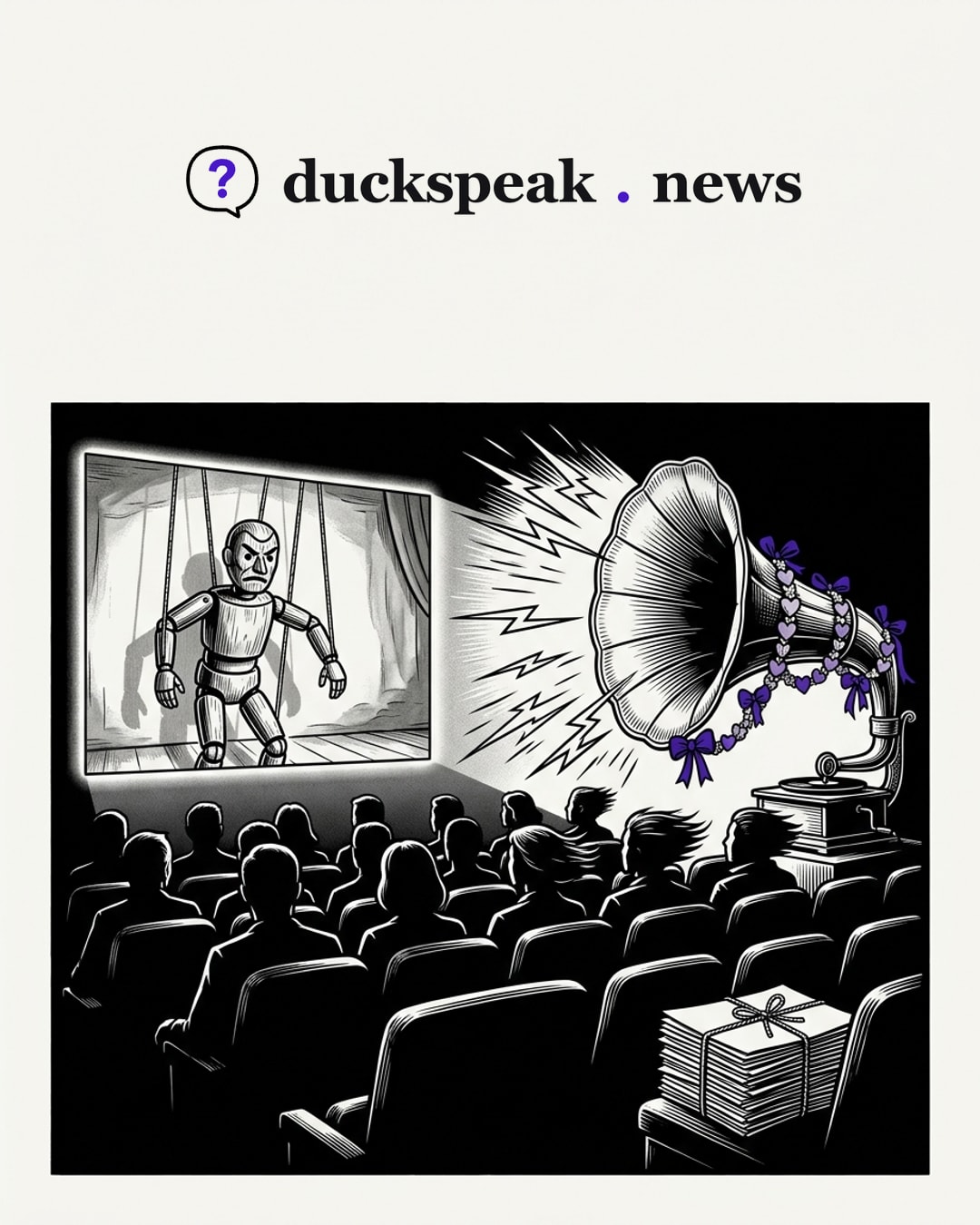
Two reviews of Aaron Sorkin’s “The Social Reckoning,” the dramatization of Frances Haugen’s Facebook Files leak, arrived from the Guardian and from France Info. Between them they demonstrate a two-stage maneuver: first a documented scandal is converted into drama, then the drama is converted back into citation. What gets lost at each stage is checkable, because both reviews name the primary documents and then point the reader at the movie instead.
The euphemism that survived the exposé
France Info explains that Facebook adopted an algorithm “qui fonctionne sur le principe dit des ‘interactions sociales significatives’ (MSI)” (which works on the so-called “meaningful social interactions” principle) and which, in the review’s own words, “amplifie la diffusion des messages haineux” (amplifies the spread of hateful messages) [2]. Read that pairing slowly. The mechanism that amplifies hate speech is named, in quotation marks, as the pursuit of significant social interaction. The Guardian renders the same mechanism with the euphemism stripped away: Zuckerberg “changed the algorithm so that engagement was supercharged by rage bait and hate speech, malice and envy” [1]. One review quotes the camouflage while describing the gun; the other translates. The euphemism outlived the exposé.
This is the cleanest Newspeak in the source material. Orwell’s political speech, designed to make lies sound truthful, is usually a metaphor; here it is a product spec. A company names its rage amplifier after meaning, and the name is sticky enough that a review of a film about the harm repeats it in quotation marks, as though the marks were skepticism rather than transport. Quotation marks around an official euphemism are not critique; they are the euphemism’s commute to work.
One word, two owners
The Guardian catches a second inversion and drops it in a subordinate clause. Haugen “is dismissed as a ‘disrupter’” in the film, and the review notes that “this in other circumstances is what oligarchs smugly call themselves” [1]. That is doublethink in a single lexical item: disruption is innovation when capital performs it, sabotage when an employee does. The observation deserves a headline. The headline went elsewhere: “all-new evil puppet Zuckerberg” [1]. France Info’s headline does the same, promising “l’approche discutable de la liberté d’expression par son patron Mark Zuckerberg” (its boss Mark Zuckerberg’s questionable approach to free speech) [2]. Both reviews sell the man. The Guardian’s own review concedes the man is “almost a cameo” in the film [1]. The system is the story; the villain is the marketing.
When the script becomes the record
France Info’s review is the sharper case study in laundering. It states, as a fact about the actual executive, that Zuckerberg is a man “dont la phrase préférée est ‘le débat est clos’” (whose favorite phrase is “the debate is closed”) [2]. Is that a documented habit or a line Sorkin wrote? The review does not say, and from the material available I cannot tell; that is precisely the problem. The film is labeled “inspiré de faits réels” [2], the standard dramatization disclaimer, and the disclaimer evaporates on contact. By mid-review, script dialogue carries the citation structure of a finding: a fictional PR officer’s line that Facebook is “post-gouvernement” is glossed as evidence of “la pleine mesure que l’entreprise a de sa puissance” (the company’s full awareness of its power) [2]. The review even asserts its subject as “les égarements avérés” (the proven missteps) [2], avérés, a word doing the verification the review never performs.
The pairing inside that same review is worth holding up: Zuckerberg defends “une liberté d’expression ‘sans limites’” while his supposed favorite phrase closes the debate [2]. If that juxtaposition is Sorkin’s, it is a good joke. France Info repeats it as a characterization of a real person, and the reader cannot see the seam. The irony is that the review holds a piece of actual record and still routes the reader through the film: Haugen’s testimony, quoted at length (“l’entreprise cache délibérément des informations cruciales au public” [2]), is real, public, and available, yet the review’s conclusion is that Sorkin’s “magie du cinéma” makes it all “plus accessible” [2].
The omission the film chose and one review inherited
The Guardian’s best finding is about absence: the film “does not say aloud the word ‘Trump’ and rather cravenly declines to specify Maga activity” [1], despite presenting Facebook as “a major player in the Capitol riots” [1]. A reckoning that will not name the beneficiary of the rage it documents is a limited one. The Guardian also notes the period framing: the story is frozen at the moment “when it seemed as if the Capitol riots were the ultimate wake-up call and moderation had returned” [1], while the closing credits concede that Facebook “still isn’t checking political ads” [1]. The present-tense fact is buried where films bury caveats. The Guardian adds the wider freeze: “the values of investigative journalism have been thrown out at the Washington Post by its owner Jeff Bezos” [1]. France Info registers none of this. Its review pivots instead to a montage of current tech bosses (Altman, Amodei, Musk) and even the pope’s encyclical [2], which keeps the personality frame and loses the platform’s actual current policy entirely.
The remedy is more screen time
France Info closes its case with a prescription: “tout utilisateur majeur de Facebook devrait se passer The Social Reckoning en boucle” (every adult Facebook user should watch The Social Reckoning on repeat) [2]. The critique of the engagement machine, delivered as an engagement instruction. The review, a public broadcaster’s culture desk, is itself formatted as a product listing, complete with “Distributeur : Sony Pictures France” [2], and it ends by teeing up the next release in the genre, Guadagnino’s “Artificial” about Sam Altman [2]. Harm as franchise. The Guardian names this condition in its opening line: the film is “for all those people who solemnly deplore social media in conversation but haven’t quite got round to deleting their accounts” [1]. Deplore and scroll; now deplore and rewatch. The Guardian also catches the film manufacturing comfort: the radicalized acquaintance glimpsed “looking ambiguously appalled by what she has become,” which the reviewer suspects is “just the film-makers’ wish fulfilment” [1], and the whistleblower dressed in “a slinky evening dress” so the lead “looks glamorous” [1]. The harm must be watchable and the arc must resolve.
What a reader would need instead
The primary record, all of it named inside these very reviews: Haugen’s testimony to the US Congress and the European Parliament, partially quoted in [2]; the 17 Wall Street Journal articles by Jeff Horwitz that the film is built on, cited by France Info [2]; a passing, unsourced claim that a majority of US states recently made Meta bend over youth addiction, worth chasing to its actual source [2]; and the one present-tense policy fact, that political ads still go unchecked, conceded in the film’s own credits and reported by the Guardian [1]. Read the documents rather than the digest of the dramatization of the documents. And when a review puts an official euphemism in quotation marks, ask whether the marks are performing skepticism or just carrying the word through one more cycle.