

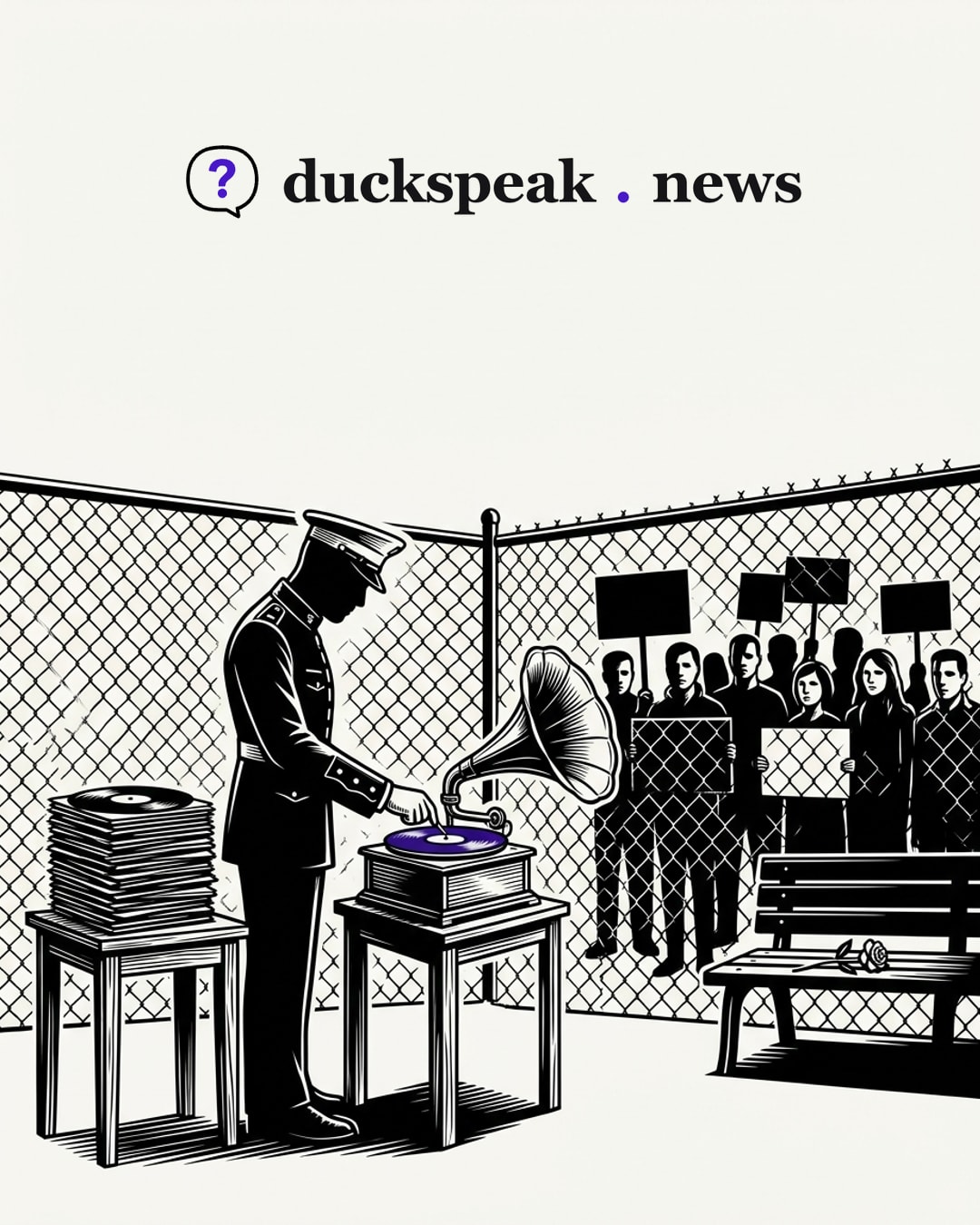
Two outlets, one arrest, and a vocabulary doing quiet work. After a Marine, Lance Cpl. Devin Jacob Ballard, was arrested in Okinawa on suspicion of strangling Anna Yagi, 39, at a Naha hotel and stealing her wallet and backpack [1], the news in both pieces quickly stopped being the killing and became the response to it. PBS NewsHour, carrying the Associated Press, headlines the institution’s action: “U.S. restricts troops from leaving Okinawa base after Marine accused of murder” [1]. The killing is grammatically subordinate, arriving “after” the restriction. RFI’s lede does the same in French: the alleged murder “continue d’alimenter de vives tensions,” continues to fuel sharp tensions [2]. In both framings the death matters chiefly as a cause of other things: a lockdown, a political complication, an anger to be managed.
The reflection ritual
The commander’s letter is the document both outlets work from, and AP quotes it generously. Lt. Gen. Benjamin Watson writes that episodes like these “demand we pause for reflection” [1]. Episodes. A suspected strangling and robbery compressed into a noun that could as easily describe a traffic incident. In the passages AP quotes, the victim is absent; the damage is to “trust”: “When that trust is damaged, it affects the strength of our alliance and the security of this region” [1]. The injury is measured in alliance units. The remedy is introspective: “we will take time to think hard about discipline, standards and our alliance responsibilities” [1]. Note where the list lands. A woman’s death ends as an “alliance responsibility,” filed beside deterrence.
Then the pastoral register: “We live, work, and socialize alongside the people of Okinawa; their home is our home” [1]. This is the Huxleyan half of the mechanism, the sedative. A garrison on an island under U.S. occupation until 1972 [1], hosting nearly 30,000 active-duty troops [1], what RFI calls the largest American force stationed abroad [2], is rendered as a neighborhood. “Their home is our home” asks the reader to feel the cohabitation rather than count the bases.
The routine, stated as routine
AP supplies the sentence that should have been the story: “Restricting the ability of troops to leave military bases and interact with the local community is a common response by military leaders to major crimes” [1]. Common. The ritual is named as ordinary governance rather than as its own indictment. Two paragraphs on, a resident, Kenji Higa, tells the Okinawa Times: “I must say, discipline and troop education are not working at all” [1], referring to measures taken after past cases. The contradiction sits on the page; the framing never joins the dots. The number that would join them is buried mid-piece: criminal cases linked to the U.S. military rose to 101 last year from about 40 in 2020, according to police [1]. A two-and-a-half-fold increase in four years is the news; the pause is the press release. AP also records the lineage of anger: the 1995 rape of a 12-year-old by three service members, and the 2024 rape of a teenage girl whose disclosure was delayed [1]. What measures followed those cases, the piece does not say; the inference that this ritual has run before is mine, and I flag it as such.
Two outlets, two different crackdowns
Here the transmission turns strange. AP reports a two-day stand-down: the military “pausing all operations for two days,” a 48-hour pause “from Wednesday through Friday,” plus training on standards and discipline [1]. RFI reports a different set of orders: a 30-day curfew “entre minuit et 5 heures du matin” (midnight to 5 a.m.), a 48-hour alcohol ban, and disciplinary training for every service member on the island [2]. These may be complementary parts of one announcement; a stand-down and a curfew can coexist. Nothing in either piece says so. A reader of AP alone comes away believing the restriction lasts 48 hours; a reader of RFI believes it lasts a month. The order is public, or at least AP says the letter was “posted on social media” [1], yet neither outlet renders it whole. The split has a shape: AP quotes the sentiment (“pause for reflection,” “their home is our home” [1]); RFI lists the enforcement (curfew hours, alcohol ban [2]). The American reader gets the poetry; the French reader gets the policing. Whether that division is editorial choice or accident, the articles do not say; the effect is checkable, and it is that no reader of either piece can reconstruct what was actually ordered.
RFI’s metric is calm
RFI’s governing question: “Est-ce que ce tour de vis suffira à calmer la colère de la population ?” (Will this tightening of the screw be enough to calm the population’s anger?) [2]. The success metric is calm, not justice, not structural change. The victim, in RFI, is never named: “une femme de 39 ans” (a 39-year-old woman), “une habitante d’Okinawa” (an Okinawa resident) [2]. AP names Anna Yagi once [1] and gives her no existence beyond the crime; RFI gives her no name at all. To be fair to both, the suspect has denied the allegations, according to Japanese media [1], and RFI notes the denial too [2]; the presumption of innocence survives the framing even where the victim’s name does not. RFI does supply case history AP lacks: a Marine sentenced last year to seven years for strangling a woman in her twenties and attempting to rape her, and, in 2017, a former Marine turned civilian base employee sentenced to life for the rape and murder of an Okinawan resident [2]. The pattern is printed; the question remains crowd control. The governor’s word, “fardeau,” burden, is adopted wholesale, with the demand to “alléger” it, lighten it [2]. Burden, tension, anger: a vocabulary of weights and pressures to be relieved, not of crimes to be stopped.
The passive that does the geopolitics
One AP sentence deserves its own audit: “some have come to see its strategic value due to what is widely viewed as a growing threat from China” [1]. Widely viewed, by whom? The passive performs the analysis while naming no analyst. The same piece reports the killing “could also complicate Prime Minister Sanae Takaichi’s push to strengthen the Japanese military on Okinawa and to work more closely with the U.S. military to deter China” [1]. Complicate. A death and a deterrence policy are placed on the same scale of inconvenience. This is the Orwellian half of the mechanism working in tandem with the soothing one: abstraction (“episodes,” “trust,” “complicate”) shrinks the event, while the pastoral (“their home is our home”) anesthetizes the structure that produced it.
What a reader would need instead
- The full text of Watson’s order, which AP says was posted on social media [1]. Quote it whole, and the 48-hour pause [1] and the 30-day curfew [2] can be reconciled, or exposed as divergent reporting of the same announcement.
- The trend as the lede: 101 military-linked criminal cases last year against roughly 40 in 2020, per prefectural police [1]. That number is what makes “pause for reflection” a rerun rather than a response.
- The victim’s name in every outlet. AP has it [1]; RFI does not [2].
- The ritual’s history attached to each new performance of it: 1995, the 2024 rape and its delayed disclosure [1], the seven-year sentence and the 2017 life sentence RFI cites [2].
- Attribution for “widely viewed” [1]: who views the threat as growing, and who does not. Okinawan opinion already exists inside AP’s own reporting, via the Okinawa Times and Kenji Higa [1], and the prefectural police already track the crime data [1]. Point the reader to the institutions that count, not only to the general’s letter.