

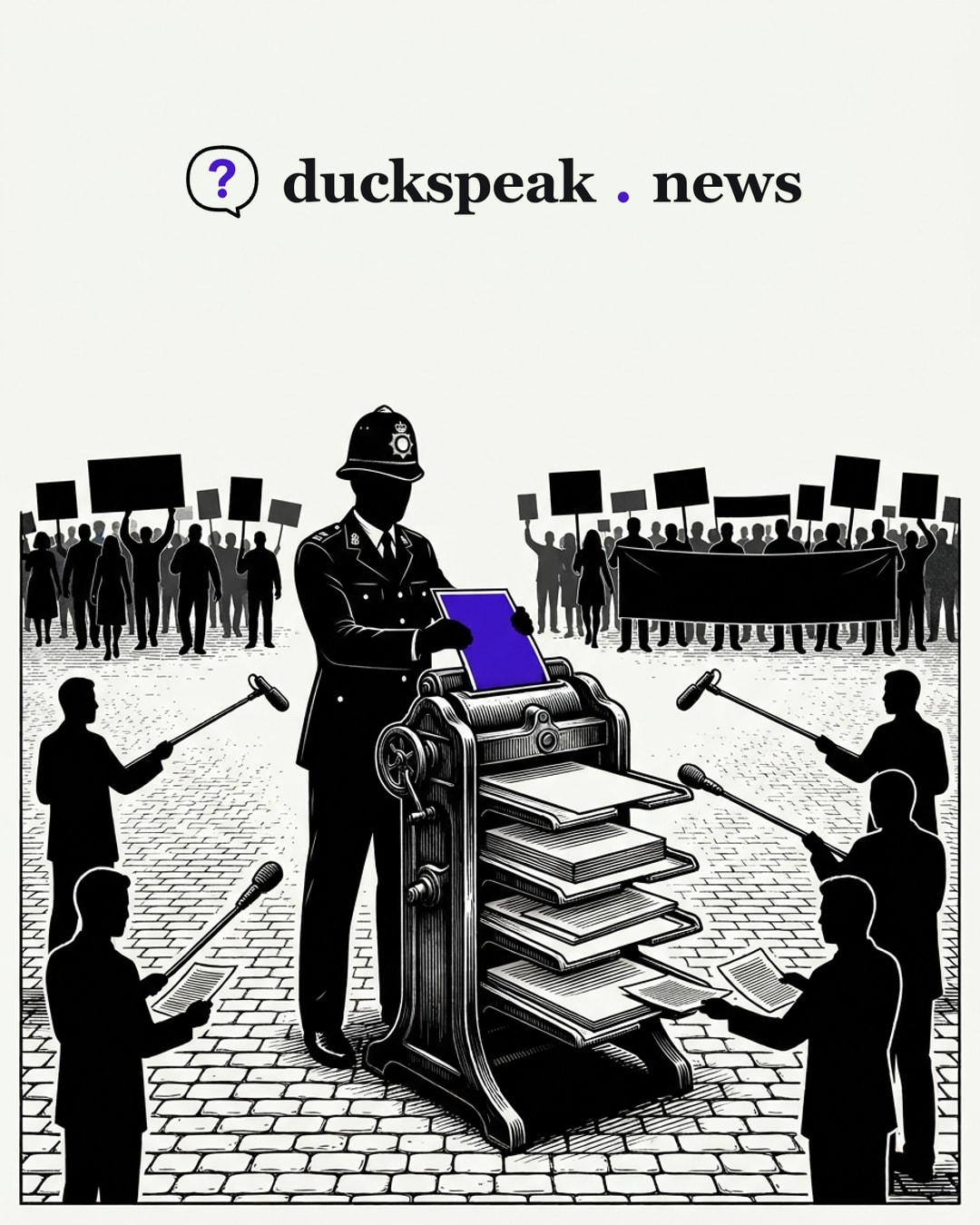
Five people were arrested outside the Board of Deputies of British Jews in Camden on Wednesday, on suspicion of inciting racial hatred, allegedly for chanting “intifada.” Eleven arrests were made across the day’s protests and counter-protests in London. Or possibly seven, depending on the outlet; that discrepancy is one finding of this piece. The larger one concerns authorship. Across four reports, from the BBC, The Independent, The Mirror and GB News, the story was written substantially by the Metropolitan Police [1][2][3][4].
One statement, pasted, then pasted again
The Met’s statement reads: “Earlier this morning, officers made arrests at a spontaneous protest outside the British Board of Deputies in Camden. Five people were arrested for inciting racial hatred, involving allegedly shouting or chanting slogans calling for intifada. They remain in police custody. The protest in Camden has now ended.”
The Independent prints it in full, attributed to “Scotland Yard,” then prints it again further down the same article, almost word for word, under the heading “Separately, the Metropolitan Police said” [2]. A statement cannot be “separately” from itself. The Mirror carries the quote once [3], GB News once [4], and the BBC paraphrases it [1]. Three outlets repeat the police’s words verbatim; one repeats them twice. This is duckspeak in Orwell’s sense: speech as reflex, fluency without examination, the quack indistinguishable from the report.
The hedge that evaporates
What the police said was “allegedly shouting or chanting”; the BBC, more careful, reports arrests “on suspicion of inciting racial hatred” [1]. Suspicion does not survive the journey to the headline. The Independent announces “Five arrested for inciting racial hatred” [2]. GB News adds a relocation, “arrested for inciting racial hatred during pro-Palestine London march” [4], though its own report places the five at the Board of Deputies office and says “Separately, a further two people have been arrested at the student march” [4]. The arrests happened at an office, not on a march; the offence has so far happened nowhere, being an allegation. Between body and headline, “on suspicion of” is memory-holed, and most readers read only the headline.
A word with a legal status and no meaning
Five people were arrested over a word, and in three of the four reports the word is never defined. The Independent, The Mirror and GB News repeat “slogans calling for intifada” without telling readers what it means or that its meaning is contested [2][3][4]. Only the BBC explains: the term “came into popular use during the Palestinian uprising against Israeli occupation of the West Bank and Gaza Strip in 1987”; “Jewish groups have described the term as a call for violence against Jewish people”; “Pro-Palestinian groups have said it is a call for peaceful resistance” [1]. Readers of the other three learn the word’s legal status and nothing else. That is the Newspeak condition: a token reduced to its function, arrestable, its history and contestation deleted as irrelevant. Whether the arrests will stand is a question no report engages; the police’s own “allegedly” is the only trace of doubt, and it is the first casualty of the editing.
“Spontaneous,” said the police
“Spontaneous” appears nowhere in this coverage except in the Met’s mouth, yet The Independent and The Mirror adopt it into their own paraphrase, “in what police described as a ‘spontaneous protest’” [2][3], and GB News carries it inside the quotation [4]. What it implies, an assembly without organizers or stewards, is never examined, because examining it would require asking someone other than the police. GB News, whose page boilerplate invites readers to “Join the fight for free speech and fearless journalism” [4], also publishes this sentence, apparently unread: “As the protest ‘failed to reach a threshold’ to lobby Home Secretary Shabana Mahmood, the Metropolitan Police instead placed restrictions on the event today” [4]. What threshold, lobbied by whom, failed how? It explains nothing. The same report stitches in that the protests “come after” a Green Party motion on Zionism [4], binding unrelated events with an unattributed “controversial.”
The marchers exist as sound
Count the quoted voices in four reports about a protest: the Met, Board of Deputies president Phil Rosenberg, Universities UK’s Vivienne Stern, two cabinet ministers in The Mirror (“shameful”; “show compassion and protest on another day”) [3], Andy Burnham, the Prime Minister, the Israeli embassy, the Community Security Trust, and, in GB News, “two senior Rabbis” [1][2][3][4]. No organizer. No student. No civil-liberties voice anywhere. The marchers exist as transcribed chants and scenery. The clearest case is the banner: three outlets carry the identical sentence, “with a group at the back of the march holding a banner reading: ‘Holocaust survivor descendants against Gaza genocide’” [2][3][4]. That group collapses the story’s binary, Jewish grief and Palestinian solidarity on one banner, and in three reports it is set dressing; the BBC omits it entirely [1]. Nobody holding it is asked anything. Rosenberg’s “small and extremist minority of British society” [2][3] is likewise carried without anyone asking who it covers: the five arrested, the hundred marchers, or the movement.
The frame holding all this in place is “despite”: protests “went ahead despite calls for them to be postponed” [1]; “despite calls for a ban or for the protests to be moved to a different date” [2][3]; “faced backlash” [4]. The Met’s reasoning, that demonstrations would “cause distress on a day of mourning” [1], is passed along as weather. The state’s coercive arm lobbying for the timing of dissent to change is the story’s reasonable center; marching anyway is the transgression.
Fingerprints of the assembly line
The shared copy betrays itself. The sentence about the October 7 dead, “killing some 1,200 people, mostly civilians, and taking more than 250 others hostage,” appears near-verbatim in three outlets [2][3][4]. So does “Shouts of ‘scumbags’, directed at the pro-Palestine protesters, could be heard” [2][3][4]. So does a placard quoted as reading “Stop the Gaza genolie” [2][3][4]. Either every placard at Russell Square carried the same misspelling, or three newsrooms pasted identical text without reading it; this piece cannot tell which, and neither can the reader. Then the arithmetic: the BBC and The Independent report eleven arrests in total [1][2]; The Mirror’s own figures add to seven [3], and GB News reports “a further two” beyond the five [4]. Perhaps their shared copy was filed earlier in the day; nothing in the reports says. No outlet flags the gap, because no outlet did the sum.
There is also an asymmetry of doubt. Israeli casualties are stated as plain fact in all four reports. The Palestinian toll, more than 74,000, is carried by the BBC “according to the Hamas-run health ministry” [1] and by The Mirror “according to Gaza’s health ministry, which is part of the Hamas-led government” [3], and is absent from The Independent and GB News entirely [2][4]. One death toll needs no attribution; the other either vanishes or arrives pre-hedged with a qualifier whose work is to seed doubt, whatever the ministry’s actual record, on which these reports give the reader no basis to judge anything.
A related placement: The Mirror and GB News carry Community Security Trust data, 1,926 incidents in the first half of 2026 [3][4], citing as causes “the immediate aftermath of the US and Israel launching their war on Iran, and following a double stabbing of two visibly Jewish men in London” [3][4]. Not the protests. Yet the paragraph sits inside a story about protests, inviting a connection its own cited causes do not make.
What a reader would need instead
- The charge and its threshold. “Inciting racial hatred” is an allegation; none of the four says what must be proven or what happens next. The Independent alone names the Public Order Act [2], and none explains what it requires.
- The word. The BBC’s explainer on “intifada” [1] exists and could be standard in any report leading with arrests over the word. A reader told a word is arrestable is owed its meaning.
- A protester’s voice. One organizer, one student, one of the Holocaust survivor descendants holding that banner; any of them would convert scenery into testimony.
- The basis for “spontaneous.” Whose characterization is it, and is it contested? One question to the Met would establish whether the Camden protest had organizers.
- The CST data in context: what the trust counts, and what its own report attributes spikes to, which on these outlets’ own text is not the marches.
None of this requires a conspiracy. It requires only newsrooms where the police statement arrives pre-written, the template is waiting, and the same quote can run twice under “Separately” without anyone noticing. Orwell named the condition; it does not need orders from above to operate.