

The ledger nobody led with
By the close of Reform UK’s Birmingham conference, the factual ledger read as follows. The Metropolitan Police “confirmed they are considering complaints from Labour and the Lib Dems” over Channel 4 and Verbatim footage that “appeared to show senior Reform figures discussing how to disguise donations from foreign sources” [1]. West Midlands Police said it was aware of a video showing a protester being grabbed and struck, and asked the woman to come forward, “quoting log number 924” [1][4]. The Mirror reported that Reform “faces the possibility of investigations by the police and the Electoral Commission” [3].
The phrase that traveled furthest was none of that. It was Nigel Farage’s explanation for why the investigations exist: “they’re scared of us” [1][2].
A frame that seals itself
Farage told ITV: “Come back and see me in six months, there’ll be 5 more investigations. It won’t end. This won’t end.” [1] He added: “They are not going to give us a free ride. They will do anything they can.” [1] The frame is self-sealing. An investigation is proof of persecution, and the expectation of investigations is announced in advance, so every future probe arrives pre-classified as harassment before anyone has read it. The first Independent report’s headline is built on his verb: “Nigel Farage expects ‘many more investigations’” [1]. Inside, the Metropolitan Police gets a single sentence [1]; Farage’s establishment grievance runs across multiple paragraphs in two separate reports [1][2]. Proportion is framing.
This is not an accusation of collusion, and it should not be read as one. It is the ordinary mechanics of quote driven reporting, which is exactly what makes it worth watching: a campaign’s vocabulary becomes ambient when outlets carry the same three words on the same day without testing them. Take Farage’s promise not to be distracted by “a highly coordinated campaign of attacks” [1]. The phrase is repeated, shortened to a “campaign of attacks”, in the Mirror’s live blog [3]. “Coordinated” implies an orchestrator, an actor, a plan. Neither Independent report nor the Mirror asks who coordinates, or how. The adjective is unfalsifiable as printed. That is the duckspeak habit in miniature: repetition without examination, until a claim reads as description.
The euphemism ladder
The underlying allegation, in the Independent’s own words: “Accepting donations from a foreign company, including donations in kind such as polling, could constitute a criminal offence, and the party has been reported to the police.” [1] That is the top rung. Nearly everything the coverage transmits afterward is a descent from it.
Farage calls the recordings “loose pub talk” [1][3]. Robert Jenrick accuses a TV presenter of wanting to “waste the interview talking about tittle tattle” and dismisses the undercover sting as a report by “some pranksters” [3]. The closing speech does the Orwell work in a single breath: “More often than not, things will be put upon us that are unfair. But sometimes we will make mistakes, sometimes we will get things wrong and get a bit of a kicking for it.” [3] The passive voice, “things will be put upon us”, erases every agent; the diminishing noun, “mistakes”, swaps a legal category for a schoolyard one. The distance between “could constitute a criminal offence” [1] and “a bit of a kicking” [3] is the whole story, and no article in this set marks it.
Then the non-denial denial. Farage “insisted he and his aides ‘had done nothing illegal’ and that no money changed hands” [1]. Elsewhere in the same report we learn the alleged scheme involved “donations in kind such as polling” [1]. “No money changed hands” can be entirely true and entirely beside the point, and the paper prints both sentences without connecting them. The formulaic denial follows: “Reform has broken no law… We take compliance extremely seriously” [1], delivered by a leader who had just accepted the resignations of two senior aides, one of whom, James Orr, had been “caught in the video apparently accepting an illegal foreign donation” [1]. Even the distancing is hedged. The party’s home affairs spokesman, Zia Yusuf, on the two suspended men: “It’s just not something I am personally involved in.” [2] A sentence that answers a question about his feelings while appearing to answer one about facts.
“Gentle treatment”
The second police story got the same treatment. The Mirror calls it “a sickening clip”: “a woman being hit around the head with a crutch before her hair is pulled and a hand put over her mouth”, by a man who “was not a member of the event’s security team” [4]. The Independent describes “audience members pulling her hair and grabbing her head” and “a man in the audience… hitting the protester with a walking stick” [1].
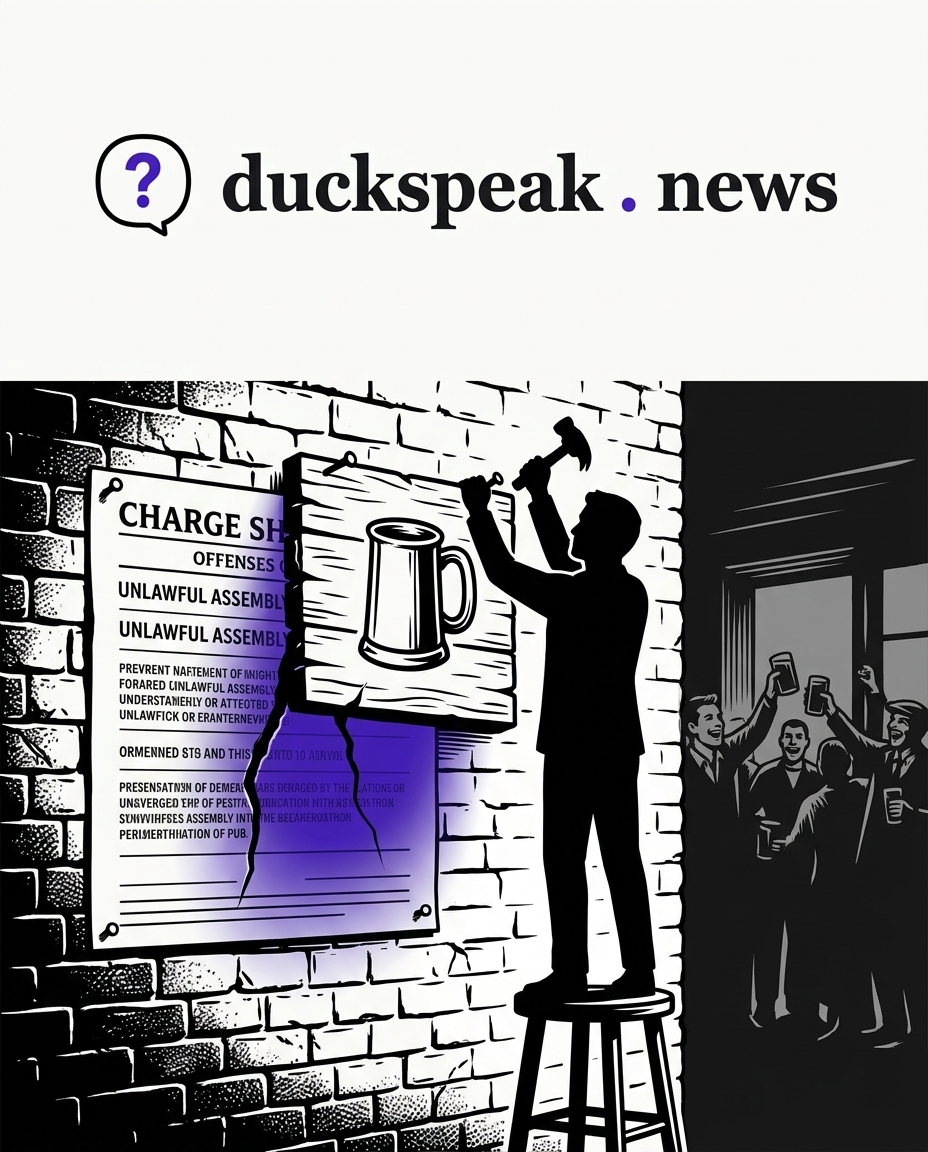
Then the renaming. Nadine Dorries, speaking during “a debate about free speech” [3][4]: “If you’re going to come into a conference like this… of course you’re not going to get gentle treatment.” [3][4] “Gentle treatment” is a euphemism that prices dissent; it converts an assault into the natural tariff for heckling. She adds, in the same appearance, “It’s wrong, no one should be punched” [4], which is the doublethink in miniature: the act is condemned and its inevitability asserted within consecutive sentences. Lee Anderson completes the move as comedy: “I don’t condone any of that type of behaviour, but if anyone wants to have a quick whip around later we are collecting for a new walking stick.” [4] The Independent relays the joke as conference color [1]. The “but” is the whole sentence.
Farage’s own contribution is whataboutism: “I can have milkshakes chucked in my face, be bashed over the head with placards and that’s all fine… Suddenly we’re in the wrong. Utter nonsense.” [1] And the choreography is pure Two Minutes Hate: the crowd chanted “out, out, out” while Farage “laughed as the first demonstrator was taken away” [4]. The detail both outlets print without remarking on it: West Midlands Police “haven’t received a complaint but would ask the woman involved to come forward” [1][4]. The assaulted person is tasked with initiating her own investigation. Both outlets carry the appeal; neither notes what it means.
The vibes layer
The Huxley half is the live blog. The Mirror’s political editor renders her verdict on the closing speech and includes the sentence “Vibes do matter in politics.” [3] A correspondent files: “Like a lot of people in this room, I’m ready for this to be over.” [3] The blog’s inventory runs to a turquoise suit, Union Jack socks, “smoke machines and sparks”, an Ozempic joke that fell flat, empty seats, and a companion listicle headlined “Eight weird and sinister moments from Reform conference” [3]. The same outlet that calls the assault clip “sickening” [4] packages the conference as bingeable content. That is not hypocrisy so much as the Huxleyan condition: outrage and entertainment are the same product, and the assault clip is content too, its news peg being that police are examining footage already circulating online [2][4].
The policy coverage shows where the descriptive energy goes. Jenrick’s tax pledge is quoted in full theatrical gear, “not just with inflation, not just to £13,000, not just to £14,000, but to £15,000” [2], complete with the vow “If I don’t deliver this exactly when I have said that I will, I will resign. No ifs, not buts, I will be gone.” [2] The Independent does state the cost once, “£17.7 billion in its first year, rising to £21 billion five years later” [1]. What no piece in this sample asks is what the £17.7 billion is offset against; the pledge’s theatre is quoted more completely than its arithmetic is examined. One live-blog aside does connect a dot the straighter reports leave hanging. After Farage mocks Labour over a damehood, the Mirror’s correspondent asks: “Isn’t this coming from the man who accepted a £5million gift?” [3] The £5 million from “a wealthy backer” [1] appears in the Independent as context and in the Mirror as a zinger; in neither case does it become a question put to the party and answered.
What a reader would need instead
- The regulator, named once, in a subordinate clause [3]. The Electoral Commission is the body that polices party finance and keeps the public record of donations. None of the four reports tells readers that record exists, or that they can look up Reform’s declared donations themselves.
- The scale of the existing investigation arrives as hearsay: “The Times reports that these claims are expected to widen the police investigation which is examining donations worth £500,000” [2]. A £500,000 figure attributed to another outlet, unlinked, unverifiable from the piece carrying it.
- The law itself. The Independent states in one sentence what would constitute an offence [1]. That sentence should be the spine of the coverage; instead it is scaffolding around the quotes.
- The two police matters are distinct: the Met’s consideration of donation complaints [1], and West Midlands Police’s appeal over the assault, log number 924 [1][4]. In the live-blog format, both dissolve into conference atmosphere.
The double move
A party that closes its conference with the national anthem [3] and a promise to “crush Argentina” [2], while its leader pre-classifies every future investigation as evidence that “they’re scared of us” [1][2], is running grievance and triumph in the same breath. Orwell’s Ministry of Truth worked by rewriting the record after the fact. This is cheaper: rename the record before it is written. A criminal allegation becomes “loose pub talk” [1][3]; an assault becomes the withdrawal of “gentle treatment” [3][4]; a £17.7 billion commitment becomes a resignation vow [1][2]. Huxley supplies the delivery mechanism, an audience for whom the smoke machines [3] are the story. The four reports sampled here are not the Ministry of Truth. They are something closer to its supply chain: they quote the renaming faithfully, repeat it across outlets, and call the result coverage.