

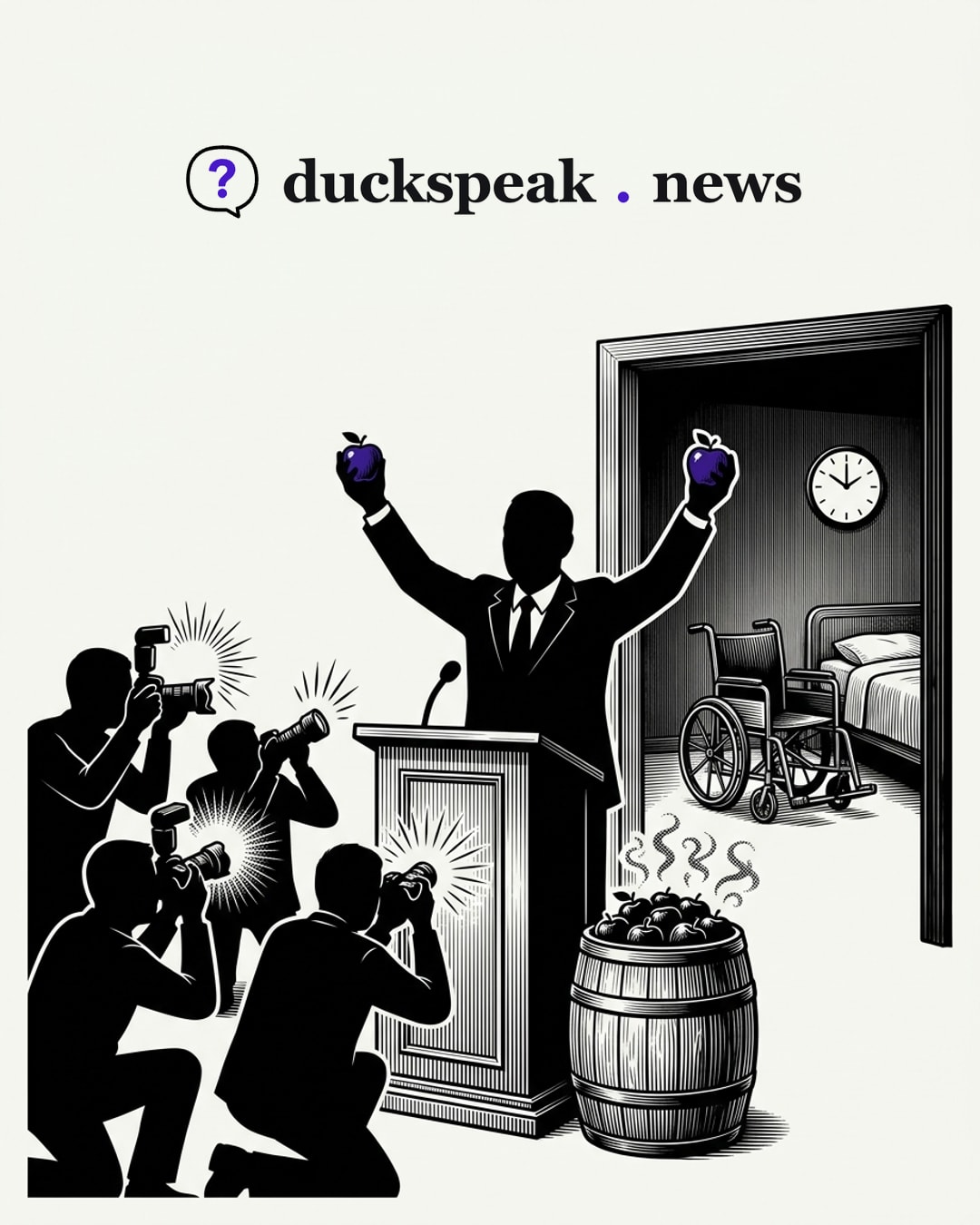
On the same day, four UK outlets reported the same story: two Sussex Police officers dismissed for gross misconduct after pepper-spraying, baton-striking and tasering Donald Burgess, a 92-year-old amputee with dementia, in his care home bedroom. Read the headlines side by side and the frame announces itself. The Independent: “Two police officers sacked after tasering 92-year-old amputee in care home” [1]. The BBC: “PCs who used Taser and baton on amputee, 92, sacked” [3]. GB News and the Mirror follow the same grammar [2][4]. In all four, the main clause is the punishment; the violence is a subordinate clause. The taser became a subordinate clause; the sacking became the news. That is the whole frame in miniature: an act of state force against a wheelchair user, retold as a story of institutional self-correction, with the correction as the news.
Two statements, four articles
Strip the articles down to their sources and the assembly shows. The IOPC’s Emily Barry statement runs nearly whole in all four pieces, from “Our thoughts and sympathies remain with the family of Donald Burgess” to “they have been held accountable and dismissed from policing” [1][2][3][4]. Deputy Chief Constable Paul Court’s statement runs nearly whole in two of them [1][3]. What each outlet added on its own is thinner than it looks: the BBC dipped into the panel hearing for the force lawyer’s “acted, hastily, harshly and lost control” [3]; the Mirror transcribed fragments of the bodycam audio [4]; GB News supplied color from the footage it embedded [2]. The narrative architecture, though, the beginning and the ending, was inherited wholesale from two institutions. This is not coordination; it is economics. Pre-narrativized statements are cheaper than friction, and all four outlets paid the same price.
Split-second, meet nine seconds
Here is the sharpest evidence, and it sits inside single articles. The IOPC’s Barry, quoted by all four: “This was not a fast-paced incident where the officers or other care home residents were in immediate danger” [1][2][3][4]. Deputy Chief Constable Court, quoted paragraphs later by the Independent and the BBC: officers “must make split-second decisions to keep the public safe and to do so with measure, compassion and skill” [1][3].
The record quoted in the same articles: pepper spray drawn “within nine seconds of entering Burgess’s room” [3]; “Within 90 seconds of arriving on scene, both officers subjected Mr Burgess to physical force” [1]; the panel found Smith “made no attempt to assess or understand” Burgess’s vulnerability [3]. “Split-second decisions” is Newspeak in the strict sense: a phrase constructed to be its own defense, arriving pre-loaded with extenuation, deployable regardless of fit. Here the facts, quoted three paragraphs away, refute it, and neither outlet prints the collision. Not a lie; a formula that survives contact with its own contradiction because nobody is required to hold the two sentences together.
The verb laundering runs alongside. The Independent has PC Comotto having “deployed her Taser device” [1]; everyone’s noun of choice is “use of force”, the phrase the panel itself used when it found it “unjustified and excessive” [3]. A baton strike, a face full of PAVA and a Taser discharge become a “use”, agentless and symmetrical. GB News alone writes that Comotto “fired her taser into the 92-year-old’s chest” [2], which proves the other register was available and simply not chosen.
“In no way reflects”
Court’s statement closes the loop: the officers’ conduct “in no way reflects the conduct of those who serve in Sussex Police” [1][3]. The bad-apple formula converts a systemic question into a personnel matter. But the BBC, alone, carries Comotto’s testimony that other officers at Hastings police station “were laughing and joking at my expense for deploying a Taser in a care home” [3]. That detail, a hint of a station where the incident was already a punchline, sits unconnected, paragraphs from the “in no way reflects” claim. The Facebook joke, “We all know what happens in care homes” [1][2][3][4], is framed by all four as individual failing: Barry’s “further poor judgement” [2][3][4], the force lawyer’s “inappropriate and/or unprofessional” [3]. One outlet printed the hint of a culture and then quoted, without comment, the assurance that nothing here reflects the force.
The closure sentence drifts
Every article seals off the death. The Independent: “Sussex Police stated that evidence did not suggest the officers’ actions caused or contributed to his death” [1]. GB News: “A pathologist confirmed that the officers’ actions did not cause or contribute to the pensioner’s death” [2]. The Mirror: “a pathologist found the officers’ actions did not cause or contribute to his death” [4]. The BBC, passively: “the officers were not held responsible for his death” [3]. One sentence, three attributions: the force, a pathologist, nobody. GB News supplies the post-mortem cause, “bronchial pneumonia with cardiac disease” [2]; the BBC supplies the chain, hospitalized after the incident, “contracted Covid and died 22 days later” [3].
Note: we do not have the panel’s written findings or the pathologist’s report, so this critique cannot establish who actually made the “did not contribute” determination. We are not arguing the officers caused the death. We are noting that the closure sentence was required, in nearly identical words, in all four articles, and that its attribution drifted between an interested institution and a neutral expert without any outlet appearing to notice. The precipitating event drifts the same way: “threatening staff” [1], “threatening to stab staff” [4], “threatened carers with a dinner knife” [3], GB News’s “flicked his food at a healthcare worker and refused to put down the dull blade” [2]. Even the panel’s finding drifts: “inappropriate” force in the Independent [1], “unjustified and excessive” in the BBC [3].
The acquittal is handled the same way. All four note the Southwark Crown Court acquittal [1][2][3][4]; none examines what it means that the same act is not a crime but is “unjustified and excessive use of force” [3] warranting dismissal without notice. The gap between the criminal standard and the misconduct standard is the deepest question in the story, and all four carry it as an unremarked fact.
This is the Huxley half of the mechanism. The coverage is consumable: outrage, a villain pair, a punishment, and Barry’s closing chord, “held accountable and dismissed from policing” [1][2][3][4]. GB News supplies the feelies version, “unleashed an entire can of pepper spray” and the man “heard saying ‘I’m dying’” [2], affect without structure. What evaporates is the residue the story should leave: why police were the first responders to a dementia patient with a cutlery knife, what the care home expected when it called, what the acquittal says about the criminal law’s fit for this. Only the BBC gives Burgess a mourner rather than an institutional sympathy statement, his great nephew asking that he be “remembered for the life he lived and not simply for the events which brought us to this point” [3].
What a reader would need instead
- The misconduct panel’s written findings. The panel’s specifics, the nine seconds, the “no attempt to assess or understand”, Smith’s evidence that he “would not do anything differently” [3], are the richest material in the coverage, and only one outlet dipped in.
- The IOPC’s full investigation report. The coverage tells us it existed: a voluntary referral from the force, a six-month investigation, a file to the Crown Prosecution Service in June 2023 [2]. Nothing else about it.
- Reporting from the criminal trial: what the jury heard at Southwark that the disciplinary panel did not.
- The dispatch record: what the care home actually reported, given the four versions above, and what response was sent. Assistant Chief Constable Gardner’s line that “More information should have been ascertained from care home staff” [3] is the thread no outlet pulled.
- The pathologist’s report, or at least a consistent attribution of the “did not contribute” finding.
- Sussex Police’s policy for calls involving vulnerable people, and an explanation of the College of Policing barred list, mentioned twice [1][3] as a fact and never as an institution with rules.
The two officers were dismissed without notice. The vocabulary that made their actions sayable, “deployed”, “use of force”, “split-second decisions”, was kept on, without notice of a different kind.