

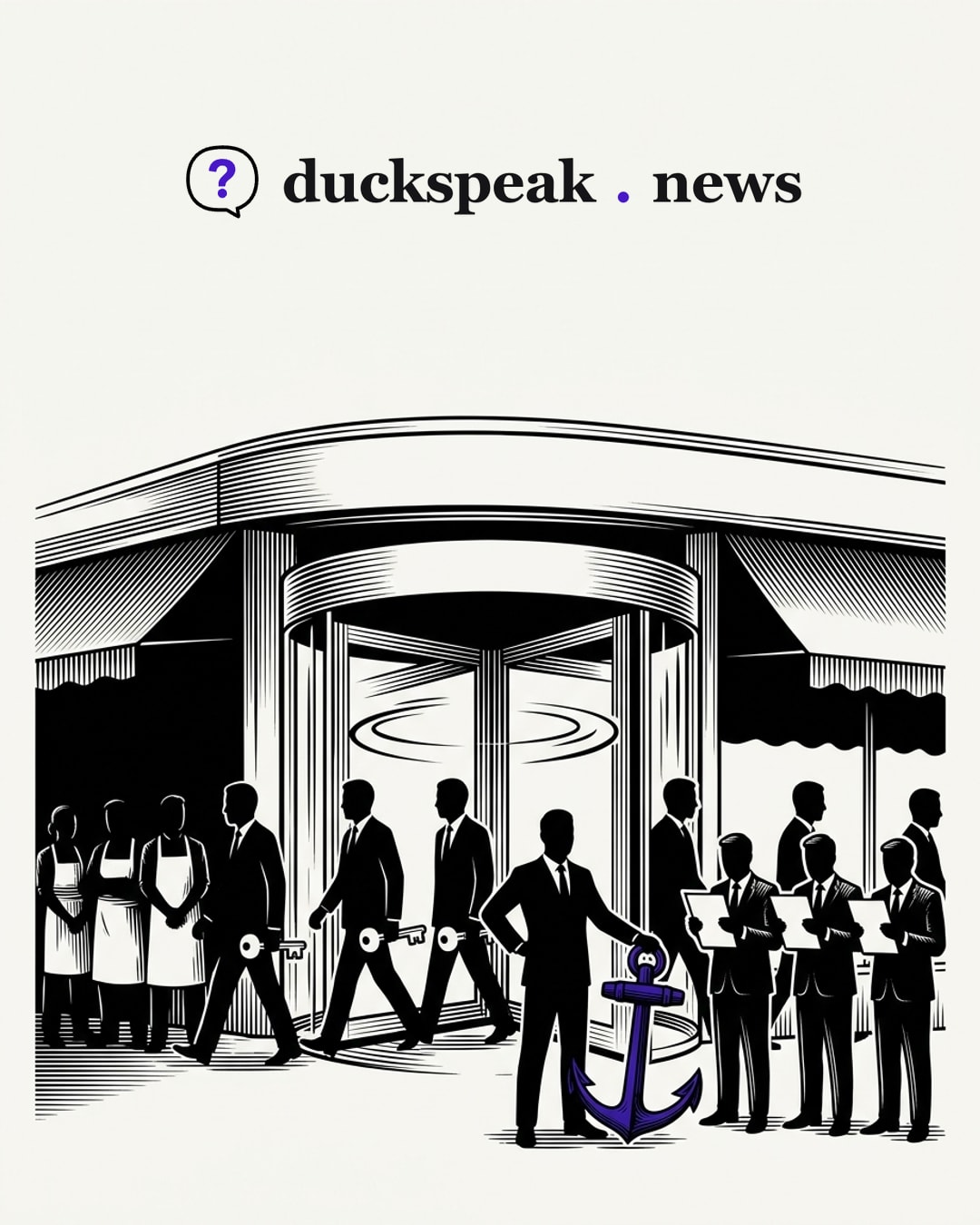
Four UK outlets carried the Boots sale, and the seams show. BBC News, The Mirror, The Independent and GB News all print the same Galen Weston paragraph, word for word: “We see a meaningful opportunity to make a great business even better through stable long-term ownership, further capital investment, and the renewed operating focus required to serve customers with excellence for generations to come” [1][2][3][4]. All four recite the acquired assets in the same order (UK and Ireland retail and pharmacy, Boots Opticians, No7 Beauty, Thailand and franchises) [1][2][3][4], and two carry the Boots chief executive’s statement [2][3]. This is not coverage of a press release; it is a press release, distributed with bylines.
The phrase that does the work
The load-bearing words are “stable long-term ownership,” and they arrive in all four outlets unexamined. No outlet asks what they mean, and each outlet’s own copy refutes them.
The BBC, paragraphs later: “The last two decades has seen several changes of ownership under discussion and sometimes completed. Sycamore only owned the retailer for 18 months” [1]. The Mirror: “It marks another change of ownership for Boots,” in an article that itself records the 2007 sale to Stefano Pessina and KKR for £11.1bn [2]. GB News adds that “It is not the first time the Weston family has tried to buy Boots,” and that Sycamore “had considered floating the retailer” before selling it on [4]. So the record inside these articles: a 2007 private equity megadeal, a stretch under Walgreens Boots Alliance, an 18-month interlude, a contemplated flotation, and now a new owner whose promise is stability. The claim and its refutation sit in the same article, and in none of the four do they touch.
That is the Newspeak mechanism in miniature. A phrase becomes true not through evidence but through placement and repetition. “Stable long-term ownership” is not a description of anything; it is a promise whose test lies years away, printed as present-tense fact. Nobody has to lie. They only have to decline to connect the paragraphs they already ran.
Even the one voice gesturing at the churn softens it. BBC’s retail expert Catherine Shuttleworth calls the “chopping and changing of owners” “an unhelpful distraction” [1]: as though two decades of ownership churn were noise around the business rather than a cause of anything, in coverage that itself records Boots “closed hundreds of branches across the UK in recent years” [1].
Sold, in the past tense
The headlines: “Boots sold in £7bn deal” [1]; “Boots SOLD for £6.7bn” [4]; “Boots sold to Canada’s Weston family” [3]. Only the Mirror’s is honest to the timeline: “Boots to be bought” [2]. By the outlets’ own copy the transaction “is subject to regulatory approvals” and “expected to complete during the first quarter of 2027” [2][3]; the BBC says completion in early 2027 [1]. Three of four headlines convert a pending agreement into an accomplished fact, and in doing so they narrate away the only window in which anyone could object. Two outlets mention regulatory approval [2][3]; none names a regulator or asks what a review might cover, even as GB News presents the family’s existing grocery and pharmacy holdings as “significant experience in both grocery and pharmacy retail” [4]. (The BBC headline also rounds £6.7bn up to £7bn [1]; rounding up is a choice.)
The soothing expert
The BBC’s only independent voice is Shuttleworth, “chief executive of savvy marketing” [1], whose contribution is that shoppers can “expect over time is an improved shopping experience as the new owners invest in the business” [1]. A marketing executive forecasting marketing outcomes is not external analysis; it is the press release wearing a lanyard. Across four outlets, the quoted humans are the buyer [1][2][3][4], the seller [4], the chief executive [2][3], and a marketing executive [1]. The Mirror prints that the business employs “more than 51,000 people” and raises “the future of its stores” as “one of the big questions facing the new owners” [2], then never returns to it. No union, no pharmacist, no shopfloor worker appears anywhere.
Two numbers that never meet
The Mirror, in a single article, prints both £11.1bn (the 2007 purchase) and £6.7bn (today’s price, which “includes Boots’ debts”) [2], and lets them pass without meeting. On the Mirror’s own figures, the British institution is changing hands for some £4bn less in nominal pounds than it fetched 18 years ago, treated as heritage color. A caveat: the 2007 figure’s basis, debt-inclusive or not, is not stated in the copy, so the comparison is suggestive rather than conclusive. But no outlet even attempts it. Meanwhile the investment vocabulary flows: “fresh investment” [1], “much needed investment” [2], “further capital investment” [4]. The BBC prints the closures [1] and, separately, Weston’s plans for “shop upgrades and an expansion of healthcare services” [1]; the two facts share an article but never a sentence.
Errors travel with the frame
When copy is rewritten rather than reported, mistakes travel with the message. The Selfridges sale appears as “from 2003 to 2021, before selling it for $4bn” [1], as “£4 billion in 2022” [3], a date GB News repeats [4], and, in the Mirror, as having happened simply “five years after” [2]. Three dates and two currencies for one transaction, across four outlets, with no correction. At least one rendering is wrong, and no editor appears to have checked. The frame arrives intact, and so does whatever is embedded in it.
The shopper is the citizen
The BBC closes: “What are your views on Boots? What has been your shopping experience? Get in touch.” [1]. That is the whole frame in two sentences. The subject is who owns the country’s largest pharmacy network: 1,800 stores, 51,000 staff, 4,700 registered pharmacists [2], vaccines, eye and hearing tests, “much needed health care support in everyday moments as well as at times of national crisis like the coronavirus pandemic” [1]. The reader is invited to review the meal deal. This is the Huxley half of the mechanism: nothing is hidden, everything is soothed. The Independent prints the chief executive’s “Every day, our colleagues give millions of people longer, healthier and happier lives” alongside his claim of “unmatched authority, capability and leadership across health, wellness and beauty” [3], brand copy running as news. GB News alone carries the seller’s valediction, Pessina calling Boots “an iconic brand and a British institution” [4]; the adjectives do not stay in his mouth. The BBC’s own prose calls the chain “a stalwart of the High Street” that “remains a familiar British brand” [1]. After four repetitions, “trusted,” “iconic,” and “institution” stop being claims and start being facts.
What a reader would need instead
- Who reviews the deal. “Subject to regulatory approvals” [2][3] is as specific as the coverage gets. The Competition and Markets Authority is the UK body that examines acquisitions of this scale; a reader would need to know what its remit covers when a family with existing pharmacy and grocery interests buys the largest health and beauty retailer.
- The real price. The Mirror’s line that “The value of sale includes Boots’ debts” [2] is the only debt mention across four articles. Equity value, debt load, and what Sycamore paid 18 months ago against what it sold for: all absent.
- What the last owners did. Sycamore’s 18-month stewardship appears as chronology [1], never as a subject. What happened to the business in that window, and what the split-and-sell strategy extracted, is the story behind the story.
- A voice from inside. Among 51,000 employees and 4,700 registered pharmacists [2], not one is quoted. A union, a pharmacist, a shopfloor worker: any would break the choir.
- The two numbers side by side. £11.1bn in 2007 [2], £6.7bn including debts now [2]. Even with the caveats, it is the most revealing fact in the coverage, and all four outlets declined to make it.