

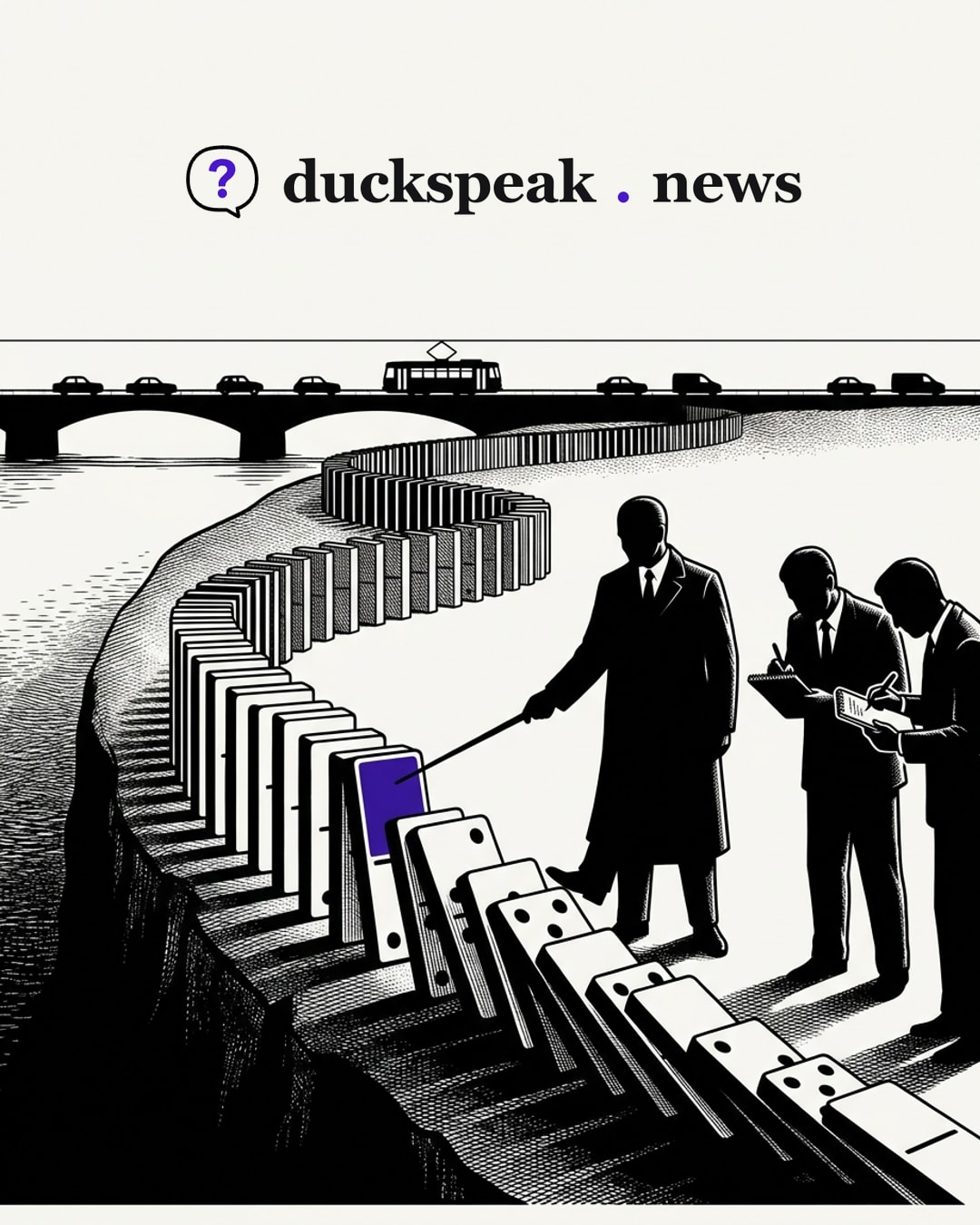
Over four days of Russian strikes on Kyiv’s bridges, four pieces from three outlets in three countries told one story in one grammar: everyone is responding [1][2][3][4]. Zelensky promises refinery strikes “pour répondre aux attaques sur Kiev” (to respond to the attacks on Kyiv) [1]. Russia, “à son tour” (in its turn), will increase its bombardments [1]. Putin “is acting in response to Ukraine’s strikes on Russian energy facilities” [2]. The ministry launches “massive strikes” “in response to Ukraine’s threats” [3]. In this chain nobody initiates; every bomb is a reply. That grammar did not grow in the newsrooms. It arrived from the Russian Defence Ministry, and the outlets planted it in their own prose.
A reply with no first move
RFI is the clearest case, because the transfer happens in the outlet’s own voice rather than in a quote. “En réaction aux propos de Volodymyr Zelensky” (in reaction to Volodymyr Zelensky’s remarks), RFI writes, “le ministère russe de la Défense a fait savoir dimanche que la Russie allait à son tour accroître le nombre de ses bombardements” (the Russian Defence Ministry said on Sunday that Russia would in its turn increase the number of its bombardments) [1]. “À son tour”: in its turn. The phrase is RFI’s, not the ministry’s, and it installs the ministry’s causal claim (we bomb because they spoke) as the connective tissue of the sentence. Two sentences earlier, RFI’s own reporting has already undercut it: “les frappes russes s’étaient déjà intensifiées” before Zelensky said a word about refineries [1]. The escalation predates the stated trigger, inside the same article, and the two facts are never allowed to meet.
NBC attributes the claim, then lets it stand untested: the ministry “has been launching ‘massive strikes’ against Kyiv in response to Ukraine’s threats to intensify attacks on Russian oil refineries” [3]. A threat is a speech act. Further down the same piece, NBC reports that Ukraine “has disabled more than half of Russia’s oil refining capacity in a string of successful strikes since this summer” [3]. Whatever the ministry is responding to, the material to complicate its timeline sits in NBC’s own copy, unused.
BBC, to its credit, prints the disproof: Putin “has said Russia is acting in response to Ukraine’s strikes on Russian energy facilities, despite the fact that it was Moscow that had first launched such attacks” [2]. That sentence dismantles the entire response frame. It is also the final line of the piece, arriving long after the lede has fixed the frame (“as Moscow ramps up attacks on critical infrastructure” [2]). The correction and the frame never meet; the frame gets the top, the correction gets the exit.
This is Newspeak in its polite, attribution-friendly form. “Retaliatory” does its work not by lying but by converting a chosen escalation into a forced one, an aggressor into a party replying, and the question of who started this phase into bad manners. The Russian Foreign Ministry’s own phrase, “large-scale retaliatory strikes” [3], is at least honestly attributed. The subtler problem is the curve verbs the outlets reach for on their own initiative: strikes “ramp up” [2], “have ramped up” [3], “s’étaient déjà intensifiées” [1]. Escalation becomes weather, a gradient, something that rises on its own. RFI goes furthest, letting the strikes intensify themselves while Moscow appears mainly as the announcer of a future in which “le pire était encore à venir” [1].
Escalation measured in chancellors
Three of the four pieces peg the bombing to Friedrich Merz’s diary. RFI notes the explosions “n’ont pas cessé même pendant la visite surprise du chancelier allemand Friedrich Merz” (did not stop even during German Chancellor Friedrich Merz’s surprise visit) [1]. BBC: “The latest bridge attack came as German Chancellor Friedrich Merz made a surprise visit” [2]. NBC supplies the actual baseline, and it deserves to be read twice: “During previous visits by international dignitaries of Chancellor Friedrich Merz’s stature, the Kremlin paused or dramatically reduced attacks on the city” [3]. So the “new level of escalation” [3] is defined as this: Moscow no longer pauses its bombing for visiting dignitaries. The residents, who never got the pauses, are the scenery; the chancellor is the protagonist; the war runs on his clock.
The novelty vocabulary does the rest: “a new strategy from Moscow” [2], “a new tactic” [3], “a new level of escalation” [3]. Each attack arrives as unprecedented, which conveniently resets the baseline every cycle. This is the Huxleyan half of the mechanism: the “new” is consumed as spectacle, one fresh escalation at a time, and nothing is permitted to accumulate into a pattern. The one place pattern is permitted is the diplomat warnings, where both BBC and NBC do the memory work (“It also repeated a warning” [2]; “A similarly-worded warning was issued in May” [3]). The outlets demonstrably know how to say “this has happened before.” They say it for the warnings, not for the retaliation claim.
Troops and military cargo, heating mains and hot water
The ministry’s justification travels with its causality: the bridges were hit, Russia said, because they are “used to transfer Ukrainian troops and military cargo” [2], or “to move troops and military cargo” [3]. Both outlets attribute it; neither tests it, and the counter-evidence is already in the corpus. BBC’s own verified video shows “cars moving on Pivnichnyi Bridge” at the moment of impact [2]. RFI’s entire report is civilians: a metro line truncated at the river, two soldiers on leave chasing a taxi through air-raid alerts, a crossing that should take minutes taking 40 [1]. Klitschko’s inventory of what is being battered includes “critical infrastructure, logistics, housing” [2]; the same BBC piece records a damaged heating main and “a temporary lack of hot water” in a residential district [2]; NBC records an apartment block destroyed in Pryluky, “killing 15 people, including four children” [4]. Whether the bridges also carried military cargo cannot be determined from this material, and this critique does not claim otherwise. The point is narrower and harder to dodge: the claim and the observed damage sit in the same coverage, unconnected, and no outlet marks the gap.
The gap widens when the target category is quoted. RFI relays the ministry’s list as “installations militaires et industrielles, ainsi que toutes les infrastructures qui leur sont liées” (military and industrial installations, as well as all infrastructure linked to them) [1]. “Toutes les infrastructures qui leur sont liées” is elastic enough to swallow a heating main, a metro line, an apartment block. Meanwhile the bridge prognosis is delivered by nobody in particular: “Experts say Russian drones are unlikely to bring down the bridges,” though “repeated attacks will force their closure” [2]. Unnamed experts, future tense. RFI’s named reality is already in the present tense: the metro stops at the river, the trip takes 40 minutes, and the GPS voice itself has learned to announce that “la circulation peut être partiellement restreinte” during air raids [1]. The anonymous future is softer than the documented present, and the softer version is the one styled as analysis.
The attack Kyiv saw coming
The fourth piece, on the barrage that killed at least 21, is headlined “a major attack that Kyiv saw coming” [4]. Not “Russia launched”; a quiz about Ukrainian preparedness. The body follows the headline’s logic into hardware: Patriots without ammunition, “a new generation of interceptors,” a race between drone and interceptor [4]. The war becomes a gadget story, the other Huxleyan consumption mode, in which the tech race is inherently interesting and the political question (who chose to fire at an apartment block) is not. Even the birthday gets a cameo: the attack “coincided with Russian President Vladimir Putin’s 74th birthday” [4]. The strongman’s biography is color; the ministry’s target list is copy; von der Leyen’s “deliberate strategy of terror” [4] is a quote that is never required to argue with either.
What a reader would need instead
- The sequence, with the initiator, in paragraph one. BBC already wrote the sentence that settles it (“it was Moscow that had first launched such attacks” [2]); it needs promoting from the final line to the lede, everywhere.
- The two lists, side by side: the ministry’s stated targets versus the documented damage. The UN’s human rights monitoring mission in Ukraine has spent the war keeping precisely that ledger of strikes on civilian infrastructure; none of the four pieces points a reader toward any such record, which leaves the ministry as the only systematic narrator of what is being hit.
- Named experts. “Experts say” [2] is not a source; it is a placeholder where a source should be.
- The May standard, applied evenly. When the outlets recognized the diplomat warning as a repeat, they contextualized it [2][3]. The retaliation claim deserves the same memory: how far back does the chain of replies actually reach? BBC’s final line already contains the answer.
- The resident’s clock, not the chancellor’s. RFI’s taxi ride, the orders cancelled during air alerts, the 40-minute crossing [1] are the model the other three pieces lack. The bombing of a capital is not new because it failed to pause for a German visitor. For the people crossing the Dnipro, it is Tuesday.