

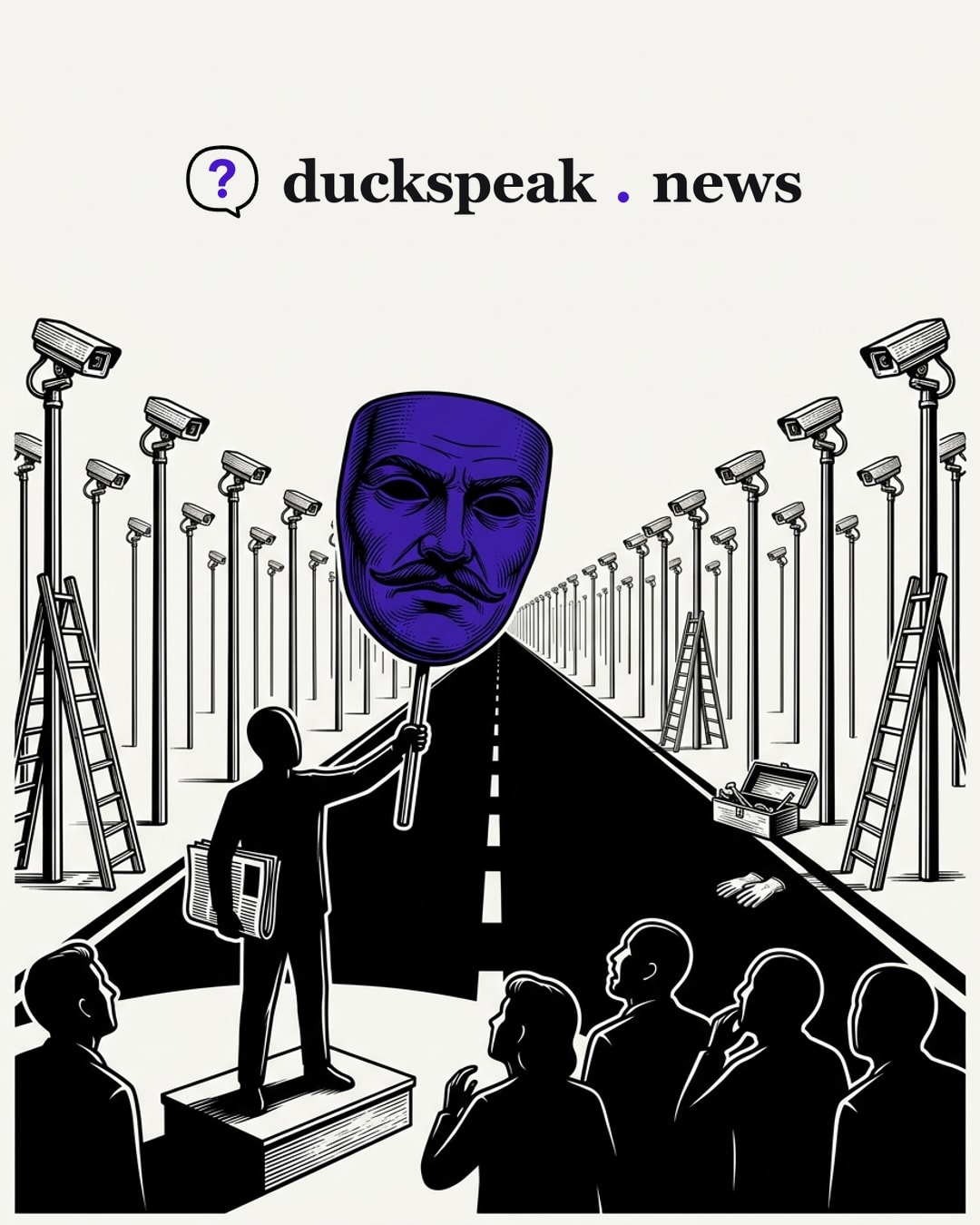
The New York Post’s story on Suffolk County’s Flock Safety cameras puts the strongest word in the English language for state surveillance right in the headline: “Big Brother,” wrapped in scare quotes [1]. It is the right word for the subject. It is also, in this article, a costume. The headline performs the criticism so the article doesn’t have to, and the body commits, in miniature, the sins Orwell diagnosed in “Politics and the English Language”: agents vanish into passive constructions, a dying metaphor does the thinking, and the reader is handed a mood rather than a map.
The scare quotes are a laundering device
Notice where the Orwell comparison actually lives. In the body, it belongs to someone else: “Critics have likened the tech to a ‘Big Brother’-style surveillance system” [1]. In the headline, the attribution is gone and the word belongs to the outlet, still safely in quotes. The scare quote is a remarkable instrument: it lets the paper use the word’s full voltage while disowning responsibility for it. If a reader objects, the comparison was the critics’; if the reader clicks, it was the Post’s. “Big Brother” here has decayed into exactly what Orwell called a dying metaphor, a phrase invoked for its aura and severed from its meaning. The meaning, in this story, would require naming who watches. The article is structured so that no one can be named.
“Quietly,” against the article’s own facts
The lede says cops have “quietly more than doubled their number of Flock Safety cameras” [1]. The adverb collides with the article’s own reporting. Seven paragraphs in, we learn the cameras were “purchased through a $542,500 law-enforcement tech grant from the state and unanimously approved by the county legislature in August 2025,” and that the deployment details come from “documents published by the Suffolk County Sheriff’s Department” [1]. A unanimous vote by an elected legislature and a published sheriff’s document are public record, not secrets. Two readings are possible, and the article never distinguishes them: either the county disclosed all of this in August and the press, this outlet included, simply wasn’t in the room, or “quietly” is not a fact but a mood, chosen to make the reader feel like the discoverer of a secret. This critique can’t settle which it is from the text alone; that is the point. “Quietly” is doing the work that a named official, a vote tally, and a date should do.
The agents keep disappearing
Orwell’s objection to the passive voice was that it lets responsibility evaporate. The piece is a case study. “More than 30 new cop AI-powered cameras have been put into place along Suffolk’s roads” [1]: put into place by whom? The sentence contains no subject with hands. A second category of plate readers, ones that “do not require legislative approval,” is acknowledged in a single sentence, with the location left as “it was not specified where, according to the documents” [1], and then dropped. That is arguably the most alarming fact in the article, surveillance hardware installed outside any vote, and it receives less attention than the Hamptons. Later, “the municipality unexpectedly delayed the installation of Flock Safety’s ‘Raven’ listening system” [1]: no official is named, no reason is given, and “unexpectedly” is a feeling attributed to no one in particular. Someone made a decision; the prose is built so that the decision simply occurred.
“Controversial” four times, substance zero
Count the adjectives. “Controversial ‘Big Brother’ cams,” “the controversial tech’s reach,” “the controversial brand of cameras,” “another controversial piece of tech” [1]. “Controversial” is Newspeak running in reverse: it announces that conflict exists while deleting its content. The actual substance is present, stated once, cleanly: police “don’t need a warrant to look through Flock’s database” [1]. That is the entire Fourth Amendment argument, and it sits in a paragraph about the brand’s reputation, surrounded by engagement arithmetic like a “staggering 140% jump” [1]. Likewise “AI-powered,” which appears three times and is never defined; the only concrete description of what the system does, logging “dents and bumper stickers” [1], is offered as product detail rather than as the thing being contested. The reader is told the technology is controversial four times and is never told precisely what the controversy is about beyond that one warrant sentence.
The Hamptons are the Huxley part
The headline’s real hook is not surveillance; it is class: “with many targeting this tony enclave” [1]. The body lists where the East End cameras actually went: “Southampton, Riverhead, Southold, along Route 114 in Sag Harbor and East Hampton Village” [1]. Riverhead and Southold are not “tony enclaves”; the headline compresses the East End into the Hamptons because the Hamptons are where reader attention lives. This is the Huxleyan half of the mechanism. A story about the routine, warrantless logging of every car on Long Island is packaged as gossip about the rich. The article itself notes, in passing, that New York City suburban drivers are “one of the most surveilled populations in the country,” and that the county’s roughly 60 cameras sit atop “hundreds more” run by towns, villages, and “even private living communities,” most of which “directly share their data with police” [1]. That is the story: a region-wide grid, queried in “roughly 3,000 manual searches” by Long Island cops in June alone, for reasons ranging “from ordinary traffic violations to ‘suspected terrorism’” [1]. The hook, though, is that wealthy people might get caught in it too. The reader consumes the surveillance state as entertainment, which is precisely the condition under which grids like this double.
What the article gets right, and what it buries
The skeleton is strong, and should be said so. The Post reports that “upwards of 100 cops nationwide” have been arrested for misusing Flock data, including a Georgia chief who tracked his ex-girlfriend and her teenage daughter “roughly 600 times” [1]. It reports the warrantless database. It reports the unapproved camera category. These are accountability facts. They arrive, though, as a pile of anecdotes with no architecture: no named county officials, no sponsor or bill number for the “newly proposed federal law” that would strip federal funding [1], no named “anti-Flock activist organizations” [1], no crime statistics offered by anyone as justification for the expansion, and no explanation of who delayed the $4 million Raven listening deal or why. Every institution involved is gestured at; almost none is named.
What a reader would need instead
- The vote record: which county legislators unanimously approved the $542,500 grant in August 2025, and what they said. The article proves the record exists by citing “documents published by the Suffolk County Sheriff’s Department” [1]; it never tells the reader where those documents are.
- The bill: a “newly proposed federal law” with no number, no sponsor, and no provisions beyond a funding penalty [1] is a rumor with a byline.
- The unapproved cameras: where the plate readers that “do not require legislative approval” [1] are located, who purchases them, and under what authority.
- The rationale: any crime data the county offered for doubling the network. Its absence from the coverage is itself a fact worth reporting.
- The names: the officials who “said,” the organizations that protest, the decision-maker who delayed the Raven system.
- The terms: how long Flock retains data and who else can search it. The article says cops nationwide can, warrantlessly [1], and stops there.
Orwell’s insight was that decayed language makes bad actions easier to hide. The Post has the vocabulary right and the grammar wrong: it shouts “Big Brother” in the headline, then writes the body in the passive voice, so that by the final paragraph the reader is alarmed at everyone and can name no one.