

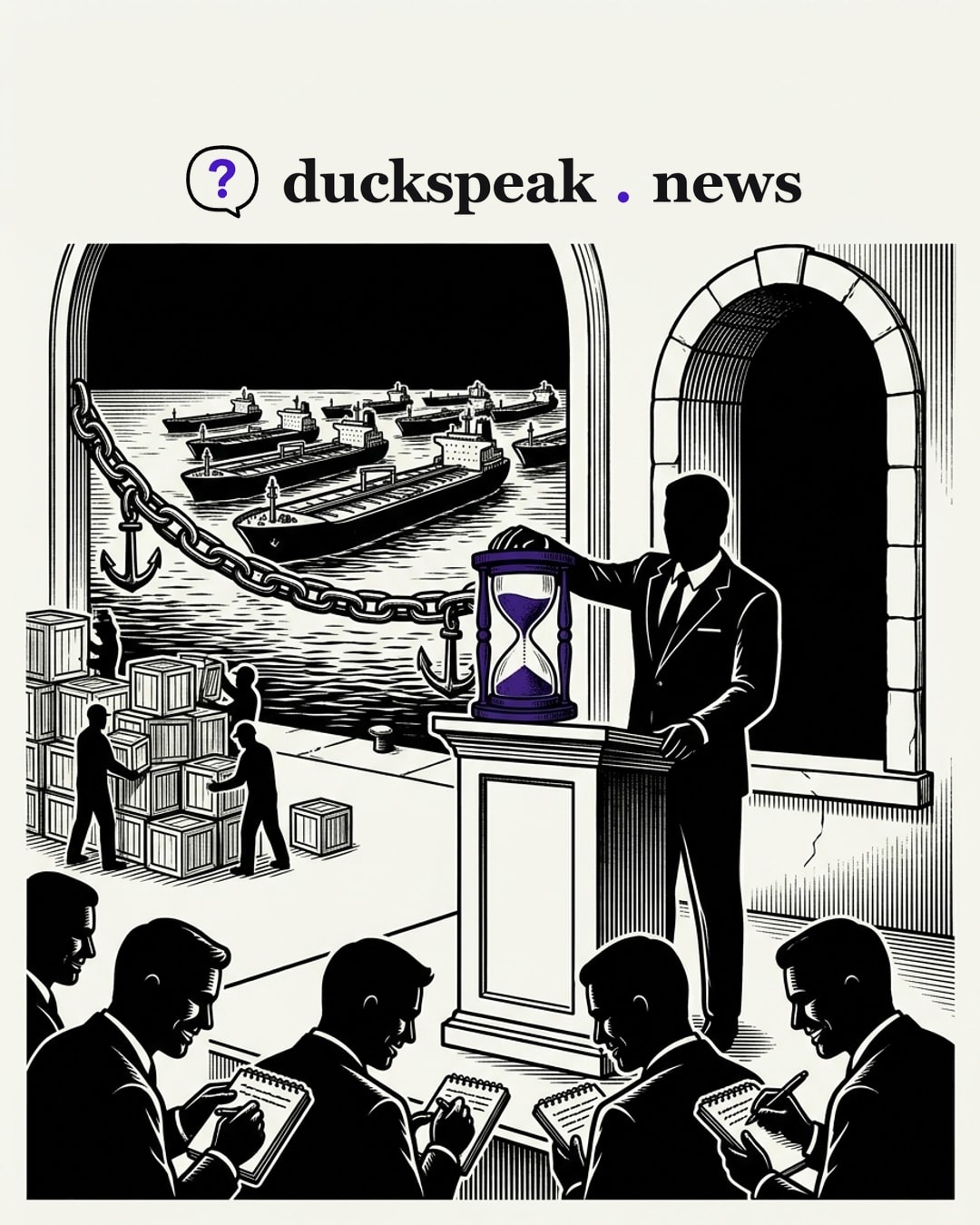
The reassurance headline and the sentence underneath it
Two outlets, one ocean apart, carried the same news on Thursday. The New York Post: “Trump says US military will not attack Iran before midterm elections” [1]. The Guardian: “Trump claims US won’t strike Iran before November midterms” [2]. Both are accurate, and both are packaging. The sentence underneath reads: “we will not be attacking Iran at any time prior to the Midterm Elections” [1]. Read that clause slowly. The only variable restraining the attack is the date of the election. Nothing in the statement concerns peace; it concerns scheduling. A guarantee that names its own expiry date is not a guarantee against the thing, it is a guarantee about its timing, and both headlines flattened that into reassurance. The Guardian’s verb “claims” registers doubt about whether the pledge is true [2]; neither headline registers what the pledge concedes.
The conditional both outlets quote and neither glosses
The full Truth Social post, reproduced by both outlets, is a conditional sentence. It opens with “We are having productive discussions with the Islamic Republic of Iran” [1] and then sets the terms: no attacks “while Iran is in very bad condition, both Economically and Militarily and while the Blockade will remain in full force and effect” [1][2]. Both outlets quote this in full. Neither glosses it. The “promise” holds only while the siege keeps hurting. That is not a peace pledge; it is coercion with a pause button, and “productive discussions” is the polite name for the same arrangement. This is the Ministry of Peace’s use of the word: peace attached to a sentence whose content is a blockade, an oil squeeze, and a bombing campaign deferred for convenience.
The verbs that make war ambient
The Post’s copy does quieter work around the edges. The Atlantic’s report is described as “claiming that he had been contemplating strikes” [1], where the Guardian states the same report flatly: the White House “asked the Pentagon to develop strike options” that could be carried out ahead of the midterms [2]. (Both relay the Atlantic secondhand; we only see their summaries, so any critique of the Atlantic piece itself would be speculative.) The Post adds that Trump “has long been rumored to be considering a resumption of attacks against Iran after the midterms take place” [1]. “Resumption” is the load-bearing euphemism: attacks do not get launched or ordered, they resume, like a series between seasons. Note also what that sentence concedes. The body text says “after the midterms”; the headline says “before the midterms.” It is the same fact, wearing two outfits. Meanwhile the war itself has become weather. The Guardian mentions in passing that gas costs “more than a dollar more than before the war with Iran began in February” [2], a clause that treats a war running since February as background climate.
The machinery that keeps running under the headline
The Post’s copy relays, via Axios, the fact that undercuts its own headline: “The Pentagon directed Central Command to be prepared for major military operations against Iran, though a timeline for when strikes may resume is up to the president” [1]. Preparation continues; only the date is unsettled. The market read the statement correctly. Oil went “surging to $105 a barrel” on the Atlantic report, then “falling to about $103” after Trump’s post [1]. A two-dollar dip. Traders did not price a de-escalation; they priced a delay. That is the most honest gloss of the day available, and it sits in the Post’s copy unremarked.
The same feed, the same day
The Guardian’s live blog is, by format, an anesthetic. The strike pledge shares the scroll with a ceremony honoring tech executives with the National Medal of Science [2], a Missouri redistricting saga [2], and a Maine Senate race [2]. Huxley’s insight was that distraction does not need to be imposed; it only needs to be abundant. Buried mid-scroll is the sharpest material of the day: the USS Abraham Lincoln arriving in San Diego “after a record-breaking deployment which saw the aircraft carrier at sea for more than 260 days without a port call,” with the acting navy secretary acknowledging that “eight service members from the Lincoln and its accompanying strike group attempted to take their own lives” [2]. The defense secretary’s response to reporting on this was to blame the media for “disingenuous headlines” about “patently false claims of low troop morale, or flat-out propaganda, as if it’s written by our adversaries” [2]. That is the pre-emptive move: classify bad news as enemy text, so the report itself becomes the attack. The format guarantees it will be gone from the page by tomorrow.
The same day’s feed also carries the secretary of state predicting Tehran is “only weeks away from ‘facing the most cataclysmic economic catastrophe in the history of modern Iran’” [2], and Treasury sanctioning seventeen shadow-fleet vessels, with the warning that “No enabler of Iranian sanctions evasion is safe from the full force of Treasury’s authorities” [2]. So the “no attack” pledge coexists, in one scroll, with siege escalation. The bombing is paused; the war is not. Only one of those facts made the headline.
The tell in the Post’s own copy
The Post closes with the sentence that explains the pledge: “Republicans in key races across the country, including Senate races in Maine and Michigan, have distanced themselves from Trump’s decision to go to war in Iran” [1]. The election is the variable. The pledge names the variable. The headlines report the pledge while hiding the variable in plain sight. The Post even recalls, as a personality footnote, that Trump “infamously warned that an entire civilization would die if Iran didn’t cut a deal” back in April [1]. A president who has threatened civilizational death is now offering a no-bombing guarantee with a November 3 expiry, and both outlets present the second statement as the news and the first as color.
What a reader would need instead
A reader would need the expiry date in the headline: not “won’t attack Iran before midterms” but “attacks paused until after the election, timeline up to the president.” They would need the conditional glossed: the guarantee holds only while the blockade keeps working. They would need the CENTCOM preparation order [1] printed beside the pledge, and the market’s two-dollar shrug [1] read aloud as commentary. They would need the same-day siege news, Rubio’s “cataclysmic economic catastrophe” [2] and the seventeen sanctioned vessels [2], framed as what “no attacks” means in practice. They would need the Lincoln’s 260 days and the eight suicide attempts [2] treated as the war’s ledger rather than mid-scroll filler, and Hegseth’s “flat-out propaganda” line [2] reported as an official pre-emptive delegitimization of reporting. And they would need the electoral incentive stated plainly: gas at $4.36 nationally [1], a dollar-plus above the pre-war price [2], Republicans in battleground Senate races running from the war [1]. The pledge is not about Iran’s behavior; it is about November 3. The outlets quoted the date. They declined to say what it means.