

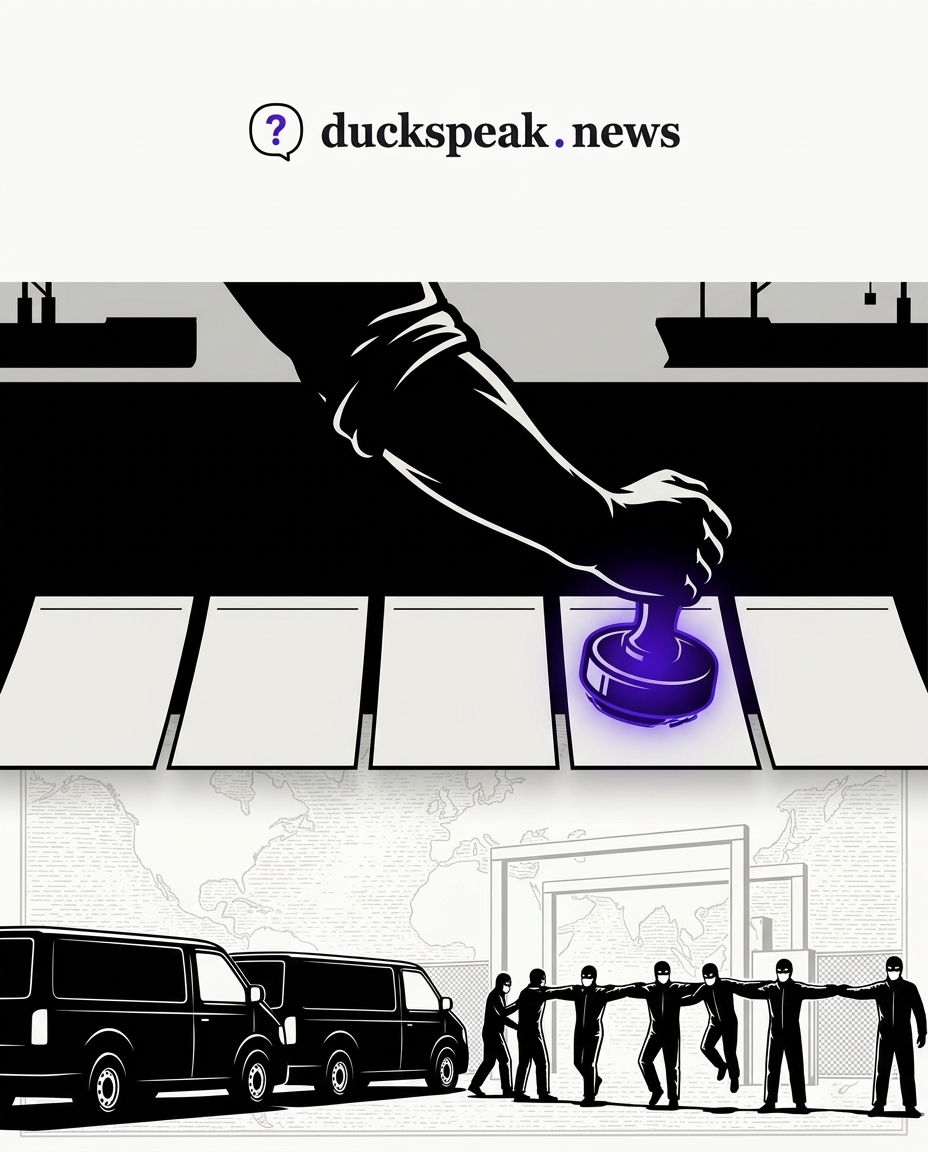
The statement that quacked
On Saturday 5 September, several hundred masked men dressed in black blocked the roads into and out of the Port of Dover for around three hours [3], caused four miles of congestion [1][4], spray-painted “blood is on your hands” outside a migrant processing facility [3], and left one motorist saying he “feared for my life” [3]. Every one of those facts is in the coverage. What the coverage mostly does with them is hand them over to official nouns.
Start with the countable thing. The Government’s statement on the event reads: “The right to peaceful protest is fundamental to our democracy, but we condemn the behaviour in Dover and the travel disruption it has caused” [1][2][3][4]. That paragraph appears in GB News [1], twice in The Independent’s liveblog [2], in the Mirror’s liveblog [3], and again in The Independent’s standalone report [4]. Five printings of one statement across four articles, and not one of the five is accompanied by a question.
Look at what the sentence does. It concedes a principle (peaceful protest is fundamental), then condemns… what, exactly? “The behaviour.” Which behaviour? The blockade? The balaclavas? The graffiti? The statement does not say, and no outlet asked. Orwell described this kind of construction as language “designed to give an appearance of solidity to pure wind”: a noun with no referent, performing condemnation while naming nothing that could be checked, disputed, or followed up. The same statement then thanks “policing partners” [1][2][3][4], which is worth pausing on, because those policing partners, by their own account, made no arrests [2][3][4].
This is duckspeak in both of Orwell’s senses. The statement itself is quacked prose, assembled from reusable parts and deployable against any disruption event whatsoever, which is precisely why it could be deployed against this one. The outlets’ recycling of it, five times over, is duckspeak in the second degree: reproduction at speed with no engagement of the brain. In the Huxley frame it is hypnopaedia; the same formula is repeated until it feels as though the event has been addressed.
“Spontaneous,” said the police, and three outlets repeated it
Kent Police’s afternoon statement said the force “responded to a spontaneous protest in Dover” [2][3][4]. Three outlets printed the word “spontaneous” without challenge. Here is what the same articles contain:
- Tommy Robinson (Stephen Yaxley-Lennon) posting that “Simultaneously at different locations across Dover patriots have mobilised to close down the port” [3][4];
- Councillor Chris Vinson describing how “several hundred masked men wearing black clothing and balaclavas seem to have co-ordinated and loaded into rental vans and then descended on roads leading in and out of Dover” [3][4];
- The local MP, Mike Tapp, saying “there’s no way that wasn’t co-ordinated… they’ve all arrived at the same place at the same time, wearing the same clothes” [3].
“Spontaneous” and “co-ordinated rental vans” sit in the same web pages, and no writer notices the collision. This is doublethink as copy desk practice. And the word does work: if the protest was spontaneous, the question of what police knew in advance dissolves. That question was actually raised, by the policing commentator Danny Shaw, who said “serious questions” would be asked of police and port officials, and asked: “If they didn’t know, why didn’t they know?” [3]. In the Mirror’s liveblog that question is scroll-filler; the word “spontaneous” is the load-bearing frame.
“Engaging with protesters”
Kent Police’s morning formulation, “engaging with protesters” [1][2], is the euphemism doing the heaviest lifting. Assemble the arc from the coverage itself: the crowd blocks the port; police “engage”; police then “marched the crowd to a nearby railway station” [1]; masked men are seen “at Dover Priory station at around midday boarding a train” [4]; “Hundreds of protesters were seen being escorted by police to leave Dover” [3]; and “No arrests were made” [2][3][4].
Blockade, engagement, escort, train, dispersal, zero arrests. That is a complete sequence, it is documented across four articles, and it is reported as logistics. Not one outlet asks in its own voice what “engaging” consisted of, or why a three-hour shutdown of the port GB News itself calls “the UK’s busiest international port” and “the UK’s largest international gateway for trade and passengers” [1] produced no charges of any kind. Care is needed here, because the material documents no comparator case: what it documents is an absence. The facts of the response are in the copy; the interrogation of the response is not, except in quotes that are printed and immediately moved past [3].
Vocabulary quarantine
The word “paramilitary” appears in this corpus only inside a councillor’s quotation marks: “men wearing black paramilitary gear and balaclavas” [3][4]. The outlets’ own vocabulary is “protesters” [1][2][3], “demonstrators” [2][4], and, in The Independent’s standalone piece, “activists”: “Activists could be seen marching along the A-road” [4]. This is the standard quarantine mechanism. The strongest available descriptor of the event is outsourced to a politician so that no newsroom has to own it in its own voice, while the house words stay safely generic.
Meanwhile the slogan travels in the opposite direction. “Stop the boats” begins as a chant on the A-road [3][4] and is promoted, within hours, into the neutral category name for the event: a “‘stop the boats’ demonstration” [2], a “‘stop the boats’ protest” [3]. The campaigners’ own coinage becomes the descriptive vocabulary of the coverage, and the politician who tells GB News “nobody feels more strongly about stopping the boats than me” [1] is quoted at length condemning only the costume the campaigners wore.
The organizer vacuum
Who shut down the port? GB News: “A group called Patriot Platform appeared to claim responsibility for the blockade” [1]. The Mirror: “It has not been confirmed who organised the protest” [3]. The hedge “appeared to” does double duty: it protects the outlet while leaving the reader with nothing. The Mirror alone does actual digging, citing Hope Not Hate’s identification of the action with Patriot Platform, recently launched by Daniel Thomas (“Danny Tommo”), whom the campaign group calls Robinson’s “right-hand man” [3]. That attribution runs once, mid-scroll. A uniformed crowd arriving in rental vans [3][4] closes a national port, and the collective answer to “who?” across four outlets is one hedge and one buried paragraph of NGO research. Hope Not Hate, the institution that already tracks these networks, is named in the material [3]; a reader needs its findings given headline weight, not filler placement.
The numbers nobody reconciles
Tapp’s claim that “small boat crossings are down by 40 per cent” is repeated in all four articles [1][2][3][4]. Further down the Mirror’s own page sits the primary data: “Crossings for the month of August were down 46 per cent on last year,” with “7,416 arrivals between June 1 and August 30” [3]. No outlet reconciles the politician’s rounded 40 with the department’s 46. (Note: they may measure different baselines, monthly versus seasonal; the coverage does not say, and the Mirror’s own comparison sentence garbles its years, “15,458 over the same period in 2022 and 12,421 in 2022” [3], which is the number-chaos that lets a rounded figure circulate unchallenged.) The Home Office data release, cited by the Mirror as published on the Wednesday before the protest [3], is the primary source; every rounded percentage in a quote is downstream of it.
Farage, and the debate that narrows to a balaclava
Asked by ITV’s Robert Peston whether intimidating the public was the right way to protest, Farage replied: “Intimidation goes both ways, you know. There’s intimidation through mothers walking through a park with their kids where there are gangs of men just idling around, staying at HMOs… or hotels” [2]. The pivot is printed without comment: a question about Dover is answered with an unrelated claim about hotels, and the claim itself is not examined. (The Independent’s sentence relaying the question garbles “intimidated” into “intimated” [2], a small symptom of the tempo.) GB News goes further in its own voice: “Mr Farage went on to insist masked protesters were not acceptable despite his concerns about the Iranian regime placing terrorist operatives on small boats bound for Britain” [1]. The syntax attributes the “concerns” to Farage, but the construction smuggles the content into the article’s factual texture; no evidence for operatives on small boats appears anywhere in the four pieces.
The result is a debate staged at the narrowest possible width: balaclavas, yes or no. Farage says no, and GB News counts the repetitions for us, noting he used the word “disgusting” three times [1]. Jenrick calls the blockade “disgraceful” [2]. Tapp says “get a job” [1][2][3]. Everyone condemns the costume; the claims riding underneath it (boats as disaster, operatives, “gangs of men idling”) pass through the same paragraphs unexamined. GB News’s headline completes the manoeuvre: “Nigel Farage blasts ‘disgusting’…” [1]. The story of a blockaded port becomes the story of a politician’s reaction to it.
What the stream is for
The liveblogs are full of felt experience: a passenger who found it “scary” and “an out-of-body experience” [2]; two weekend-breakers from London who “just saw a lot of these men wearing ski masks” [2]; Steve and Maureen Lightwood from near Leeds, stuck on a bus [2]. Some of this is legitimate color. But in the Huxley frame, the endless stream of sensation is exactly what occupies the space where the unanswered questions should sit: who organised it, why no arrests, what did police know, what does “engaging” mean. The feelies and the duckspeak converge in the liveblog format. The statement is quacked five times; the eyewitness is felt; the questions are neither asked nor felt. Even the rumor mill gets a turn: a protester broadcasting on YouTube admits he invented the “three-day blockade” claim as a “wind-up” aimed at police watching his stream [3], and that admission, too, is printed flat, without anyone noting what it says about how information moved through this event.
A reader who wants the event rather than the texture needs four things, all named in this very coverage and none of them put at the top by any of the four outlets: Hope Not Hate’s research on Patriot Platform and Danny Tommo [3]; the Home Office’s own data release [3]; Kent Police’s statements, read as documents of record rather than as copy [2][3][4]; and the prior-knowledge question as posed by Danny Shaw and Mike Tapp [3]. And the basic editorial act none of them performed: describing the event with the words already present in their own copy (blockade, co-ordinated, paramilitary) instead of the words supplied to them (spontaneous, engaging, the behaviour).