

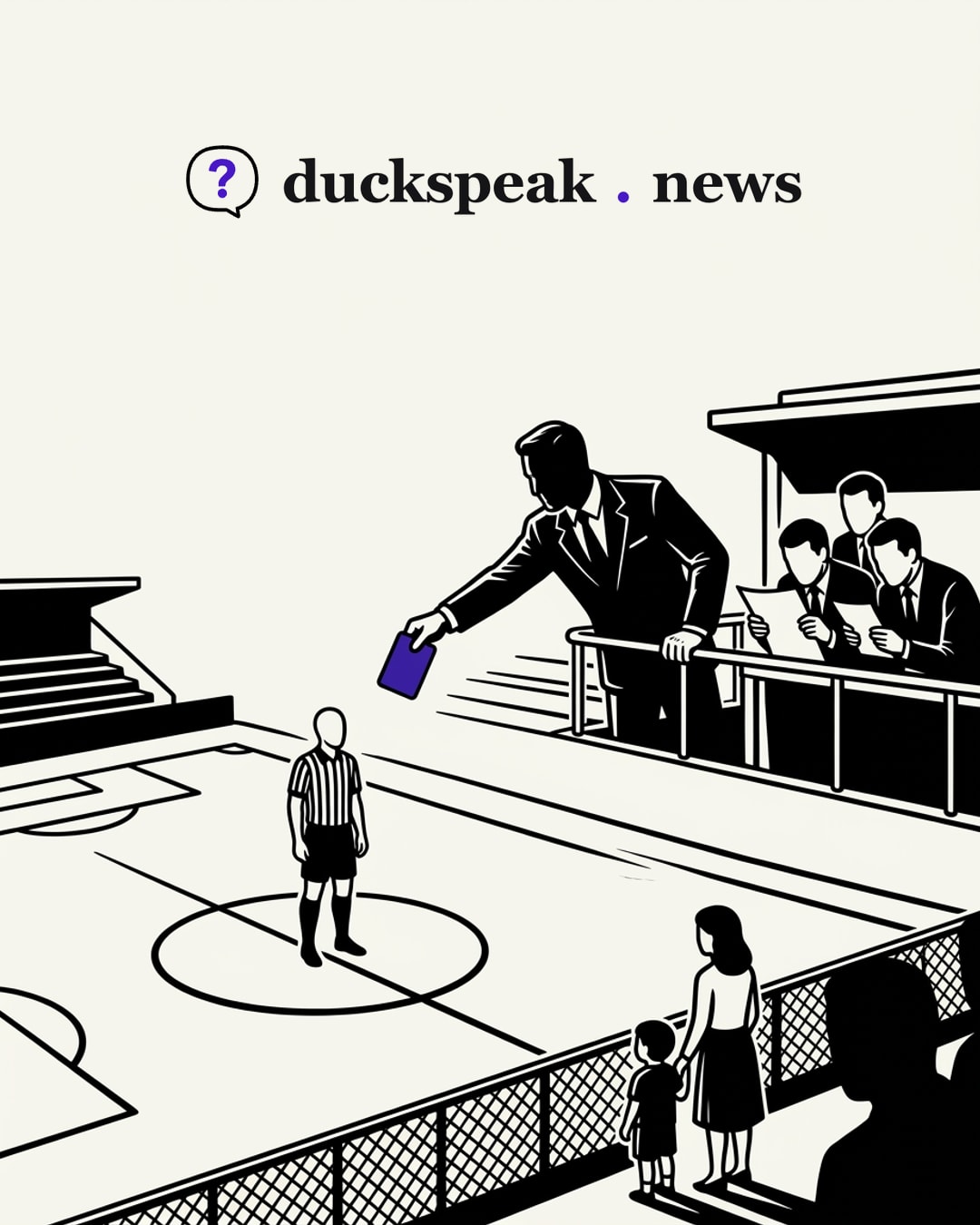
The New York Post has a story about sanctions. The sanctions have no described form, no named targets, no cited legal authority, and no date more precise than “soon” [1]. What the story has instead is a word. “Unaccountable” arrives in the headline wearing scare quotes, and by the second paragraph it has been promoted from someone’s characterization to the piece’s working premise.
The memo is the article
Every load-bearing news claim traces to two sources: “a US official and an internal memo reviewed by The Post” [1]. The article does not say which office produced the memo, who signed it, or how it arrived. What it does instead is quote it, four times, at a length that makes the memo the piece’s real author. The Post’s own prose is mostly connective tissue between quotations: diplomatic posts “were receiving warnings Thursday that ‘further ICC action’ was imminent” [1]; the sanctions “are expected to take effect soon, though the memo did not disclose in what form” [1].
That last clause is the story’s confession. A sanctions story in which the sanctions are undisclosed is a story about a mood, and the mood is supplied entirely by the memo.
From prosecute to persecute, in one letter
The memo’s central sentence, relayed without comment, describes the court as “empowered to persecute American servicemen and officials at will without authority” [1]. Two moves happen in that clause. First, “persecute” where the institution’s function is “prosecute”: one letter converts legal process into victimization, and the Post prints the conversion without marking it. Second, “unaccountable,” aimed at a court the memo elsewhere complains is “apparently unconstrained by the Assembly of States Parties” [1], a body the United States does not sit in, because it is not a member. The grievance is that a club Washington declined to join has failed to discipline the club’s referee to Washington’s satisfaction; the Post relays it as one of the “longstanding grievances” [1] without noticing that the grievance is structural, since the US holds no vote in the assembly whose constraint it demands. This is inversion, the oldest item in Orwell’s Newspeak inventory: the party that accepts no review of itself names the reviewer “unaccountable.” The word does not describe the court’s position; it describes the speaker’s, which is that no review reaches them (“no jurisdiction over us,” as the president puts it elsewhere in the same article) [1].
Then there is the memo’s strangest sentence, quoted in full: “It must be clear, once and for all, that the ICC can pose no threat to those who did not accept its authority” [1]. The article’s own timeline contradicts it. A court that “can pose no threat” would not require revoked visas, sanctions on employees and, per the piece, their “immediate family members” [1], and a campaign to peel away its member states. The memo declares the court powerless while the government behaves as though it were dangerous, and the story carries both claims without letting them meet.
The facts are in the piece; they are just never introduced to the rhetoric
Midway through, the Post reports that the Rome Statute has 125 signatories, “whose number include Australia, Canada, the UK and most of Europe” [1]. A few paragraphs later, Trump’s demand that members “officially resign from this rogue institution immediately” [1] is relayed without friction. The article possesses the fact that complicates the quote and never lets them touch. “Rogue” denotes deviation; a court whose membership includes most of the reader’s allies is many things, but by the article’s own reporting “rogue” is the hardest word in the piece to defend and the easiest one to print.
The most severe fact gets the lightest treatment: “Trump previously signed an executive order in February 2025 sanctioning some ICC employees and their immediate family members” [1]. Family members of court staff. One clause, no detail on what sanctioning a family member means in practice, no comment. Euphemism by placement: the heaviest item travels as luggage.
A montage of invective
The structure is a relay of escalating voices: the memo; Rubio in Athens praising “the unapologetic pursuit of national power” [1]; Rubio’s Wall Street Journal op-ed, in which the Post says he “bragged” the US was “dismantling the ICC” [1]; Trump at the UN General Assembly: “We will never allow US service members or anyone else to be investigated or given show trials by an anti-American tribunal with no jurisdiction over us” [1]; and then, “What an evil group of people” [1].
Note “show trials.” The article says the ICC has made “attempts to charge American service members” [1]; no charges are named, and no trial exists to be a show of anything. The phrase punishes a hypothetical. This is the Huxleyan half of the mechanism: the piece does not suppress the invective, it is the invective, delivered at a pace that preempts the boring questions, which are what law applies, to whom, and what these sanctions would actually do. The one evaluative verb the Post musters, “bragged,” is about tone. Nothing in the piece is about whether anything is true.
The memo’s fatalism gets the same free passage: “the United States has no choice but to impose further sanctions” [1]. A government that, by the article’s own account, holds a menu of options (urging withdrawals, revoking visas, “ratcheting up sanctions” [1]) describes itself as choiceless, and the article relays the fatalism without noting the menu.
What a reader would need instead
Which service members, and which situation. The article reports “attempts to charge American service members” [1] and never names a case, a country, a conduct, or a stage of proceedings. Any guess a reader makes would be the reader’s, not the paper’s; the omission is not neutral, because without it “persecute” and “show trials” cannot be checked against anything.
What the sanctions are. The memo “did not disclose in what form” [1]; a story can say so, but it should also describe what the February 2025 order actually did, since the article itself says the new memo “appeared to reference” it [1]. The template sits in the story’s own timeline, undescribed.
The jurisdictional dispute, stated fairly. The article mentions the Rome Statute and its 125 signatories [1] but never explains the actual argument: the court’s basis for claiming jurisdiction over crimes committed on the territory of member states even when the accused is a national of a non-member state, and the US counterargument. That is statable in two sentences. Its absence lets the memo’s count of “at least sixteen other ICC investigations, arrests, detentions or prosecutions” undertaken “without consent of that person’s country of nationality” [1] read as a list of abuses, when whether non-consent of the nationality state is an abuse or the court’s ordinary jurisdiction is precisely the question in dispute.
Any voice other than the memo’s. No ICC statement, no Assembly of States Parties response, no independent legal voice appears in the piece. Whether the Post sought comment and was refused cannot be known from the article; either way, a reader should be told.
A story about “unaccountability” in which every account comes from one side is not coverage of a dispute. It is one party’s brief, typeset. The word “unaccountable” traveled from an internal memo into a national headline, kept its scare quotes, and lost nothing else.