

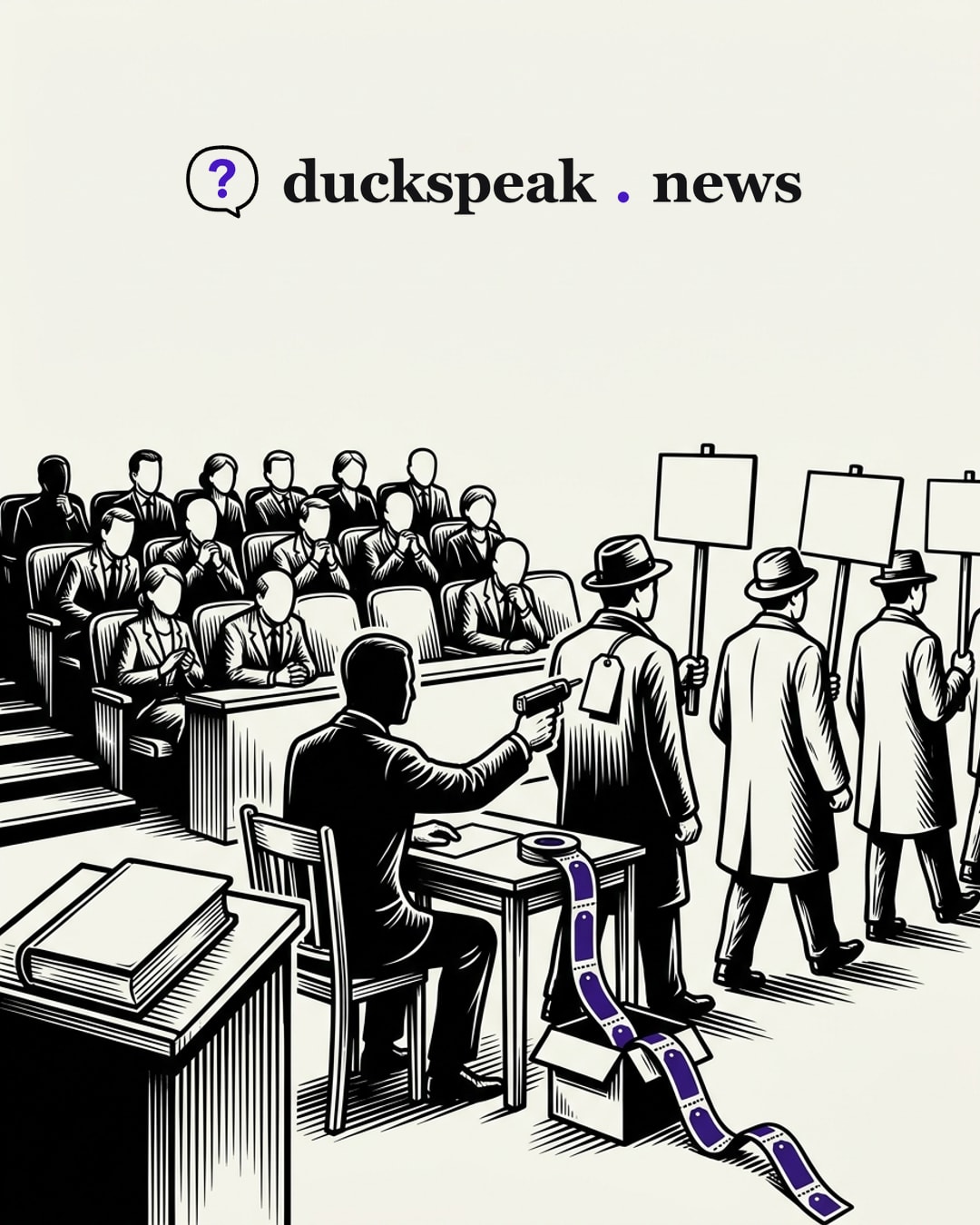
The first sentence of Fox News’ “Antisemitism Exposed” newsletter does something quietly remarkable: “A pro-Israel supporter confronted an anti-Israel agitator outside City Hall in New York City, causing NYPD to de-escalate the situation” [1]. One confrontation, two vocabularies. The person on one side is a “supporter”; the person on the other is an “agitator.” Nothing happens in that sentence except word choice, and the word choice is the entire editorial position. It is also the newsletter’s method in miniature.
One protest, four names
The demonstrations marking the anniversary of October 7 are renamed repeatedly across a few hundred words: “anti-Israel groups” [1], “pro-Palestinian demonstrators” [1], “pro-Hamas protests” in the headline [1], “anti-Israel agitators” in a photo caption [1], and, back in that same headline, “deranged Israel haters” [1]. Note the gradient. “Pro-Palestinian” describes a position. “Pro-Hamas” attributes allegiance to a specific armed organization, with no evidence offered that the marchers hold it. “Agitator” pre-criminalizes assembly; an agitator is someone whose presence is inherently a public order problem. “Deranged” removes the subject from the space of argument altogether: you do not debate the deranged, you contain them.
This is Newspeak’s core function as Orwell described it, not to forbid a thought but to make it unnecessary. A reader handed “deranged Israel haters” never needs to ask what the protesters demanded, who organized them, or what “long live the intifada” [1] means to the people chanting it. The newsletter does not answer those questions; the labels make the questions redundant. The chant is the only protest content quoted anywhere in the issue, and it is quoted purely as an indictment. No organizer is named, no stated aim appears, no march size or route is given.
Anonymous authority
“Critics erupted after details revealed” [1]. Which critics? “A group notorious for its aggressive anti-Israel advocacy” [1]. Notorious to whom? These phrases are load-bearing, and they are made of nobody. Orwell warned in “Politics and the English Language” that vague, judgment-shaped words are how claims avoid the work of demonstration; “notorious” is a verdict dressed as a fact, and no evidence follows it. The Arab American Association of New York receives no quote, no description of its programs, no opportunity to respond. It exists in this issue only as a target for an adjective.
The verdict precedes the trial
The Mamdani item is headlined “FUNDING FIB” [1], and the alliteration is the argument. A “fib” is a small, childish lie, and the headline asserts one before the body offers anything. What the body offers is that the plan “increases funding for Partners Against the Hate, funneling millions to the Arab American Association of New York” [1]. “Funneling” implies concealment; no dollar figure is given, no plan text is quoted, no city document is cited, and the critics remain unnamed. Let us be explicit about the limits of this critique: nothing in the newsletter allows anyone, including this critique, to assess whether the funding claim is true or false. That is the point. The verdict is delivered on evidence the reader is never shown, about a plan the reader never sees.
The Piker item runs the same play. The headline, “PIKER IN HIS PLACE” [1], announces the outcome before the event. The body then narrates: “The emotional clash left the audience stunned as the survivor’s brutal reality shattered the streamer’s political spin” [1]. Stunned according to whom? Shattered by what measure? Maya Regev’s account is described as “a harrowing eyewitness account” [1] but not quoted; Piker’s “claims about the October 7 attacks” [1] are alluded to but never stated. Two speeches, zero sentences from either. The confrontation is rendered entirely in outcome language, and the outcome is the one the headline promised. We flag this plainly: the audience’s reaction is known to us only through the writer’s assertion.
The container: the Huxley half
Orwell explains the vocabulary; Huxley explains the container. This is not an article but a subscription product: “IN TODAY’S NEWSLETTER” [1], “WATCH HERE” [1], “QUOTE OF THE WEEK” [1], “Subscribe to additional newsletters” [1], “Get the Fox News app” [1]. The structural features are worth listing because they are the point. A fixed weekly schedule. A rotating cast of designated figures at whom the audience is invited to hiss (this week: Piker, Mamdani, the unnamed “agitators”). A closing ritual chant, the “QUOTE OF THE WEEK” from Ambassador Danny Danon: “It is like turning September 11 into a day of mourning for al-Qaeda terrorists” [1]. Presented without scrutiny, the analogy performs the same collapse as the labels, converting a day of protest into a day of “mourning for terrorists,” and it closes the issue the way a chant closes a rally.
Say it carefully: the resemblance to a scheduled communal hate ritual is structural, not conspiratorial. Nothing here requires coordination, only a format that has learned what brings an aligned audience back. Antisemitism, in this container, is not a phenomenon to be understood but a beat, a franchise, a reason to open the app; the issue’s own success metrics (subscriptions, downloads) are printed at its foot. The mission statement promises coverage of “the rising anti-Jewish prejudice across the U.S. and the world” [1]; “rising” is asserted without a single figure anywhere in the issue. The guest editorial by Bishop Robert Stearns is at least labeled as such, which is honest, but its claim that supporting Israel is “a moral and biblical duty” [1] sits in a news container with no counterweight anywhere in the issue.
The undefined center
Every verdict in this newsletter hangs on one boundary: where criticism of Israel ends and antisemitism begins. The issue never states where it draws that line, or by what definition. The protests are condemned via “pro-Hamas”; the funding is a “fib” because the recipient is “anti-Israel”; the chant is treated as self-evidently damning. The reader is never given the criterion, only the conclusions. That omission is the quiet engine of the whole product: with no stated definition, the definition can flex to whatever the week’s target requires.
What a reader would need instead
- The actual text of the $30 million plan, and the Arab American Association of New York’s programs and statements in its own words, alongside named critics with their affiliations.
- The protest organizers’ stated aims in their words, and what “intifada” means to those who chant it, next to critics’ readings, each labeled as interpretation.
- A stated definition of antisemitism (the issue never says whether it follows IHRA, the Jerusalem Declaration, or nothing at all), since every judgment in it depends on that line.
- Data instead of the word “rising”: the FBI publishes religion-based hate crime statistics and the ADL runs an annual audit; the claim is checkable, and the newsletter never checks it.
- Sentences from the Piker and Regev exchange, rather than a narration of who shattered whom.
Antisemitism is real, and tracking it matters; that is exactly why a product called “Antisemitism Exposed” that quotes no plan, names no critics, defines no terms, and offers no data is not covering the subject. Nothing in this issue is exposed; everything is asserted.