

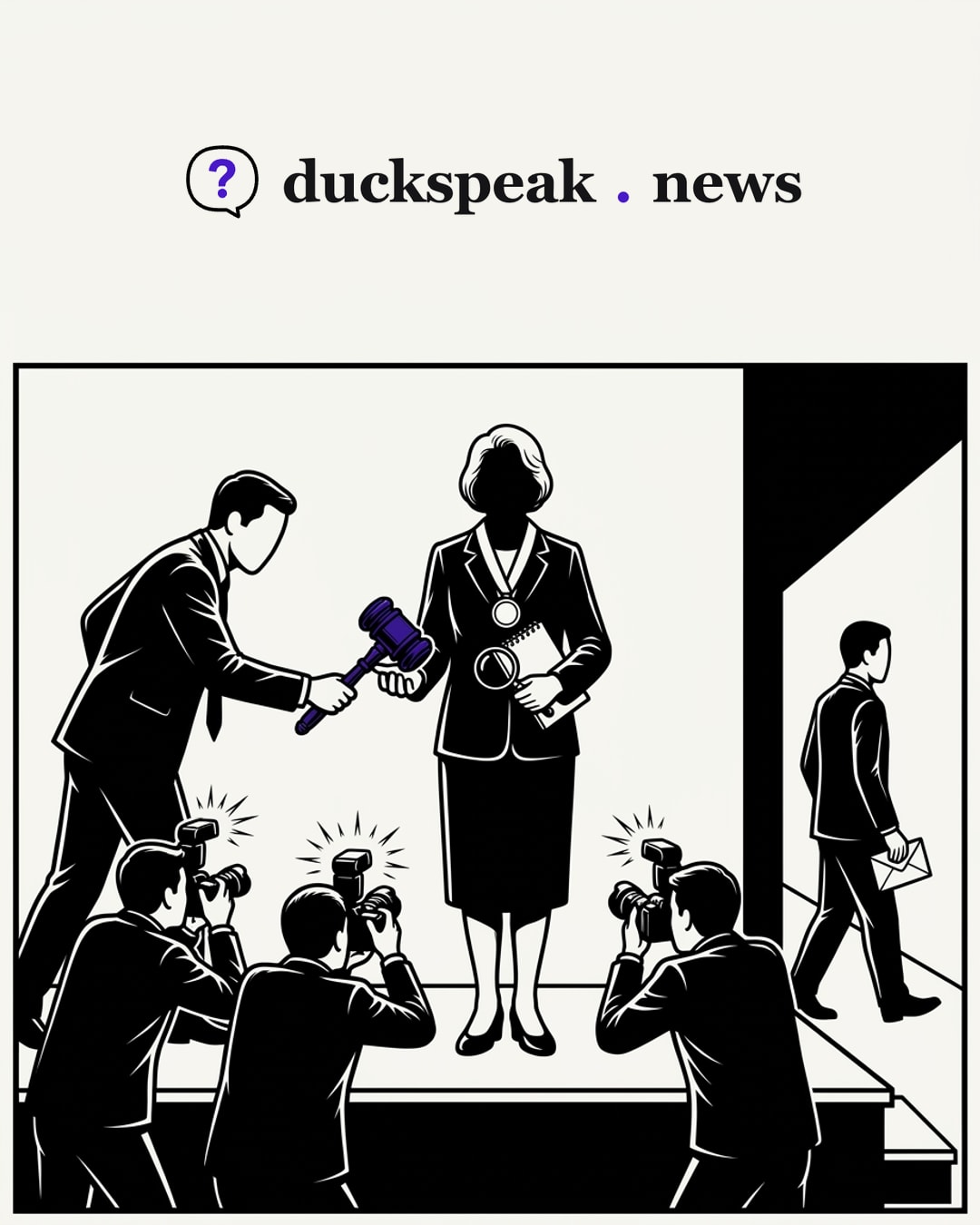
On Friday the Nobel Peace Prize went to Navi Pillay. Hours later the Trump administration announced further sanctions on the International Criminal Court, where she once sat as a judge [3]. Israel’s Foreign Ministry put out a statement in which “Joseph Goebbels is currently applauding from hell” [1]. Five reports collected here carry the day. What most of them do not carry is the single sentence that keeps the day legible, and it traveled in French.
One finding, three verbs
GB News’s headline announces “Nobel Peace Prize awarded to judge who ruled Israel committed genocide in Gaza” [2]. Pillay chaired a UN Commission of Inquiry; a commission produces findings, not rulings. The distinction is not pedantry, and PBS’s own guest makes it on air. Stephen Rapp, defending the commission’s work, says its members “were basing their findings on reasonable grounds to believe that there is a case to answer for international crimes. That’s not a judicial determination” [1]. “Reasonable grounds to believe” is a screening standard, the threshold for saying a case should proceed; a ruling is what happens at the end. GB News’s own body uses the more defensible “concluded” [2]; its headline uses “ruled.” The verb does the work of a verdict. CBS lands between the two, reporting that the inquiry “said last year it had concluded Israel’s actions in Gaza amounted to genocide” [3], with no standard of proof stated anywhere in the piece. PBS’s introduction is the most careful of the three, saying the commission “accused Israel of genocide” [1]. Three verbs, one finding, and only a guest, once, names the standard underneath them.
The caveat that traveled in one language
The Norwegian Nobel Committee’s chair, Jørgen Watne Frydnes, was asked by AFP whether awarding Pillay means the committee believes Israel is committing genocide in Gaza. His answer, as carried by RFI: “Nous ne sommes pas un tribunal” (we are not a tribunal); the finding is the commission’s, and “il appartiendra à la Cour internationale de justice (CIJ) de trancher en dernier ressort” (it will be for the International Court of Justice to decide in the last resort) [5]. The quote is RFI’s report of an AFP interview.
That caveat appears in one of the five reports collected here. The framing it hedges appears in four: PBS relays the committee’s “Institutions of international law are under political attack” [1]; CBS has Frydnes calling the prize “definitely a message to those who are undermining the international system and institutions” [3]; RFI frames the award against “attaques contre le droit international” [5] and quotes the committee on an era of “défis existentiels” [4]. The frame traveled in four of five reports; the caveat traveled in one. Whether English-language coverage carried Frydnes’s clarification anywhere cannot be known from this sample; within it, the pattern is clean. The dramatic claim repeats; the boring precision drops. That division of labor is the Huxley half of the mechanism, since “under attack” is consumable and “reasonable grounds to believe” is not. The Orwell half is what repetition then does: a prize citation hardens, with each relay, into something the chair explicitly went on record to disown, a verdict by proxy. Even the laureate resists the framing more than the reports do; asked about the committee’s praise for her courage, Pillay replied, “Why would you need courage to speak the truth?” [3].
Invective, relayed, then reset
PBS quotes the Israeli statement in full, including “the biggest lie of the 21st century” [1]. CBS carries a second statement, “if there were an award for lies, hatred, and blood libels, Navi Pillay wouldn’t just be a contender. She’d be a frontrunner,” complete with the coinage “genoLIE” [3], plus Netanyahu’s charge that the committee honored “a bigot who built her career around inventing and propagating blood libels” [3]. Relaying official statements verbatim is the job. What follows is the editorial choice. PBS’s anchor identifies Goebbels, then pivots: “Apart from the rhetoric, is there not a legitimate debate and defense against Israel’s actions in Gaza?” [1]. The question performs balance; a statement invoking Goebbels and a UN inquiry’s finding are reset as two positions in a debate. CBS, the only report here carrying “blood libels,” prints it without a word of annotation about what the term is doing in that sentence. The invective is treated as weather.
GB News makes the opposite omission: its headline hooks readers with the genocide “ruling,” and its body is a clean profile with no Israeli statement, no sanctions, and no Trump anywhere in it [2]. The conflict sells the story and then disappears from it.
Earlier in the PBS segment the anchor supplies the other pivot: “The Trump administration, of course, would argue the ICC itself is the one who’s not accountable” [1]. That “of course” presents as obvious a claim this site dissected in an earlier piece on the New York Post’s sanctions coverage, where “unaccountable” traveled from an internal memo into a headline. The vocabulary is back, this time handed over by the anchor as the natural counterpoint. Two things are genuinely new this round. CBS states the jurisdictional argument the Post piece lacked, quoting Human Rights Watch on the “limited situations in which the ICC has jurisdiction over the nationals of countries, such as the U.S., that have not joined the Rome Statute,” including crimes on member-state territory [3]. And PBS’s guest gives the sanctions a human scale the memo story never had: an administration “sanctioning judges, sanctioning people that are upholding the rule of law, treating them like terrorists,” such that “every janitor in the place is going to be sanctioned” [1]. But the new measures again arrive as mood rather than measure. CBS quotes Rubio’s intent, to “ban transactions with this rogue court, cutting off their resources and crippling its ability to operate,” a campaign to “dismantle the ICC, brick by brick” [3], with no legal instrument, no authority cited, and no named designations. As before, the sanctions have a vocabulary and no form.
The trivia coda
CBS closes with a catalog: Malala is the youngest laureate; the United States is “the most-credited country”; the prize has gone unawarded on 19 occasions; and “In 1939, a Swedish member of parliament nominated Adolf Hitler, then withdrew the nomination, saying it was never meant seriously” [3]. A story containing a Goebbels invocation, a genocide finding, and a same-day sanctions announcement ends on Hitler trivia. The joke travels everywhere too; every report carries Pillay’s “If you clap a little bit louder I may share this prize with Trump” [3] (PBS’s transcript renders it “a little bit more” [1]). The joke is charming and costs nothing to repeat. The standard of proof costs one sentence of attention and appears once, in French, in a quote given to a wire service.
What a reader would need instead
The commission’s finding and its standard. Rapp names it on PBS, findings based on “reasonable grounds to believe,” which is “not a judicial determination” [1], but no report describes what the September 2025 report actually contained, on what evidence, or with what dissent. One word, “genocide,” is doing all the work; the document behind it is absent from all five.
The chair’s caveat, in English. Frydnes on the record: the committee is not a tribunal; the ICJ decides [5]. That sentence is the difference between a prize honoring a person and a prize endorsing a verdict, and readers of the English reports were not given it.
The case’s actual posture. Rapp notes “the case on Israel is still pending on a jurisdictional issue” [1]; CBS carries no equivalent. A reader told a judge “ruled” [2] cannot weigh that against a pending jurisdictional question, because the second fact was withheld.
The sanctions’ form. Rubio’s statement of intent is not a description of a measure [3]. Which authority, which designations, what happens to staff and, per the earlier coverage, their families: none of the reports say.
The three bodies, kept apart. CBS does mark that the ICJ “is separate to the ICC” [3], and GB News and PBS note her current ad hoc seat at the ICJ on Gambia v. Myanmar [2][1]. The distinction that keeps collapsing is the one between a court and a commission of inquiry, and it is collapsing in a headline, in the direction of a verdict nobody has issued.
The committee said institutions of international law are under political attack [1]. The coverage agreed, repeated the phrase, and treated the attack as color. Orwell’s verb did the arguing, Huxley’s trivia did the anesthetizing, and the statement clarifying what the prize actually means stayed in French [5].