

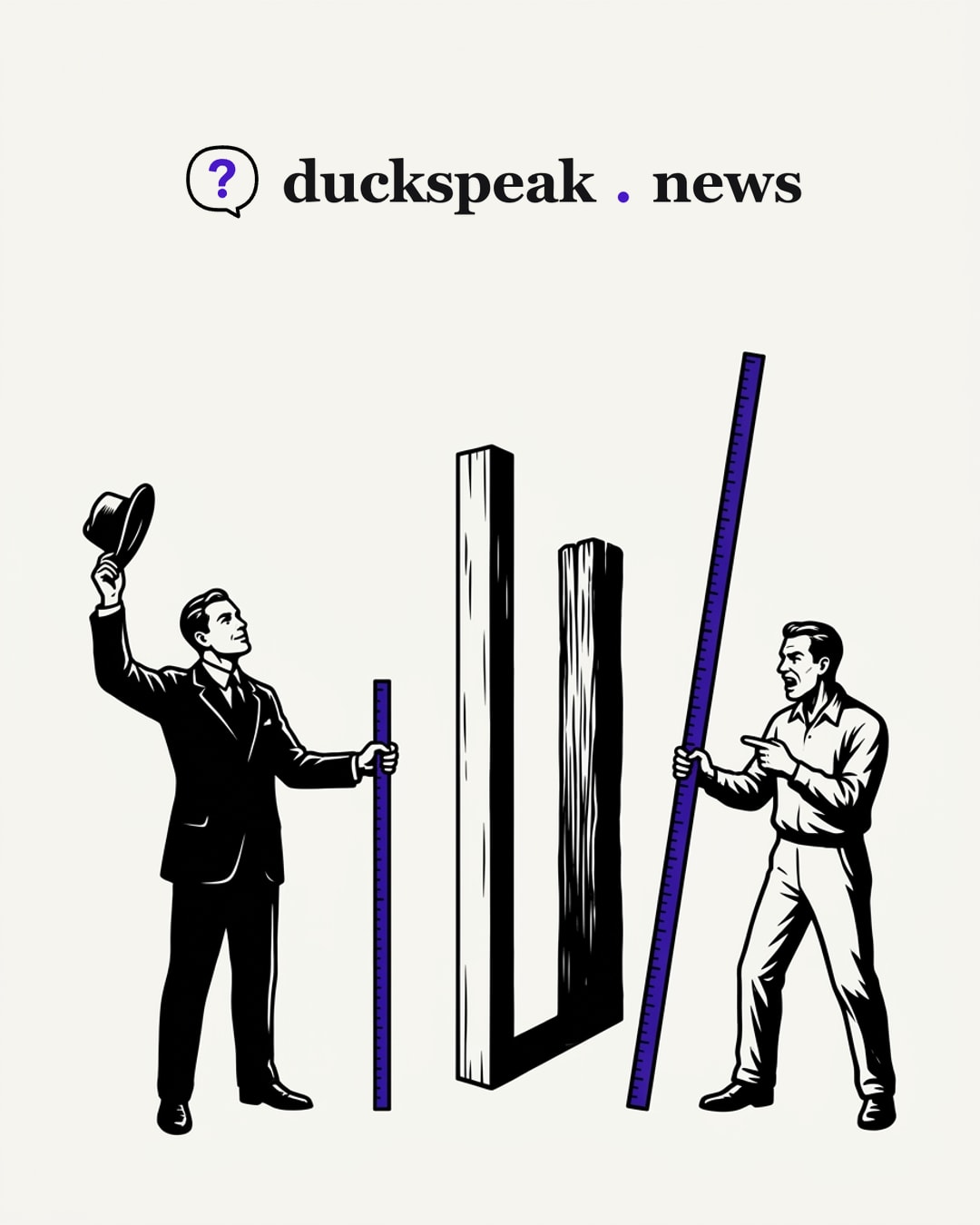
One count, five pieces, two stories. Labour’s Sagal Abdi-Wali won Holborn and St Pancras with 12,292 votes to Zack Polanski’s 8,928, a majority of 3,364, “its lowest in the seat since it was created in 1983,” with “the 13 per cent swing from the party to the Greens” falling short [4]. From those identical numbers the coverage manufactured two incompatible narratives. In one, the Greens “tripled” their vote and “are here to stay” [1][4]. In the other, the leader suffered a “humiliating defeat” and a “drubbing” [3], his “dysfunctional” party leaving voters cold [2]. Neither frame misstates the count. Each misstates the past.
Choosing the past
The triumph frame rests on arithmetic. “We tripled our vote share in a seat that Labour has comfortably held since 1983,” writes Polanski in his Guardian op-ed [1]. Against one baseline that is true: the Greens took 10.4 per cent there in 2024. But as pollster Peter Kellner observes, via John Harris’s Guardian column, “the leftwing vote two years ago was divided between the Greens’ 10.4% and an independent, Andrew Feinstein’s, 18.9%. Together, they won 29.3%,” making the true increase in the combined anti-Labour left vote “only 3.5 percentage points” [5]. Harris calls the tripling claim “very specious indeed” [5]. Orwell’s warning about controlling the past was never more literal: the fight is over which 2024 number gets to be the baseline.
The Guardian’s comment pages ran both the claim and its demolition [1][5]. The demolition stayed in one columnist’s copy, while the claim’s descendant, the party’s “second strongest by-election result (for vote share)” [4], travelled into the Independent’s results report with no Feinstein baseline in sight. A reader of that piece cannot adjudicate the claim; a reader of Harris’s can. (Only these five pieces are in view; the context may have run elsewhere.)
The same selective citation operates on John Curtice. Polanski invokes him for the flattering half, that the Greens represent “a greater threat to Labour in places like this than ever before” [1]. Curtice’s fuller verdict, as relayed by Harris, paired that with a prescription: the Greens are “in need of a period of contrition and reflection,” while remaining “a more significant player than historically they have ever been” [5]. The quotable half boarded the op-ed; the rest stayed home.
The quack that travelled
“We are here to stay,” writes the leader [1]. “We are here to stay and just getting started,” says the party spokesperson, quoted in the Independent’s results report [4]. Identical phrase, two outlets, no examination in either. This is duckspeak in its natural habitat: no timeframe, no criteria, nothing a future event could falsify. Its function is not to describe but to be repeated, until repetition itself looks like evidence. The spokesperson’s full sentence is richer still: “any ideas of a return to the cosy two-party system is just wishful thinking on the part of the establishment” [4]. “The establishment” is the classic unfalsifiable antagonist, printed without asking who wished what, or when. When a sentence cannot be wrong, it cannot be news.
The humiliation frame
GB News ran the mirror image. Polanski suffered a “humiliating defeat” and a “drubbing” [3]; both words are the outlet’s own, unattributed, where the Independent’s results report managed only “a blow” [4]. The “most challenging period as leader to date” line arrives quoted, as a pollster’s prediction [3]; by the photo caption it has shed the quotes and the attribution and become plain fact, misspelling his name en route [3]. A subheading even says the Greens “failed to win any of the by-elections they contested on Thursday,” paragraphs before the piece reports them winning one [3].
The Independent’s vox pop then promoted one voter into a constituency. The headline’s “Dysfunctional” is Dan Dexter’s word, and his formulation, “the new version of the dysfunctional old left side of the Labour Party,” is printed twice in near-identical form in one article [2], as though once were insufficient framing. The lead claims constituents “decided to stick with what they know” [2], an odd description of an electorate that just produced Labour’s lowest majority since the seat’s creation and a 13 per cent swing [4]; the two Independent reports do not appear to have met.
Huxley’s contribution is the opening quote: “I like normal, boring people in the community to be my [MP], not hypnotists” [2]. A former hypnotherapist’s profession as the lead joke; the verdict arrives as vibe rather than count. GB News calls itself “The People’s Channel” inside its own report [3], a slogan posing as a proper noun, and embeds its pitch mid-piece: “Join the fight for free speech and fearless journalism” [3]. Orwell warned about names that pre-empt evaluation; Huxley about the ad break that never announces itself.
Its headline performs one more trick: “Rupert Lowe saves Zack Polanski from clean sweep of defeats as Restore costs Reform yet again” [3]. The Greens’ one council gain, where their share rose from 25.4 to 29.5 per cent [3], is framed not as something the Greens did but as something done to Reform: “Restore Britain’s inclusion helped save Mr Polanski, with Rupert Lowe’s party eating up 10.8 per cent of the vote” [3]. In this frame the Greens lack agency even when they win; whether that reflects a fixation on Reform the material cannot say, but the effect is observable.
The label travelled; the text didn’t
Four of the five pieces carry the three-word title “Zionism is racism” [1][2][3][5]. None prints the motion’s contents. The only fragments anywhere appear in Polanski’s own op-ed, which notes “elements of the motion that I don’t agree with,” including the matter of “dictating the future shape of a state in Israel and Palestine,” and concedes that “Zionism is not easily defined” [1]. Harris, meanwhile, refers in passing to “the antisemitism meltdown” [5], a phrase that performs in three words the very equation the motion’s critics assert and its defenders dispute. The argument is assumed exactly where it should be shown.
The reporting assignment sits in plain sight. A holocaust survivor supported the motion [1]; the chair of Jewish Greens has called for the leader’s resignation [2][3]; one Jewish voter switched to Labour while her husband, saying “that this genocide and Zionism is intrinsically racist, that I believe,” would have voted Green [2]; a woman in Primrose Hill now avoids telling people she is Jewish [5]. That is a real argument among people with standing in it. What ran in the news reports instead was the title plus a word like “controversy” or “stir” [2][3]. The motion’s title travelled; its text travelled nowhere.
One euphemism, two printings
The sharpest euphemism analysis in the batch came from a politician. Polanski, on Burnham: he “hasn’t yet had to make the ‘difficult decisions’ that will reveal exactly who will lose out under his government” [1]. Scare quotes, then the gloss: difficult for whom. GB News prints the same phrase straight, from pollster Luke Tryll, on Labour facing “difficult decisions on North Sea drilling and in the October Budget” [3]. No quotes, no gloss, no losers. That is how a euphemism survives transit: the analysis stays in the op-ed; the phrase rides in the news. Polanski’s piece also describes Burnham as “a prime minister unarguably to his left” [1]; “unarguably” is an adverb whose only job is to forbid the argument it names.
What a reader would need instead
- The 2024 baseline beside every “tripled” claim: Greens 10.4 per cent, Feinstein 18.9 per cent, combined 29.3 [5]. Kellner and Curtice already did this work; it surfaced in one columnist’s copy and belongs in every results report.
- The motion’s text. Until an outlet prints what the Green party actually voted for, readers are arguing about a headline.
- Curtice’s whole verdict, not the half that flatters [1][5].
- Vivien Lichtenstein’s remarks sourced directly, not relayed from Times Radio [2][3].
- The inconvenient facts in one place: the lowest Labour majority since 1983 [4], the 13 per cent swing [4], and Electoral Calculus’s April numbers that “had the Greens ahead in the seat” [3]. Each alone fits either frame; together they fit neither, which is perhaps why they were scattered.
- And a house rule: when a spokesperson explains defeat by invoking “the establishment” [4], the sentence has ended. Printing it is fine; calling it news is not.