

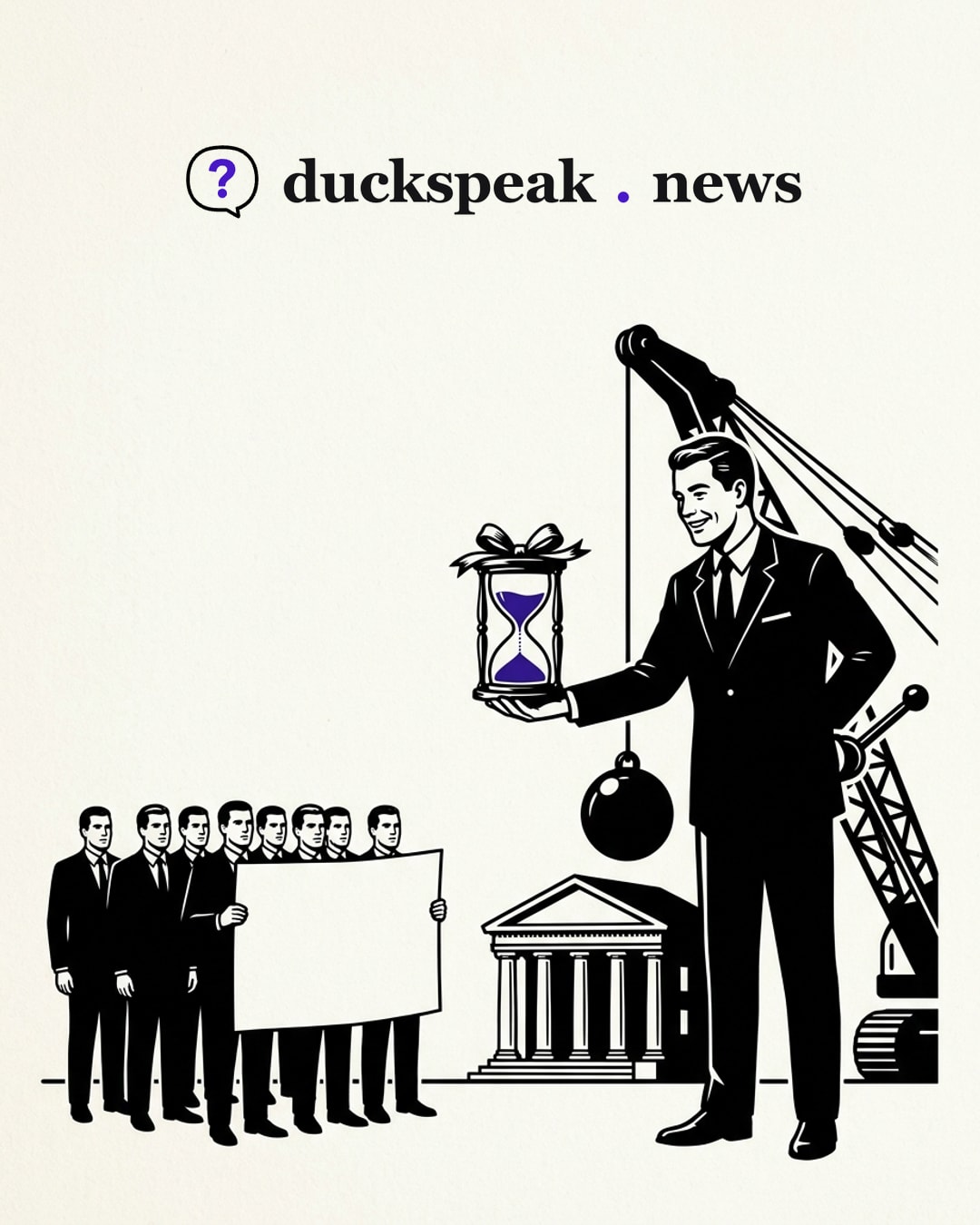
When the United States sanctioned the International Criminal Court as an institution, the British press performed two opposite tricks of phrasing in the same news cycle. The coercion was softened into patience, and the non-response was hardened into resistance. Neither trick is hidden; both sit in plain text, unexamined.
The ultimatum dressed as patience
The BBC reports that the US “has provided a six month grace period before some of these latest sanctions kick in,” a move Washington says gives countries “time to negotiate a ‘solution to address’ US concerns” [1]. “Grace” is a pacifier word: it presents the sanctioning party as patient and generous while describing, in plain terms, a countdown.
The same article carries the definition of the only solution on offer, further down the page: “Either the ICC will end its threats, or we will end the ICC,” says Marco Rubio [1]. The Mirror and The Independent carry the campaign language too, noting Rubio’s demand that allies “rein in” the court and his threat to “continue its campaign” to “end the ICC” [2][3]. A negotiation whose stated exit conditions are the counterpart’s surrender or its abolition is not a negotiation. It is an ultimatum with a payment schedule. None of the three outlets places the “grace period” paragraph beside the “end the ICC” paragraph and does the arithmetic for the reader. The facts are present; the synthesis is not.
The softer vocabulary works elsewhere. Rubio says the measures are intended to “defend US sovereignty” [1]; the administration calls the court “rogue” [1][2][3] and, in the BBC’s careful attribution, is “run by what it calls globalists” [1]. Attribution is proper practice, but attribution without examination is half the job. “Rogue” inverts the scene: a court counting 125 member states [1][2][3] becomes the outlaw, and the state strangling it financially becomes the law.
The press release dressed as defiance
The Mirror’s headline: “UK and allies stand up to Donald Trump and US over International Criminal Court sanctions” [2]. What does the standing up consist of? A joint statement in which eight governments “regret and strongly disagree with” the sanctions and reaffirm their “continued and unwavering support” for the court [1][2][3]. The strongest verb in the document is “disagree.” The headline upgrades it to confrontation.
The gap between words and action is quoted in the same articles. The court says its “fate now rests also in the hands of the states that created it” and calls on states to “continue taking concrete actions” so that it “continues to have the necessary means” [2][3]. The International Federation for Human Rights goes further: member states “cannot establish a court to hold the powerful accountable and then stand by while it is being dismantled”; “They must act collectively” [2][3]. Both quotations sit in the same copy as the joint statement; no outlet notes that the concrete action of the day was, itself, a statement.
The one material commitment visible anywhere is in the BBC: during the window, “member states can keep paying for its operations” [1]. What happens in month seven, whether the eight governments intend to keep paying, and through which banks, given that the sanctions “will stop US companies from providing goods or services to the ICC, such as banking or software” [1], is a question none of the three articles reports asking anyone. The Dutch foreign minister, whose country hosts the court, says the sanctions “would seriously affect the court’s ability to function” [1]; that is the extent of allied specificity in the coverage.
One text, three mastheads
The Mirror and The Independent have published recognizably the same article: the same joint-statement quotations, the same Rubio lines, the same ICC statement, the same rights-group comment, in the same order [2][3]. The Mirror’s version repeatedly renders “statement” as “state ment” and “states” as “state s” [2], spacing damage consistent with text moved by machine. That is an observation about production, not an accusation; wire copy is a normal fact of the industry. The effect is what matters. A reader who scans both outlets experiences the sensation of independent corroboration while receiving one text twice. Huxley’s anxiety was not the suppression of news but its frictionless recirculation: the same sentences everywhere produce the feel of consensus without adding a verified fact. The BBC’s version is longer and does add reporting [1]. The other two add essentially nothing to each other.
What the shorter copies cut
Only the BBC reports consequences. The US has “already sanctioned 17 of the ICC’s judges and officials,” and the new move “sanctions the court itself as an institution and is intended to collapse its ability to operate financially” [1]. Detainees awaiting trial in The Hague include Rodrigo Duterte, “accused of the extrajudicial killing of thousands” during his “war on drugs,” alongside figures from Libya, Sudan and the Central African Republic [1]. Professor Ryan Goodman warns they may have to be released “as a matter of law” if the sanctions make fair trials impossible, a result he calls “enormously damaging,” with victims who joined the proceedings left traumatized [1]. There are even carve-out “licenses” for “services for the operation of facilities used for the detention” of detainees [1]. Goodman supplies an irony the article leaves hanging: as a senator, Rubio was “out front” highlighting Duterte’s alleged crimes [1]; as Secretary of State, his sanctions may set the same man free.
Every one of those facts is absent from the Mirror and Independent versions [2][3]. What survives the cut is the cast: Trump, Rubio, Netanyahu, Pillay. What dies is the stakes. That is the Huxleyan trim in miniature: keep the personalities, lose the plumbing and the victims.
The BBC makes its own choices. “This showdown potentially marks the gravest crisis in the court’s 24-year history” [1] borrows the vocabulary of the ring; “showdown” symmetrizes a court that adjudicates and a state that sanctions, as though two teams had entered an arena. The announcement’s timing against Navi Pillay’s Nobel Peace Prize is reported at three temperatures: “just hours after” the award [1], “at the same time as” [2], “coincided with” [3]. “Coincided” is the most drained; it files simultaneity under happenstance and quietly retires the question of what the timing was meant to say. No outlet asks.
Signatories?
The Mirror states that “Neither the US nor Israel are signatories to the ICC” [2]; the Independent similarly reports they are not “signed up to the ICC” [3]. The BBC’s phrasing, that several countries “remain outside the ICC” [1], is more careful. Whether “signatory” is strictly accurate for either state is a treaty-status question these three articles cannot settle; the Rome Statute’s own records are where it can be checked.
What a reader would need instead
The mechanics, not the mood: which transactions are banned (“banking or software” [1]), what the 17 existing individual sanctions already do [1], and what the detention “licenses” permit [1].
The clock: what happens when the six-month window closes, whether each of the eight governments has committed to keep funding the court, and how, given the banking exposure. Someone should put that question to all eight and print the answers, or the refusals.
The stakes in full: the detainees, the possible releases “as a matter of law,” and the victims who participated on the promise of justice [1]. One outlet in three mentioned them.
The primary documents: the ICC’s full statement, which calls the sanctions “an attempt to obstruct the course of justice” [2][3]; the joint statement itself, read closely for its verbs; and the UN Secretary General’s “a serious blow to our collective pursuit of international criminal justice” [1]. All are quoted in fragments; none is printed in full in the shorter versions.
And the arithmetic the outlets declined to perform: “negotiate a solution” [1] plus “we will end the ICC” [1] equals an ultimatum. “Regret and strongly disagree” [1][2][3] plus “stand up to” [2] equals a press release.