

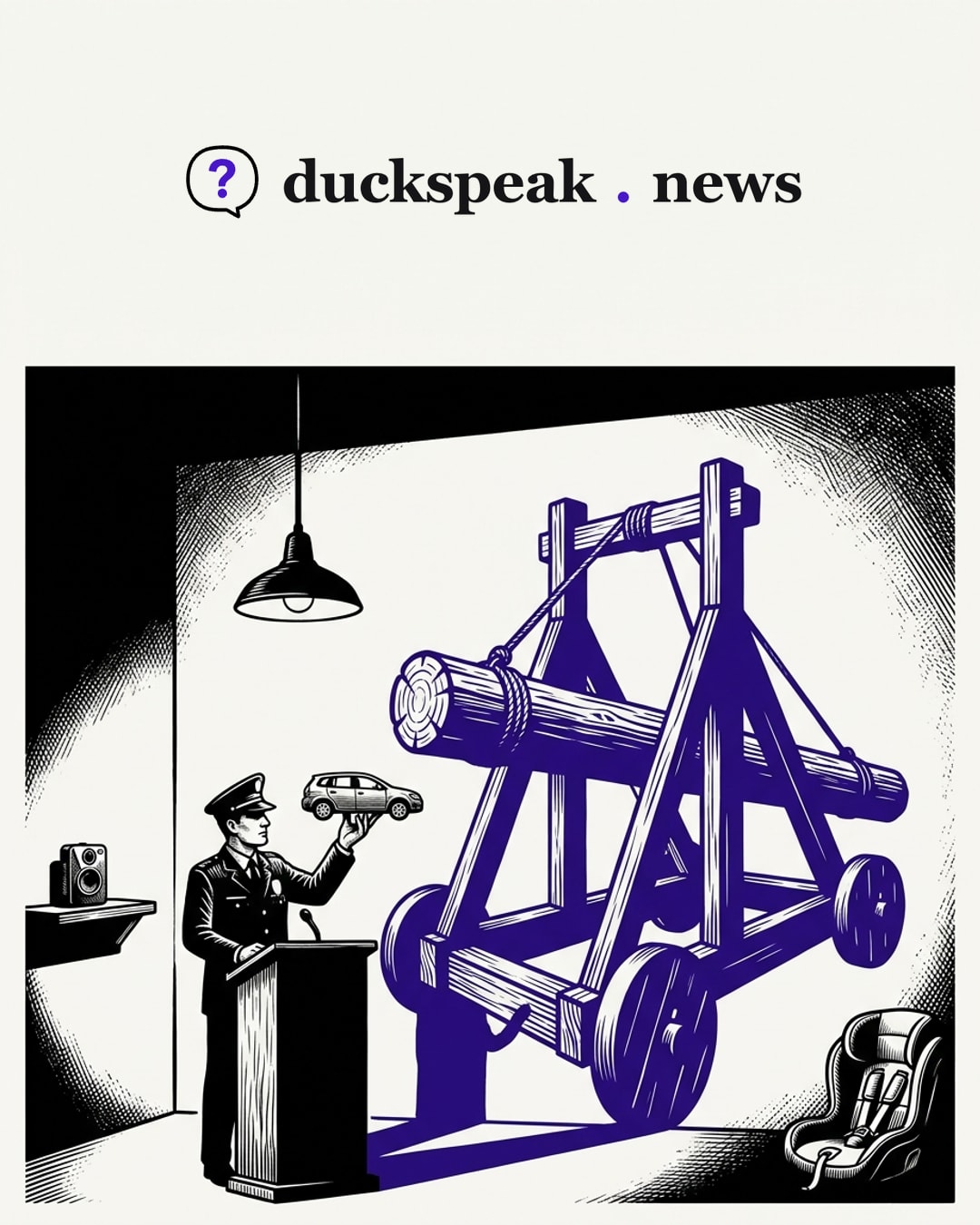
On Thursday afternoon in Marble Hill, a 28-year-old man was pulling into a parking space when a plainclothes officer approached his car with a gun drawn. At least one officer fired seven rounds, striking him below the left ear. His five-year-old son was in the back seat. That is the scene as New York City Police Commissioner Jessica Tisch described it [5], [6]. It is not quite the scene the coverage describes, and the distance between the two is where the language lives.
A phrase with a job to do
Nearly every account of this shooting carries the same sentence from ICE official Marcos Charles: Bergal “weaponized his vehicle and proceeded to accelerate going towards other officers” [1], [3], [4], [5]. Four of the six pieces collected here quote it. All attribute it correctly. None examine it, and the examination is the story.
The metaphor is the verdict: once the car is a weapon, firing at it is self-defense. The word does the argument’s work before any footage exists to check it. Mullin confirmed ICE officers were wearing body cameras that were activated, but declined to say when the footage would be released [5]. Until then the only finished narrative on offer is the official one, and its load-bearing term is a metaphor that pre-justifies the shooting.
The phrase also belongs to only one of two conflicting accounts. In Charles’s version, officers used two vehicles to block Bergal, who smashed into them [1], [3], [4]. In Tisch’s, Bergal was pulling into a parking space when a plainclothes officer approached with gun drawn, followed by another officer not in uniform; Bergal started to pull forward, and the firing began [5], [6]. Both accounts sit inside the same articles, unreconciled. A man accelerating away from masked armed strangers reads differently from a man ramming a blockade, and “weaponized” resolves the conflict by fiat, in the official direction. That is the whole trick: quoted language doing unquoted work. The repetition is not coordination but gravity. The AP copy republished by PBS NewsHour [5], [6] carries the phrasing wherever the wire travels, because the official account is the first complete narrative available.
Duckspeak, nearly literal
Charles’s fuller sentence deserves slow reading: “Our officers, using their training, and believing that their life and the life of their partners in the general public were in danger, used their training and fired weapons” [1]. He says “using their training” twice, and the AP wire repeats the sentence with the same stutter [5]. Orwell’s duckspeak is words quacked from the larynx without engaging the brain, and this is close to a specimen: a formula recited past its own repetition. “Training” is a talisman, asserting professionalism while specifying nothing.
The maddening part is that the claim is testable, and nobody tested it. In late September, ICE ordered its officers not to engage in high-speed car chases and to make vehicle stops only if they had completed specific training [6]. This was a vehicle stop. Whether these officers had completed that training is the obvious question, and across six pieces it is asked nowhere. “Used their training” is quoted as an answer when it is a placeholder for one.
One adverb, seven rounds
Charles said Bergal “was struck by one of the bullets or fragments superficially in the neck” [1], [2], [4]. The adverb is the minimization; Tisch’s version has him hit below the left ear by at least seven rounds [5], [6]. Even the hit is hedged, since “one of the bullets or fragments” declines to say what struck him. The child “was unharmed” [2], [6], meaning unstruck, while Mamdani’s line that “a 5-year-old child sits traumatized and terrified” [2] is left to read as rhetoric. DHS’s own labels do similar work: a “targeted enforcement operation” [3], [6], a word implying precision, set against Public Advocate Jumaane Williams’s account of officers who “disguise themselves as construction workers” surrounding “a man’s car with his 5-year-old son in it, coming from school at 4 o’clock in the afternoon” [3].
A conference about something else
The DHS news conference that generated most of this language was, by DHS’s own description, about “the dangerous consequences of sanctuary city policies” [5]. The shooting was folded into a narrative that predated it. Mullin supplied the frame (“Sanctuary politicians, they create an environment for criminal activity to thrive” [2], [5]) and the dehumanization (“This was a thug. The absolute worst of the worst” [5]; “It is shameful that we’re giving this particular case so much attention when this was a thug” [2]).
Note the transmission. The “thug” line runs in PBS’s broadcast segment [2] and the AP wire [5]; BBC [1], CBS [3], and NBC [4] omit it. I cannot know whether that was space, taste, or judgment, and will not guess; the observable effect is a cleaner official voice in three of six pieces. What every piece carries at length is the dossier: the Trinitarios allegation, the larceny conviction, the arrests, the pending drug case [1], [3], [5]. Mullin instructed that outrage be directed “towards this criminal” [4], and the coverage structurally obliges: the reader is equipped to adjudicate the man long before being equipped to adjudicate the shooting. Huxley’s mechanism needs no censor here; the dossier is simply more satisfying copy than a warrant dispute, and it fills the space where the questions should be. So does the spectacle of shoved barricades and hurled water bottles [6]. Even two of the headlines cast the officials as protagonists, making the defense the news: “US immigration officials defend ICE agents who shot man” [1]; “DHS officials defend their actions” [4].
What the record already contradicts
Mullin said officers were “serving a lawful warrant” [4]; Bergal’s attorneys, in a habeas petition obtained by NBC, allege ICE “lacked a valid warrant for Mr. Bergal’s arrest” [4]. A direct dispute over the stop’s legality surfaces in exactly one piece, as a single sentence.
Charles said officers “rendered first aid, and then took him to the hospital” [4]. The NYPD body camera footage shows NYPD officers, not ICE, deciding not to wait for the ambulance, driving Bergal to the hospital, and carrying him into the emergency room [1], [3], [4]. NBC states it flatly: the responders “were the ones who transported Bergal to the hospital” [4].
BBC alone carries Mullin’s claim that Bergal “has either indirect or direct knowledge” of a CBP officer shooting, “and that’s why he became a target” [1]; “either indirect or direct” is a phrase that excludes nothing. CBS carries Mullin’s claim that Trump offered Bergal’s release to the NYPD and that Mamdani refused, and reports that City Hall has not answered a request for comment [3]. That answer is still owed. Even the man’s name was still moving: authorities first said Belgal, then Bergal [3]. The record is unstable; the language is the most stable thing in it.
What a reader would need instead
- The ICE body camera footage, or at minimum a release date. Mullin confirmed the cameras were on and offered no timeline [5]; the NYPD camera recorded the lead-up but not the shooting [6]. Until then, every causal claim about the seconds before the firing is an official’s word.
- The warrant dispute resolved, not buried. The habeas petition is a court filing [4]; its claims are checkable and should lead, not trail.
- The September ICE guidance applied to this stop [5], [6]: did the officers complete the required vehicle-stop training? That memo is the institutional standard that turns “used their training” from incantation into a testable claim.
- The two accounts reconciled: parking space [5], [6] versus rammed blockade [1], [3], [4]. Both cannot be the whole story, and a reader should be told which parts conflict.
- The tally as context, not a closing line: ICE agents have fired during more than a dozen vehicle stops since last year, killing at least four [6], and federal agents have reportedly shot at least two dozen people since January 2025 [2]. The AP reporting compiled in these pieces is the closest thing to a running record in the material, and it belongs near the top of the story, not the bottom.
- City Hall’s answer on Mullin’s release-refusal claim [3].
Some of this may yet resolve in the officials’ favor. The two accounts of the stop might be reconcilable in ways not yet public, and the social media videos BBC calls “unverified” [1] are just that. But the pattern is already legible: the questions that would test the official story are the ones the coverage is slowest to ask, and the phrases that would excuse it are the ones it repeats fastest.